
(As an amazon affiliate, we earn a commission when purchasing via our links below)

Dogs have lived alongside humans for at least 15,000 years, yet most dog owners still don’t know some of the most jaw-dropping truths about their four-legged best friends. These 17 surprising dog facts that will change how you see your pup aren’t just fun trivia. They reveal a deeper picture of just how remarkable, intelligent, and emotionally complex dogs really are. Get ready to look at your furry companion with brand-new eyes. 🐾
Key Takeaways
- 🐽 A dog’s nose is up to 100,000 times more sensitive than a human’s, it’s basically a superpower.
- 🧠 Dogs understand human emotions and can even sense when you’re stressed or sad.
- ❤️ Owning a dog has real, proven health benefits for humans, including lower blood pressure and reduced anxiety.
- 🐾 Dogs communicate in ways far more complex than most people realize, using body language, sounds, and even eye contact.
- 🌍 Every dog breed has a unique history and set of instincts that shape how they behave today.
Why These Dog Facts Will Surprise Even Lifelong Dog Owners
Most people think they know dogs pretty well. After all, millions of families share their homes with them every day. But science keeps uncovering amazing things about dogs that even the most devoted dog lovers never expected.
Here’s a quick snapshot of just how popular dogs are:
| Fact | Number |
|---|---|
| Dogs kept as pets in the U.S. | ~90 million 🐕 |
| Known dog breeds worldwide | Over 340 |
| Years dogs have lived with humans | 15,000+ |
| Smell receptors in a dog’s nose | Up to 300 million |
These numbers hint at something bigger. Dogs are not just pets. They are complex creatures with deep emotional lives, incredible physical abilities, and a bond with humans that is truly one of a kind.
Let’s dive into the 17 surprising dog facts that will make you see your pup in a whole new way.
The Incredible Senses and Physical Abilities of Dogs
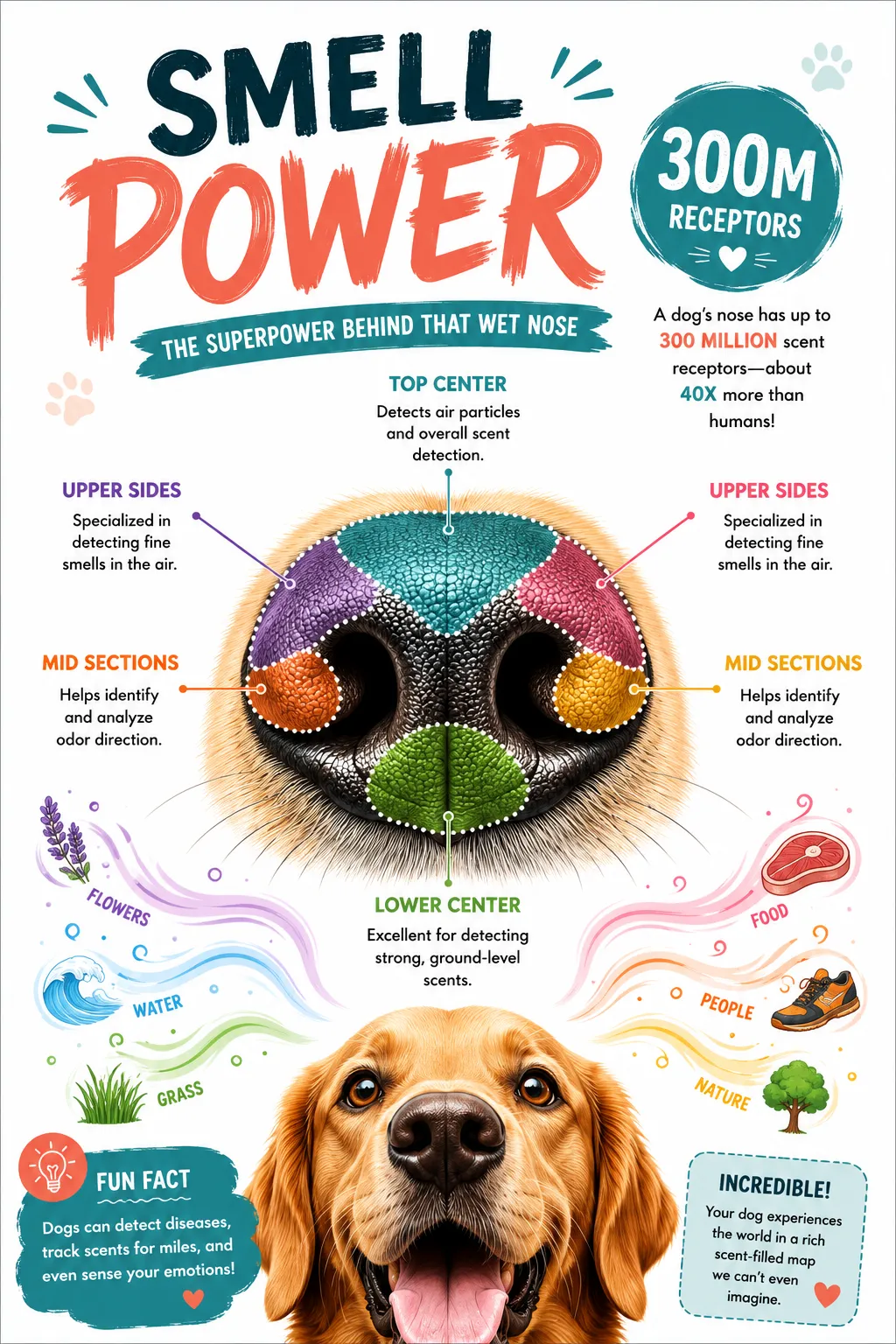
Fact 1: A Dog’s Nose Has Up to 300 Million Scent Receptors 🐽
Humans have about 5 million scent receptors in their noses. Dogs? Up to 300 million. That means a dog’s sense of smell is roughly 10,000 to 100,000 times more powerful than ours.
To put it simply: if a human can smell a pot of soup cooking in the kitchen, a dog can smell every single ingredient in that soup, separately.
“Dogs don’t just smell the world, they read it like a book.”
This is why dogs are used to:
- 🔍 Detect cancer and other diseases
- 💊 Sniff out illegal drugs at airports
- 🌊 Find missing people (even underwater)
- 🐝 Detect bee diseases in hives
Their noses even work differently from ours. When dogs breathe in, a special fold of tissue inside their nostril separates the air. Some goes to their lungs. Some goes straight to their scent-analyzing organ. That means they can smell and breathe at the same time, something humans cannot do.
Fact 2: Dogs Can Hear Sounds Four Times Farther Away Than Humans 👂
Ever notice how your dog perks up their ears before you even hear a knock at the door? That’s not magic, it’s biology.
Dogs can hear sounds from four times the distance that humans can. They can also hear higher-pitched sounds that are completely silent to human ears.
Dogs can move each ear independently using at least 18 different muscles. This lets them pinpoint exactly where a sound is coming from. It’s like having built-in radar dishes on their heads. 🎯
Fun fact: Dogs can hear ultrasonic sounds, which is why dog whistles work. The whistle makes a sound humans can’t hear at all, but dogs hear it loud and clear.
Fact 3: Dogs Have a “Sixth Sense” for Storms and Earthquakes ⚡
Many dog owners have noticed their pup acting strange before a big storm hits. This isn’t a coincidence.
Dogs can detect:
- Changes in barometric pressure (air pressure drops before storms)
- Static electricity building up in the air
- Infrasound, very low-frequency sounds from earthquakes that humans can’t hear
- Changes in the Earth’s magnetic field
Some researchers believe dogs may even use the Earth’s magnetic field to navigate. A study found that dogs tend to align their bodies along a north-south axis when they poop. Yes, really. 🧭
Fact 4: A Dog’s Paw Pads Contain Temperature-Sensing Nerves ❄️
Dog paws are tougher than they look, but they’re also incredibly sensitive.
The paw pads contain specialized nerve endings that help dogs sense temperature and texture. This helps them avoid dangerously hot pavement or icy surfaces.
However, paws can still get hurt. Hot pavement in summer can burn a dog’s paws in just 60 seconds if the surface temperature is above 125°F (52°C). Always check the pavement with your hand before walking your dog on hot days! 🌞
Fact 5: Dogs Can Run at Surprising Speeds 🏃
Most people know that greyhounds are fast. But did you know the average dog can run at speeds of 15 to 20 mph?
Here’s a quick speed comparison:
| Animal/Person | Top Speed |
|---|---|
| Average human | ~8 mph |
| Trained sprinter | ~12-15 mph |
| Average dog | 15-20 mph |
| Greyhound | Up to 45 mph |
Even your lazy couch-potato dog could outrun most humans if motivated (usually by a squirrel 🐿️).
The Emotional and Cognitive World of Dogs
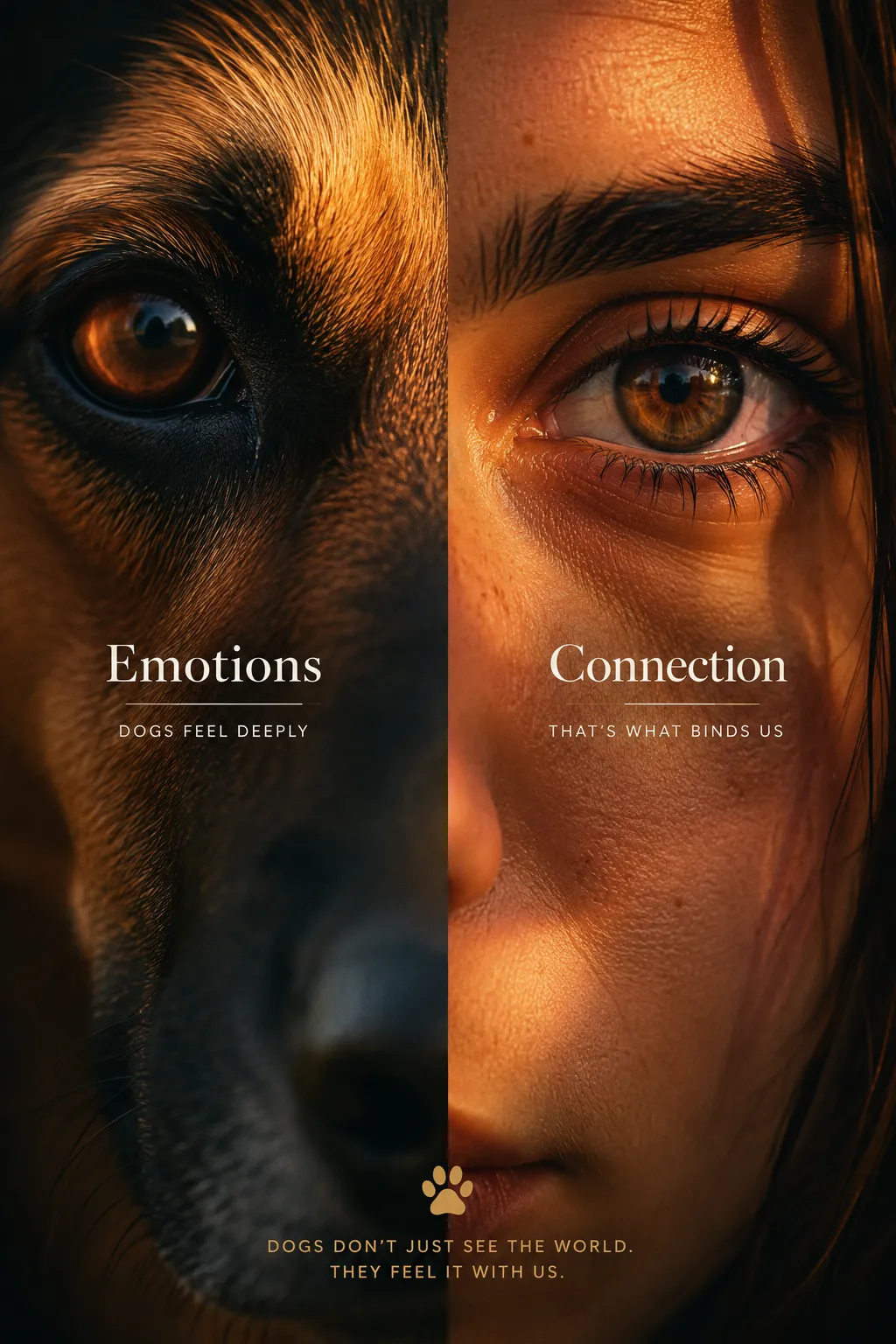
Fact 6: Dogs Experience Emotions Very Similar to Humans 💛
For a long time, scientists debated whether dogs truly “feel” emotions or just act on instinct. Today, the science is clear: dogs do experience real emotions.
Research using brain scans (MRI) shows that dogs have the same brain structures that produce emotions in humans. When dogs smell their owners, the reward center of their brain lights up, the same way it does in humans when they see someone they love.
Dogs experience:
- ✅ Joy, tail wagging, playful jumping
- ✅ Fear, cowering, tucked tail
- ✅ Anger, growling, stiff posture
- ✅ Love/attachment, following their owner, seeking closeness
- ✅ Jealousy, yes, studies confirm this too!
What dogs likely don’t experience (at least not the same way): complex emotions like guilt, shame, or pride. That “guilty look” your dog gives after chewing your shoe? That’s actually fear of your reaction, not true guilt.
Fact 7: Dogs Understand Human Words and Tone Separately 🗣️
A famous border collie named Chaser learned the names of over 1,000 different objects. That’s more words than most toddlers know at age two.
But here’s what’s even more fascinating: dogs process words and tone of voice in separate parts of their brains, just like humans do.
In a study published in the journal Science, researchers found that:
- Dogs use the left side of their brain to process the meaning of words
- They use the right side to process tone and emotion
- They only feel truly rewarded when both the word AND the tone are positive
So when you say “Good boy!” in a flat, bored voice, your dog notices. They’re listening to both what you say AND how you say it. 🎤

- ✅ 30s Clear Voice Recording & Loud Playback Each dog communication button features a powerful 0.5W speaker, delivering c…
- ✅ Durable ABS Plastic & Pet-Safe Design Built with high-quality ABS plastic, these dog training buttons withstand scratc…
- ✅ Customizable with 25 Scene Stickers Personalize sound buzzer with 25 themed stickers (food, toys, bathroom, etc.) for …
Fact 8: Dogs Can Read Human Facial Expressions 😊😟
Dogs are one of the only animals that look to human faces for information. Most animals, even other primates, don’t do this naturally.
Studies show that dogs can:
- Tell the difference between a happy face and an angry face
- Recognize familiar human faces even in photographs
- Follow a human’s gaze to find hidden objects
- Detect when a human is stressed or sad and respond with comfort
This ability likely developed over thousands of years of living with humans. Dogs that were better at reading human emotions were more likely to be cared for and survive, so the trait got stronger over generations. 🧬
Fact 9: Dogs Dream Just Like Humans 💤
Watch a sleeping dog sometime. You might see their paws twitch, hear little whimpers, or see their eyes move under their eyelids. That’s because dogs dream.
Dogs have the same sleep stages as humans, including REM (Rapid Eye Movement) sleep, the stage where dreaming happens. Scientists believe dogs dream about their daily experiences: running, playing, and yes, probably chasing squirrels. 🐿️
Puppies and older dogs tend to dream more often than adult dogs. Smaller breeds also tend to dream more frequently than larger breeds.
Pro tip: Never startle a sleeping dog awake. The old saying “let sleeping dogs lie” is actually good advice, a suddenly awakened dog may snap out of confusion. 😴
Fact 10: Dogs Have a Unique “Fingerprint”, Their Nose Print 🐾
Just like every human has unique fingerprints, every dog has a unique nose print. The pattern of ridges and creases on a dog’s nose is completely one-of-a-kind.
In fact, the Canadian Kennel Club has been accepting nose prints as a form of dog identification since 1938. Some companies now offer nose-print identification services for lost or stolen dogs.
Next time your dog boops your hand with their nose, remember, that little wet print is totally unique in the entire world. 🌍
How Dogs Communicate and Connect With Humans

Fact 11: Tail Wagging Is Not Always a Sign of Happiness 🐕
Most people think a wagging tail = happy dog. But it’s actually much more complicated than that.
Dogs wag their tails to communicate many different emotions. The direction and speed of the wag matters a lot:
| Tail Wag | What It Means |
|---|---|
| Fast wag, wide sweeping | Very happy, excited |
| Slow wag, low position | Unsure, slightly nervous |
| Wag to the right | Positive feelings (seeing owner) |
| Wag to the left | Negative feelings (seeing a stranger) |
| Stiff, slow wag | Potential warning signal |
| Tucked between legs | Fear or submission |
Research from the University of Trento found that dogs even respond differently to each other based on which direction another dog’s tail is wagging. A left-leaning wag made other dogs anxious. A right-leaning wag kept them calm. 🔬
Fact 12: Dogs Use Eye Contact to Bond With Humans 👀
When a dog stares into your eyes, something magical happens, literally.
Research published in Science found that when dogs and humans make eye contact, both species release oxytocin, the same “love hormone” that bonds mothers to babies.
This is extraordinary. Dogs are the only non-human animal known to trigger this oxytocin loop through eye contact with humans. Wolves, the ancestors of dogs, don’t do this. It evolved specifically through the dog-human relationship.
“Looking into your dog’s eyes is a two-way love exchange backed by science.”
So the next time your dog gives you those big, soft eyes, know that you’re both experiencing a genuine rush of love hormones. ❤️
Fact 13: Dogs Have Three Eyelids 👁️
Here’s one that surprises almost everyone: dogs have three eyelids.
The third eyelid is called the nictitating membrane (or “haw”). It sits in the inner corner of the eye and slides across the eyeball to:
- Keep the eye moist
- Protect the eye from debris
- Help fight infection
You usually can’t see it unless your dog is very relaxed or slightly unwell. If you notice the third eyelid showing a lot, it might be worth a vet visit. 🏥
Fact 14: Dogs Can Smell Disease, Including Cancer 🔬
This one is truly remarkable. Trained dogs can detect certain types of cancer with accuracy rates as high as 97% in some studies.
Dogs have been trained to sniff out:
- 🎗️ Breast cancer
- 🫁 Lung cancer
- 🩸 Prostate cancer
- 🧠 Ovarian cancer
- 🦠 Parkinson’s disease
- 🦟 Malaria
They detect the volatile organic compounds (VOCs) that diseased cells release, compounds that are present in a person’s breath, urine, or skin. The concentrations are so tiny that no human-made machine can detect them as reliably as a trained dog.
Medical detection dogs are already working in hospitals in the UK and other countries. In 2026, research in this field is advancing faster than ever. 🏥
The Bond Between Dogs and Humans, and What It Means for Your Health
Fact 15: Owning a Dog Can Literally Extend Your Life ❤️🔥
This isn’t just a feel-good claim. The science backs it up.
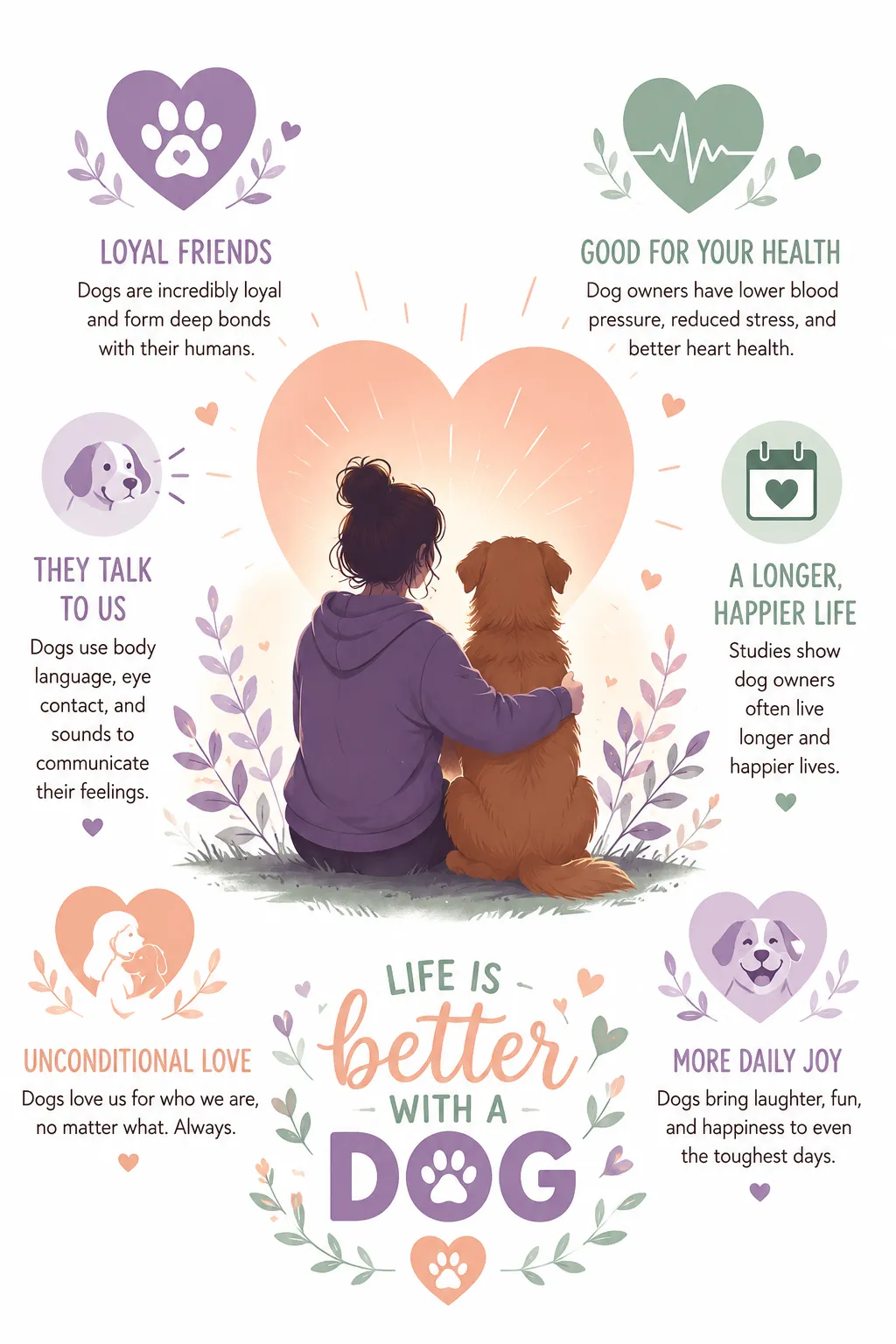
A major study published in Circulation: Cardiovascular Quality and Outcomes found that dog owners had a 24% reduced risk of dying from any cause compared to non-dog owners. For heart attack survivors who lived alone, the risk reduction was even more dramatic.
Here’s what dog ownership has been shown to do:
- Lower blood pressure, petting a dog for just 15 minutes can reduce blood pressure by 10%
- Reduce cortisol (the stress hormone)
- Increase serotonin and dopamine (feel-good brain chemicals)
- Encourage more physical activity, dog owners walk an average of 22 more minutes per day
- Reduce feelings of loneliness and depression
- Boost immune system, children raised with dogs have lower rates of allergies and asthma
Dogs don’t just make life happier. They make it longer. 🐾
Fact 16: Dogs Were the First Animal Ever Domesticated by Humans 🏺
Long before humans kept cows, chickens, or horses, they had dogs.
The domestication of dogs began somewhere between 15,000 and 40,000 years ago, making them the oldest domesticated animal on Earth. The exact origin is still debated, but most scientists believe dogs descended from a now-extinct population of wolves that began associating with early hunter-gatherer humans.
Over thousands of years, humans selectively bred dogs for specific traits:
- Hunting, speed, tracking ability
- Herding, intelligence, responsiveness
- Guarding, alertness, protectiveness
- Companionship, friendliness, affection
This long history means dogs are uniquely adapted to live with, understand, and work alongside humans. No other animal has co-evolved with us for so long and so closely. 🌍
Interesting note: The DNA of modern dogs shows that domestication happened independently in different parts of the world, meaning multiple wolf populations started becoming “dogs” around the same time in different regions.
Fact 17: Every Dog Breed Has a Unique “Job” Hardwired Into Their DNA 🧬
That border collie who keeps herding your kids? The retriever who always brings things back to you? The beagle who sniffs absolutely everything on every walk? These aren’t random behaviors. They’re hardwired instincts from centuries of selective breeding.
Here’s a quick look at some popular breeds and their original jobs:
| Breed | Original Job | Leftover Instinct |
|---|---|---|
| Border Collie | Herding sheep | Herds children, bikes, anything |
| Labrador Retriever | Retrieving game | Carries things in mouth constantly |
| Beagle | Tracking scent trails | Nose-down, follows every smell |
| Dachshund | Hunting badgers underground | Digs, goes into small spaces |
| Siberian Husky | Pulling sleds long distances | Endless energy, loves to run |
| Shih Tzu | Lap dog for Chinese royalty | Loves being held and pampered |
| German Shepherd | Herding and protection | Loyal, alert, protective |
Understanding your dog’s breed history can help explain a LOT of their “weird” behaviors. They’re not being difficult, they’re just doing what they were born to do. 🐕
Bonus: Quick-Fire Surprising Dog Facts You’ll Love
Before wrapping up, here are a few more amazing dog facts that deserve a mention:
🐕 Dogs sweat through their paws. Their main sweat glands are in their paw pads. They also cool down by panting.
🐕 Puppies are born blind, deaf, and toothless. All three senses develop in the first few weeks of life.
🐕 A dog’s mouth is not cleaner than a human’s. This is a total myth. Dog mouths contain hundreds of different bacteria, just different ones from humans.
🐕 Dogs curl up to sleep as an instinct. Curling into a ball protects vital organs and conserves body heat, a leftover behavior from their wild ancestors.
🐕 Dalmatians are born completely white. Their spots develop as they grow older.
🐕 The Basenji dog doesn’t bark. Instead, it makes a unique yodeling sound called a “baroo.” 🎵
🐕 A dog’s nose print is wet because of a thin layer of mucus that helps them absorb scent chemicals. That’s why a wet nose is usually a sign of a healthy dog.
🐕 Dogs have about 1,700 taste buds. Humans have about 9,000. This is why dogs are less picky about flavor, but much more driven by smell when choosing food.
What These 17 Surprising Dog Facts That Will Change How You See Your Pup Really Tell Us
Looking at all 17 surprising dog facts that will change how you see your pup together, a clear picture emerges: dogs are not just pets. They are:
- Emotional beings with real feelings and complex inner lives
- Sensory superheroes with abilities that far exceed human senses
- Communication experts who have evolved specifically to understand us
- Health partners whose presence genuinely improves human well-being
- Ancient companions whose bond with humanity is unlike any other in the animal kingdom
The next time your dog leans against your leg, stares into your eyes, or brings you their favorite toy, know that there is deep science and thousands of years of shared history behind that simple gesture. 🐾❤️
Conclusion
Dogs are endlessly surprising. Even after 15,000 years of living together, science keeps revealing new and amazing things about them. These 17 surprising dog facts are just the beginning of understanding how remarkable your pup truly is.
Here are some actionable next steps to deepen your bond with your dog:
- 🐽 Get down to their level. Let your dog sniff new environments fully, it’s their way of reading the world.
- 👀 Make gentle eye contact. Slow blinks and soft gazes build trust and release oxytocin in both of you.
- 🎓 Learn your breed’s history. Understanding what your dog was bred to do helps explain their behavior, and how to channel it positively.
- 🏃 Walk more. Even an extra 10-15 minutes of walking benefits both you and your dog physically and mentally.
- 🏥 Stay curious. Follow the latest dog science. Researchers in 2026 are making new discoveries about canine cognition and health every year.
- 💬 Watch their body language. Now that you know tail wags have direction and meaning, pay closer attention to what your dog is telling you.
Your dog sees you as their whole world. With these facts in mind, you can be a more informed, more connected, and more loving companion right back. 🐾
References
- Ádám, M., et al. (2013). “Dog, owner attachment and the oxytocin system.” Frontiers in Psychology.
- American Heart Association. (2013). “Pet ownership and cardiovascular risk.” Circulation: Cardiovascular Quality and Outcomes.
- Berns, G. S., Brooks, A., & Spivak, M. (2012). “Functional MRI in awake unrestrained dogs.” PLOS ONE.
- Coren, S. (2006). The Intelligence of Dogs. Free Press.
- Kaminski, J., et al. (2017). “Human attention affects facial expressions in domestic dogs.” Scientific Reports.
- Nagasawa, M., et al. (2015). “Oxytocin-gaze positive loop and the coevolution of human-dog bonds.” Science, 348(6232), 333-336.
- Quaranta, A., Siniscalchi, M., & Vallortigara, G. (2007). “Asymmetric tail-wagging responses by dogs to different emotive stimuli.” Current Biology, 17(6).
- Rehn, T., & Keeling, L. J. (2011). “The effect of time left alone at home on dog welfare.” Applied Animal Behaviour Science.
- Willis, C. M., et al. (2004). “Olfactory detection of human bladder cancer by dogs.” BMJ, 329(7468), 712.
- Worsley-Brown, A. (2011). “Nose print identification in dogs.” Canadian Kennel Club Records.