
A towel over the head. A treat under a cup. A stopwatch running. Millions of dog parents have tried some version of a viral “dog IQ test” this year, and almost all of them walked away with a number. But here’s the catch: that number might mean almost nothing.

The opinion piece “Can You Tell How Smart a Dog Is by Giving It a Test?” published in The New York Times dives straight into this tension, and it’s a question every dog lover has probably asked at 11 p.m. while filming their pup for TikTok.[1]
So let’s dig in. Can a five-minute quiz really measure your dog’s brainpower? Or is something more paw-some (and more complicated) going on?
Key Takeaways
🐾 Popular at-home “IQ tests” use simple tasks like the towel test, cup-and-treat test, and barrier test, but they measure specific skills, not overall smarts.[2][6][8]
🧠 New 2026 research suggests dogs have multiple intelligences,memory, social learning, and problem-solving, rather than one single IQ score.[15]
👃 Most cognition tests rely on sight, which may seriously underestimate dogs, since their real superpower is scent.[10]
📱 Viral “wall tests” on social media measure a neurological reflex, not intelligence, according to veterinary experts.[12]
❤️ Test results say more about motivation, training, and stress than raw brainpower, so treat them as fun, not a final grade.[12][2][5]
Can You Tell How Smart a Dog Is by Giving It a Test? The Big Debate
Here’s the honest answer: it’s complicated. A single test can absolutely tell you something about your dog. It just can’t tell you everything.
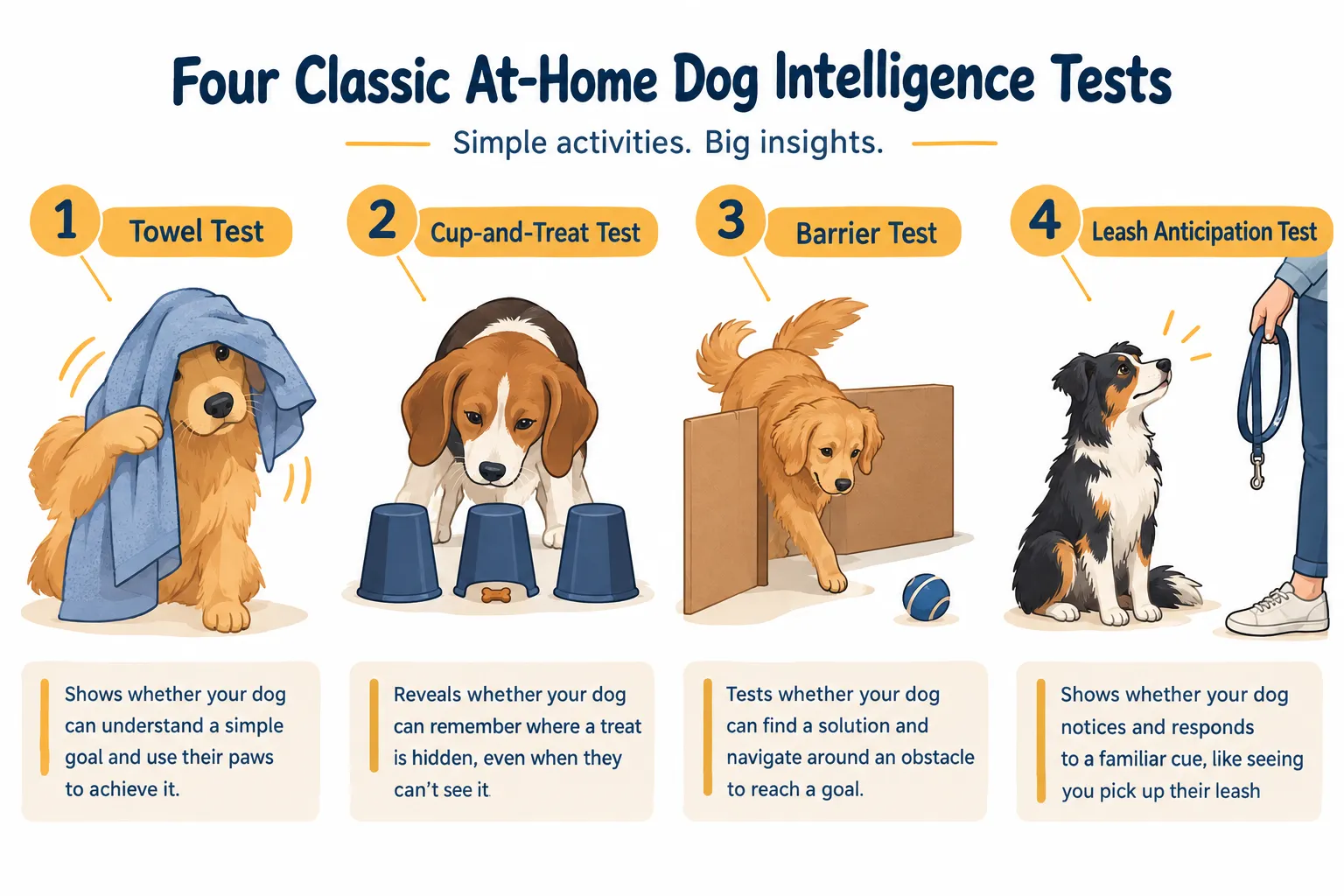
Popular vet and pet-care sites have built entire test batteries around a handful of classic challenges.
Each task usually gets scored on a simple 3-point scale, and owners add up the points for one tidy “smart score.”[2][6][8][13] It feels satisfying. It’s also a little misleading.
Dogs aren’t little furry computers running one program. They’re social, emotional, scent-driven animals with wildly different life experiences. A rescue pup who’s never seen a cardboard box might “fail” a barrier test simply because the object is unfamiliar, not because their brain is slower.[5][14]
That’s the real heart of the opinion piece behind “Can You Tell How Smart a Dog Is by Giving It a Test?” It’s not saying tests are useless. It’s asking dog lovers to slow down before turning a quiz into a permanent label.
The Most Popular At-Home Dog IQ Tests, Explained
Curious what these tests actually look like? Here are the four most common ones dog parents try at home, based on widely shared vet and pet-care guides.[2][4][6][8][13]
- Towel Test Problem-solving under a light stress. How fast the dog removes a towel from its head
- Cup-and-Treat Test Memory and object tracking. Whether the dog picks the right cup
- Cardboard Barrier Test Spatial reasoning. Time to find a way around the obstacle
- Leash Anticipation Test Associative learning. Whether the dog reacts before the walk starts
Newer expert guides go further, layering in scent-based hidden-treat tasks, point-following, delayed-reward patience checks, and social-learning challenges.[14][5] These give a fuller picture of a dog’s learning style,not just a pass/fail grade.
A few quick tips before trying these at home:
Keep the room calm and free of distractions.
Use your dog’s favorite treat, not just any snack.
Run each test more than once, one bad day isn’t the full story.
Watch your dog’s body language, not just the “result.”
If your dog seems more anxious than curious during testing, it might be worth reviewing 19 silent signs of pain in dogs that every owner should know, since discomfort can easily masquerade as “not trying.”
Why the Viral Wall Test Isn’t a Real Intelligence Test
You’ve probably seen it: someone holds their dog against a wall to see if the paws instantly plant. Cue the applause emojis and captions calling the dog a “genius.”
Not so fast. A May 2026 Popular Science article pulled back the curtain on this trend, and the science is clear: this is a neurologic placing reflex, not an intelligence test.[12] It’s an automatic response wired into the nervous system, similar to a knee-jerk reflex in humans. Every healthy dog does it. It has nothing to do with IQ.
“Reflexes tell you the nervous system is working. They don’t tell you how smart the dog is.”, paraphrased from veterinary and cognition experts cited in 2026 reporting[12]
This matters because trends like this shape how dog parents think about their pups. A dog that’s slow to plant its paws isn’t “dumb.” A dog that does it instantly isn’t secretly plotting world domination. It’s just biology.
This is exactly why the opinion piece “Can You Tell How Smart a Dog Is by Giving It a Test?” pushes back on viral shortcuts. Real canine cognition is far more layered than a 15-second clip can capture.[1][12]
For dog lovers who want a deeper, more accurate read on their pup’s behavior patterns, exploring dog behavior and canine communication resources is a much better starting point than a wall trick.
What Science Says: Multiple Intelligences, Not One IQ Score
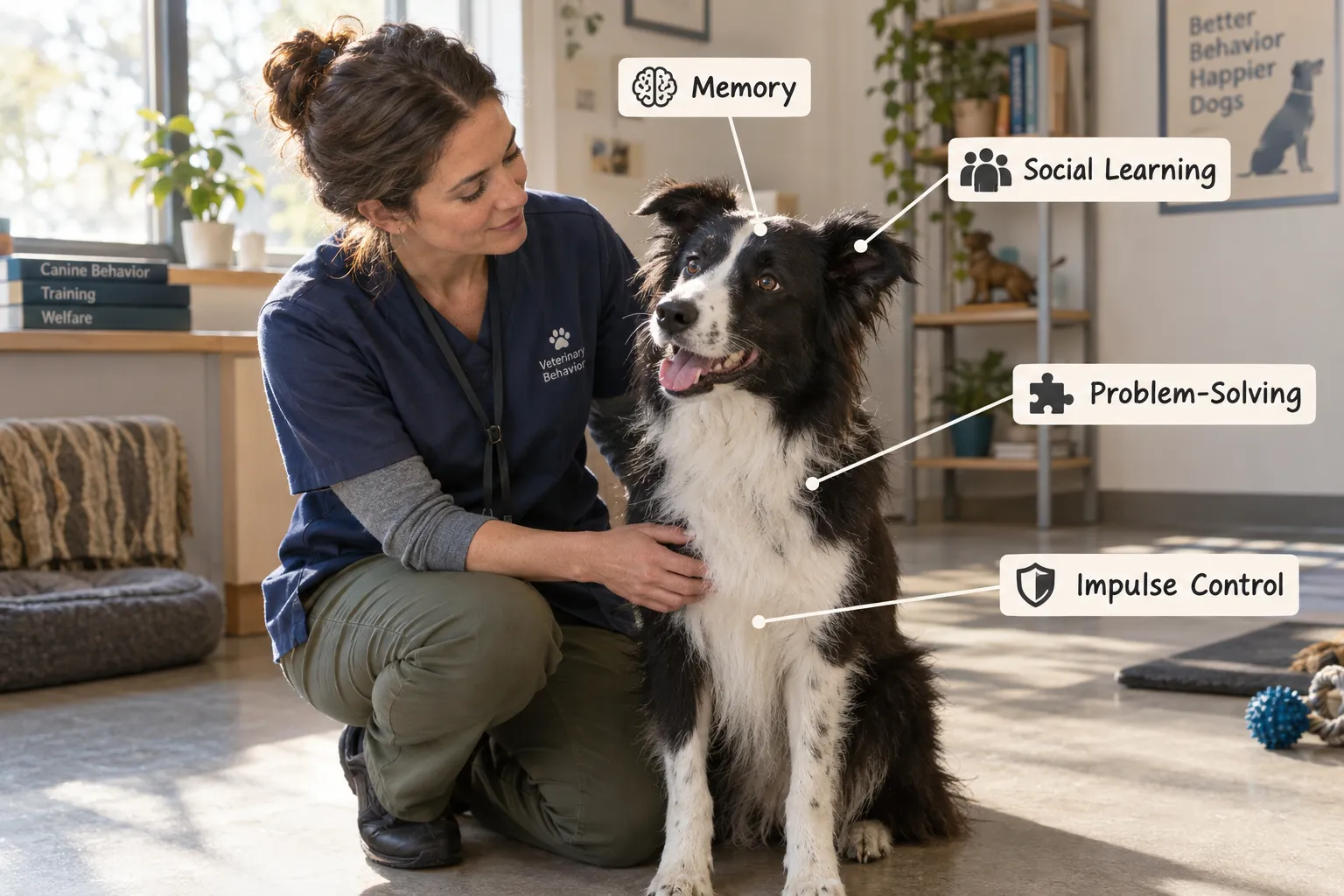
Here’s where things get genuinely exciting. Researchers at the University of Arizona’s BRAY Lab published a February 2026 paper in Animal Behaviour tracking assistance dog puppies over time. Their findings? Dogs likely have multiple intelligences,separate but related cognitive skills like memory, social learning, and problem-solving, rather than one unified “dog IQ.”[15]
Think of it like human intelligence. Some people are gifted with numbers. Others read a room instantly. Nobody boils that down to a single score anymore, and dogs deserve the same nuance.
There’s another twist: most lab-based cognition tests lean heavily on vision.[10] But dogs experience the world through their noses first. A 2026 commentary on a study published in the journal Animals argues this bias means we may be underestimating dogs across the board. The recommendation? Build tests that “follow the nose”, hidden-scent puzzles instead of purely visual ones.[10]
That’s a big deal for anyone raising a working or scent-driven breed. A dog that seems “average” on a visual cup test might be a scent-detection prodigy in disguise. If you’re building enrichment around your dog’s natural strengths, check out dog enrichment routine ideas or brush up on foundational dog obedience commands that reward the way your dog naturally learns best.
So, Can You Tell How Smart a Dog Is by Giving It a Test?
Short answer: sort of, but not fully, and that’s actually good news.
A test can absolutely reveal:
✅ How your dog solves a specific problem
✅ What motivates them (food, praise, play)
✅ Their memory for recent events
✅ How they respond to novel objects
But it can’t hand you one tidy label like “genius” or “average.” Motivation, anxiety, prior training, and even how clearly you give cues all shape the outcome.[12][2][5] A nervous dog in a new environment may “test low” simply because they’re stressed, not because they’re less capable.
Some popular quizzes still hand out totals, 5 to 8 points means “basic commands with work,” 13 to 15 means “very smart,” 15-plus means “super smart.”[6][9][11] These labels are catchy. They’re also oversimplified. The emerging 2026 consensus among researchers and vets is that dogs show diverse cognitive strengths, and no five-minute test can fully answer the question.[10][12][15][1]
If you want to build real skills instead of chasing a score, structured training does more good than any quiz. Tools like clicker training and a consistent dog training schedule build genuine problem-solving ability over time, no towel required.
Conclusion
Dog IQ tests are fun. They’re a great rainy-day activity, a bonding moment, and honestly, a great excuse to give your dog extra treats. But they’re not scientific verdicts on how smart your furry family member is.
The real takeaway from “Can You Tell How Smart a Dog Is by Giving It a Test?” is this: every dog carries a unique mix of memory, social smarts, patience, and sensory genius. No single test captures all of that, and that’s what makes dogs so tail-wagging fascinating in the first place.
Next steps for curious dog parents:
Try one test at a time, and repeat it on a calm day.
Watch for patterns in how your dog learns, not just a final score.
Lean into your dog’s natural strengths with enrichment and training.
Skip the viral “wall test” trend, it’s reflex, not intellect.
Celebrate your dog’s unique brain, quirks and all. 🐶💛
References
[1] Dog Smart Intelligence Test – https://www.nytimes.com/2026/09/14/opinion/dog-smart-intelligence-test.html
[2] Is My Dog Smart – https://bondvet.com/blog/is-my-dog-smart
[4] Is My Dog Smart 5 Minute At Home Intelligence Test – https://dognition.com/blog/is-my-dog-smart-5-minute-at-home-intelligence-test
[5] 5 Tests To Tell Your Dogs Iq – https://www.petplace.com/article/dogs/pet-behavior-training/5-tests-to-tell-your-dogs-iq
[6] 4 Ways Test Dogs Intelligence – https://www.rover.com/blog/4-ways-test-dogs-intelligence/
[8] How Smart Is Your Dog – https://moderndogmagazine.com/articles/how-smart-is-your-dog/
[9] Study Urges Canine Cognition Research To Follow The Nose – https://theherd.news/the-feed/study-urges-canine-cognition-research-to-follow-the-nose
[10] Take This Dog Iq Test – https://www.foundanimals.org/take-this-dog-iq-test/
[11] Take This Dog Iq Test – https://www.foundanimals.org/take-this-dog-iq-test/
[12] 4 Ways Test Dogs Intelligence – https://www.rover.com/blog/4-ways-test-dogs-intelligence/
[13] How Smart Is Your Dog – https://moderndogmagazine.com/articles/how-smart-is-your-dog/
[14] 5 Tests To Tell Your Dogs Iq – https://www.petplace.com/article/dogs/pet-behavior-training/5-tests-to-tell-your-dogs-iq
[15] Study Urges Canine Cognition Research To Follow The Nose – https://theherd.news/the-feed/study-urges-canine-cognition-research-to-follow-the-nose