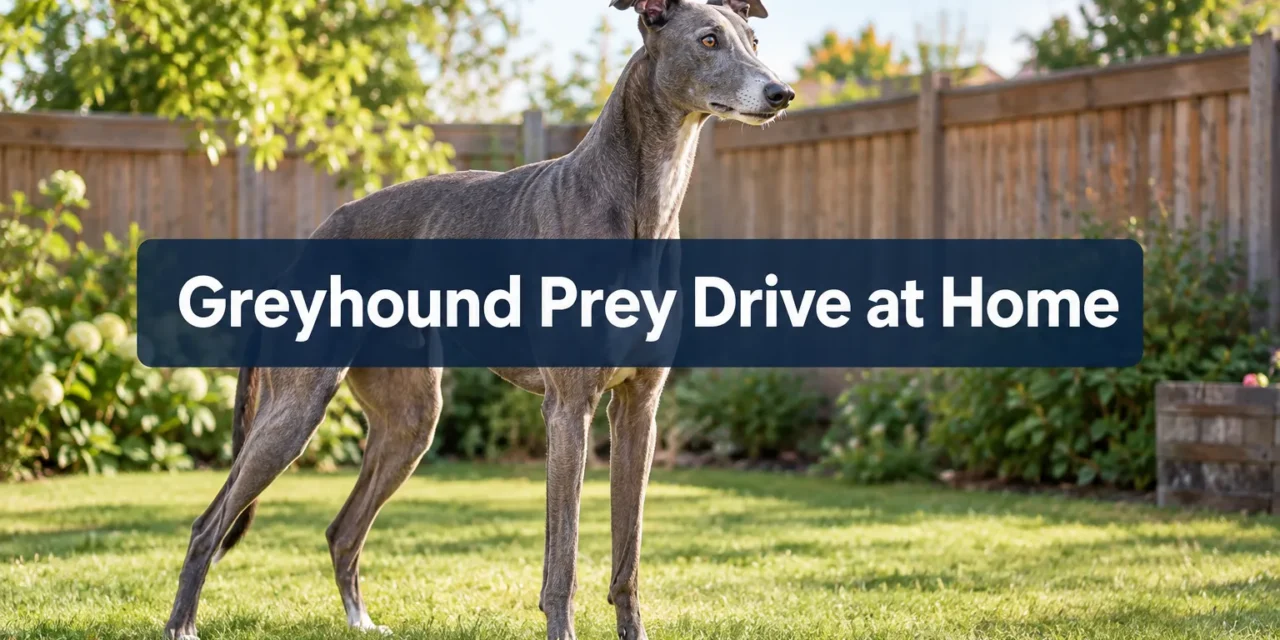
A retired racing greyhound can spot a moving squirrel 800 feet away. That same dog might sleep 18 hours a day on your couch like a furry potato. Both things are true. That’s the paradox every greyhound parent needs to understand.

Greyhound Prey Drive at Home: Cats, Small Pets, Off-Leash Safety, and Training is one of the most searched, and most misunderstood, topics in the sighthound world. Greyhounds were bred for centuries to chase fast-moving targets. That instinct doesn’t disappear just because a dog hangs up its racing collar. It’s still in there, wired deep, ready to switch on in a split second.
The good news? Thousands of greyhounds live happily with cats, small dogs, and busy families every single day. The key is understanding what prey drive actually is, managing it smartly, and never assuming it’s “trained away.” This guide breaks it all down in plain language, so adopters and current pet parents can make safe, confident decisions.
Key Takeaways
- 🐾 Prey drive is instinct, not a behavior problem. It can be managed, but current expert consensus says it can’t be fully trained out [5][7].
- 🐱 Indoor cats can work with many greyhounds, but free-roaming outdoor cats remain high-risk no matter how “cat-safe” a dog tests [1][2][9].
- 🐹 Small pets and toy breeds are often treated as incompatible unless a greyhound shows clearly low prey drive through structured testing [1][2].
- 🏃 Off-leash freedom should only happen inside fully secured, fenced areas. Recall training helps, but it rarely beats prey drive once a chase starts [10][6].
- 🎯 The best training tools are impulse control, desensitization, and smart equipment, not punishment [3][8].
What Is Greyhound Prey Drive, Really?
Greyhounds are sighthounds. That single fact explains almost everything about their prey drive. Unlike scent hounds that track smells over long distances, greyhounds hunt with their eyes. They lock onto fast movement and chase it, instantly and instinctively [5][7].
This isn’t aggression. It’s hardwired predatory sequence: spot, chase, catch. For centuries, breeders selected greyhounds specifically for speed and chase ability. That history doesn’t vanish once a dog retires from the track [5].
Here’s what prey drive actually looks like in a home setting:
- A sudden stiffening of the body when a squirrel darts across the yard
- Intense, locked-in staring at a cat or small animal
- A fast head snap toward anything moving quickly, a skateboard, a jogger, a rolling ball
- Zero response to a dog’s name once the chase has started
Important distinction: prey drive is about movement, not malice. A greyhound isn’t “bad” for having it. It’s simply doing what thousands of years of breeding built it to do [7].
Why Training Can’t Erase Prey Drive
This is the part a lot of hopeful adopters don’t want to hear: prey drive can be managed, redirected, and minimized through careful training, but current 2026 expert guidance is clear that it is not something that gets “trained out” completely [5][7]. Even the calmest, couch-loving retired racer can experience a flash of instinct that overrides everything it’s ever learned.
That doesn’t mean training is pointless. Far from it. It means training should focus on management, not elimination. Think of it like managing a food allergy instead of trying to cure it. The goal is a safe environment, not a personality transplant.
Greyhound Prey Drive at Home: Living Safely with Cats
This is the question almost every greyhound adopter asks first: “Can my greyhound live with my cat?” The honest answer is: it depends, and it depends a lot.
Rescue organizations have gotten much more structured and conservative about cat testing in recent years. Programs that once relied on quick introductions now use multi-step evaluations, often repeated over several sessions, to assess how a greyhound reacts to feline movement, scent, and sound [1][9][2].
Here’s what modern cat-testing programs typically evaluate:
| Testing Factor | What It Reveals |
|---|---|
| Reaction to a stationary cat | Baseline curiosity vs. fixation |
| Reaction to sudden cat movement | True prey trigger response |
| Response to a muzzle being removed near a cat | Impulse control under lower restraint |
| Recovery time after stimulation | How quickly the dog settles |
| Behavior over multiple exposures | Consistency, not a one-time fluke |
Even after a greyhound “passes” testing, experts recommend ongoing indoor management. That includes [2]:
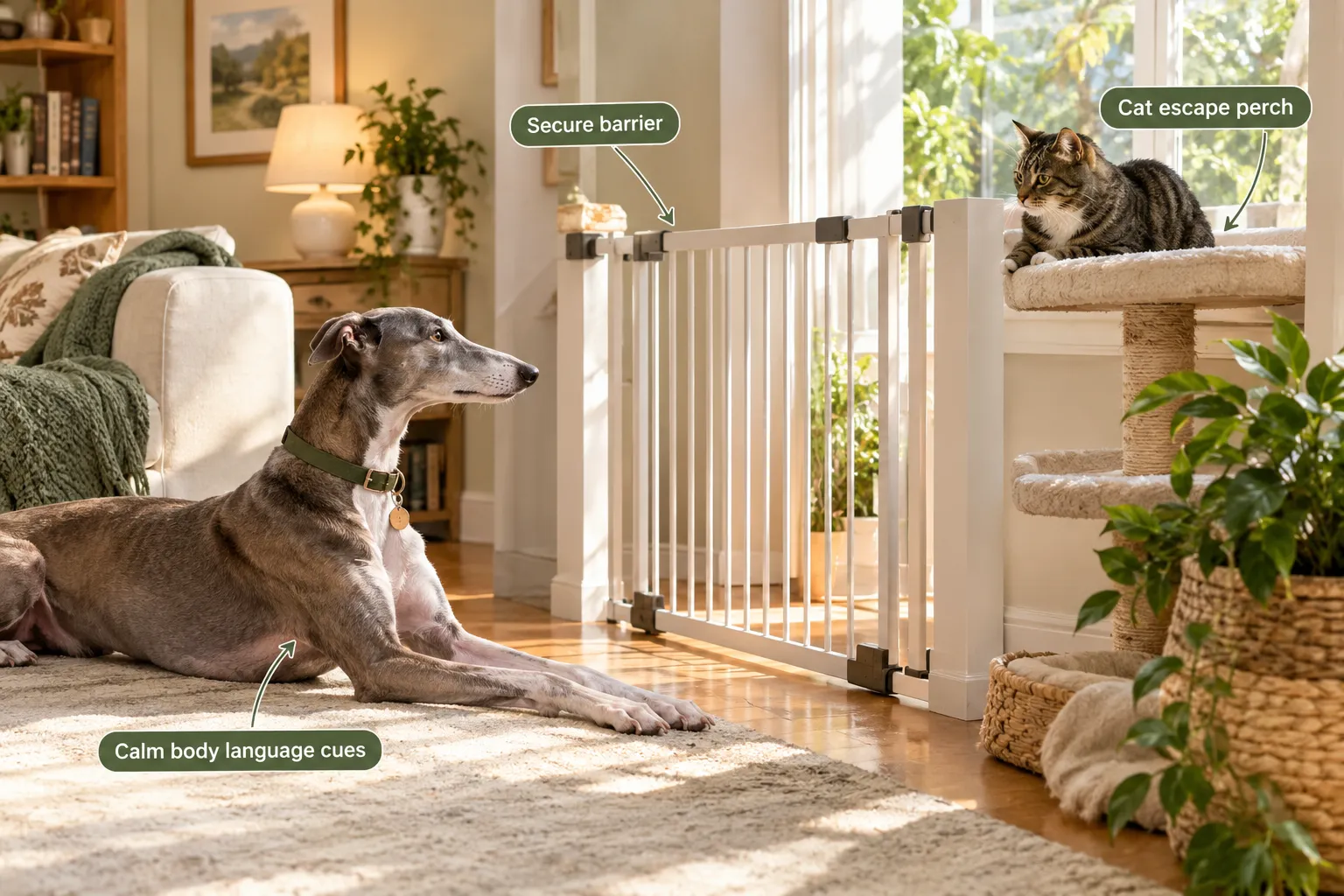
- 🐕 Muzzling during the first weeks of cohabitation, even with a cat-tested dog
- 🚪 Leashes indoors during supervised introductions
- 🙀 Escape routes for the cat, tall furniture, baby gates, separate rooms with cat doors
- 👀 Never leaving them alone together until trust is fully earned, which can take months
“A dog that’s safe with one cat in one setting isn’t automatically safe with every cat, everywhere.”, a core principle behind modern cat-testing guidance [9]
Indoor Cats vs. Outdoor Cats: A Critical Difference
This distinction matters more than almost anything else. An indoor cat that lives full-time inside the home, with controlled introductions and escape routes, can realistically coexist with many greyhounds [1][2]. A free-roaming outdoor cat is a completely different story.
Outdoor and neighborhood cats move unpredictably. They run. They dart under fences. They trigger exactly the fast-motion response that flips a greyhound’s prey drive switch instantly. Current 2024-2026 guidance treats free-roaming cats as a high-risk scenario, regardless of how a dog scored on indoor testing [1][2].
Bottom line: indoor-only cat households have a real shot at success with careful management. Homes with outdoor cats, or neighborhoods full of free-roaming cats, carry meaningfully higher risk that no amount of training fully removes.
Small Pets and Toy Breeds: When Is It Too Risky?
Cats get a lot of attention in this conversation, but small pets and toy dog breeds deserve just as much caution, arguably more.
Rabbits, guinea pigs, hamsters, ferrets, and small birds move in quick, jerky bursts. That kind of motion is practically designed to trigger a chase response. Many rescue and rehoming programs now treat greyhounds and small pets as incompatible by default, unless a dog has demonstrated clearly low prey drive through repeated, structured testing [1][2].
Toy breed dogs fall into a similar gray zone. A Chihuahua, Yorkie, or other small breed can resemble prey in motion, especially during play, running, or sudden movement. This doesn’t mean greyhounds and toy breeds can never share a home. It means the bar for “safe” is higher, and the testing needs to be more thorough.
Families considering a small companion breed alongside a greyhound might also want to browse small dog breeds suited for first-time owners to understand temperament differences before combining breeds. Apartment dwellers weighing size and energy compatibility can also check out small cute dog breeds for apartment living for context on activity levels that pair well with a calmer sighthound lifestyle.
Red Flags That Signal High Risk
- The greyhound fixates on the small pet’s enclosure, even through glass or wire
- Whining, pacing, or scratching near the small pet’s space
- A stiff body and raised hackles when the small pet moves suddenly
- Any history of chasing or catching small animals, even once
If any of these show up, most current programs recommend treating the pairing as unsafe rather than attempting gradual desensitization [1][2].
Off-Leash Safety: Why “Fully Fenced Only” Is the Rule
Here’s a sentence every greyhound parent should memorize: off-leash freedom only happens inside a fully secured, fenced area. Not a park. Not an open field. Not “just for a second” on a quiet street.
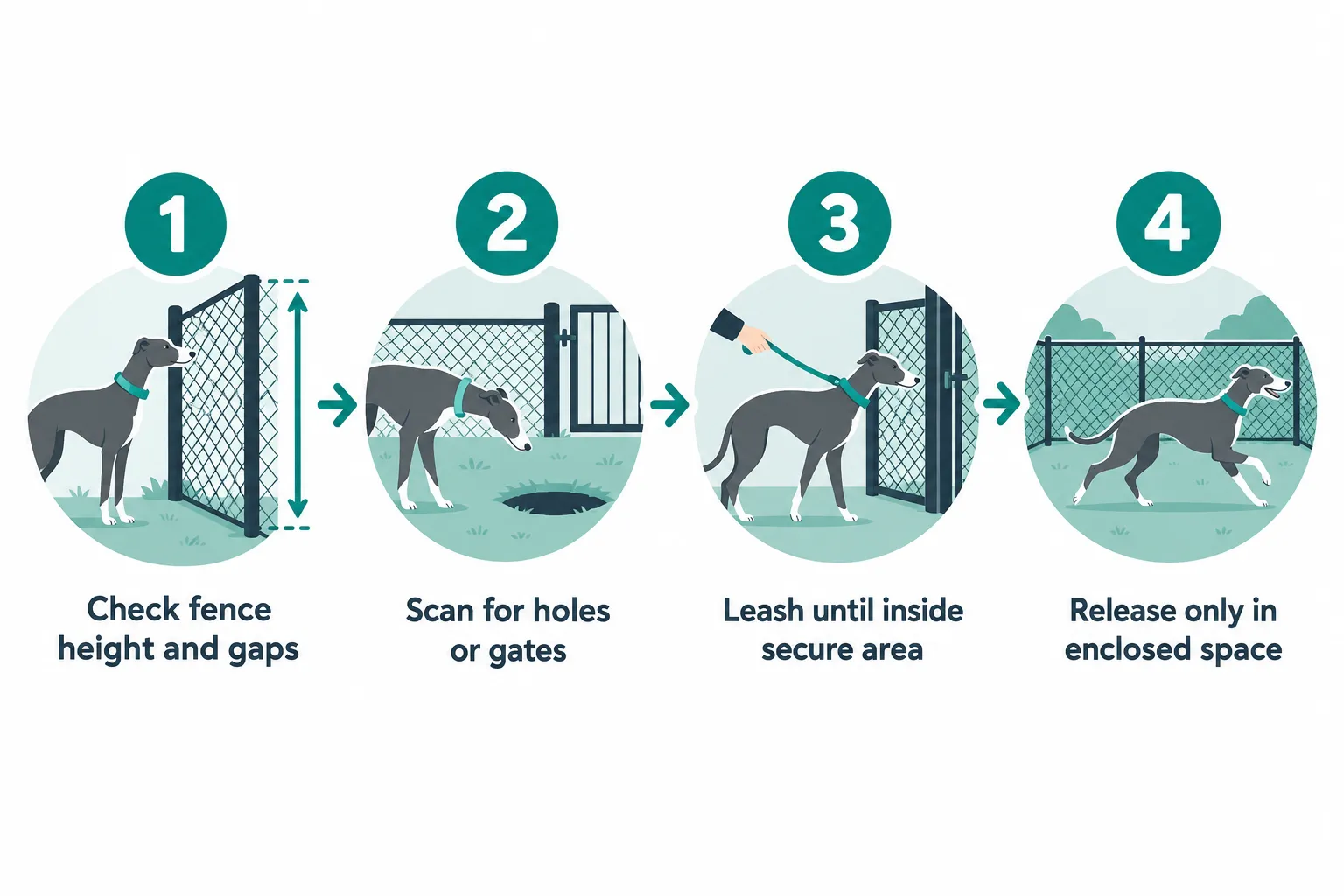
Expert consensus on this point is about as strong as it gets in the dog world. Greyhounds can reach speeds over 35 miles per hour in just a few strides [5]. Once a chase instinct fires, that speed advantage means the dog can be gone, truly gone, before an owner even registers what happened [10][6].
Fencing needs to meet specific standards to actually be “secure”:
- ✅ At least 5-6 feet tall, with no gaps at the bottom
- ✅ No visible holes, loose boards, or low spots
- ✅ Gates that latch securely and can’t be nudged open
- ✅ Regular inspection, especially after storms or yard work
Why Recall Training Isn’t a Safety Net
Recall training, teaching a dog to come when called, is genuinely useful. It builds communication and trust. But here’s the catch: once a greyhound locks onto a moving target and the chase instinct kicks in, recall commands often get completely tuned out [10][6].
This isn’t a training failure. It’s biology. A dog mid-chase is operating on instinct, not obedience. Expert guidance from greyhound-specific resources is blunt about this: recall is a nice-to-have, not a safety guarantee [10].
That’s why the “fully fenced only” rule exists. It removes the need to rely on a command winning against thousands of years of selective breeding.
A Simple Pre-Walk Safety Checklist
- Check the fence line before letting the dog off leash
- Scan for gaps, gate latches, and escape points
- Keep the leash on until the dog is fully inside the secured area
- Only unclip in a space with zero exit points
- Stay alert, don’t assume a “good” dog means a safe moment
Building a routine around this checklist takes the guesswork out of every outing. For owners working on broader obedience alongside safety habits, exploring general dog training resources can help reinforce consistency across commands.
Training Strategies That Actually Work (and Ones That Don’t)
Managing prey drive isn’t about punishment. It’s about structure, patience, and smart tools. Current training trends from 2022 through 2026 point clearly toward impulse control, desensitization, and equipment-based management as the gold standard [3][8].
What Works
- Impulse control exercises. Simple games like “wait before the bowl drops” or “settle before the door opens” build the mental muscle a greyhound needs to pause before reacting [3].
- Desensitization, done slowly. Gradually exposing a greyhound to small-animal movement from a safe distance, pairing it with calm rewards, can lower reactivity over time [8].
- Muzzle training. A well-fitted muzzle isn’t punishment, it’s a safety tool that protects everyone while a dog learns new habits [2].
- Leash and long-line management. Keeping a dog leashed during transitions (new rooms, new yards, new introductions) prevents accidents before they happen [8].
- The “wait” command. Teaching a dog to pause at doors, gates, and thresholds builds a crucial habit that buys precious seconds in real-world situations. The wait command training approach is especially valuable for sighthounds prone to bolting.
What Doesn’t Work
- ❌ Punishment-based correction. Yelling or physical correction after a chase attempt doesn’t address the instinct, it just adds stress and confusion [3][8].
- ❌ “Testing it out” without supervision. Letting a greyhound loose with a cat or small pet “to see what happens” is a gamble, not a training method.
- ❌ Assuming one good interaction means permanent safety. Prey drive can resurface even after months of calm behavior.
“Train the behavior you can control. Manage the instinct you can’t.” That’s the mindset behind every credible greyhound prey drive program today [3][8].
For owners building a broader training toolkit, general dog training tips and resource hubs like genius training hacks for high-energy breeds offer transferable techniques, impulse control and desensitization principles apply across breeds, even though greyhounds and bully breeds look nothing alike.
Greyhound Prey Drive at Home: Building Your Household Safety Plan
Every greyhound household benefits from a written, visible safety plan, not just good intentions. Here’s a simple framework to build one.
🏠 Household Safety Plan Checklist
✅ Fence inspected and secure, no gaps or low spots
✅ Muzzle fitted and used during new introductions
✅ Baby gates or barriers set up for cat/small pet escape routes
✅ All family members briefed on “no off-leash outside fenced areas”
✅ Visitors warned not to open doors or let the dog out unsupervised
This kind of plan matters most during the first 30 to 60 days in a new home, the period when a greyhound is still learning the household’s rhythm and testing boundaries [2][8].
Signs Management Is Working
- The dog can see a cat or small pet without fixating
- Recovery time after stimulation shortens over weeks
- The dog chooses to settle near, rather than stare at, a small animal
- No incidents of lunging, chasing, or fixating during supervised time
Signs to Pause and Reassess
- Any attempt to break through a barrier toward a small pet
- Escalating intensity of staring or body stiffening
- A near-miss during an off-leash moment, even in a “secure” yard
Reassessment doesn’t mean failure. It means the plan needs adjusting, maybe more separation, more muzzle time, or professional trainer input.
Legal and Policy Considerations for 2026
The regulatory landscape around sighthound ownership has shifted noticeably in recent years. Leash laws, breed-specific guidance, and muzzle requirements have become more common in many regions, reflecting a broader push toward public safety and responsible ownership [6][10].
Key trends shaping 2025-2026 policy conversations include:
- Increasing emphasis on leashing in public spaces, even for dogs with strong recall histories
- Growing use of muzzle guidance in adoption contracts, especially during the first months home
- Rescue organizations requiring signed acknowledgment of prey drive risks before adoption finalizes
This isn’t about restricting greyhound ownership, it’s about setting adopters up for success. A dog parent who understands the rules going in is far less likely to face a heartbreaking off-leash accident down the road.
Looking ahead: expect adoption contracts and local policies to keep trending toward more explicit safety language around prey drive, cats, and off-leash behavior. This is an interpretation based on current momentum, not a guarantee, but it’s the direction the data points.
Conclusion
Greyhound prey drive isn’t a flaw to fix. It’s a feature of the breed, one that deserves respect, structure, and smart management. The dogs that thrive in homes with cats, small pets, and busy families aren’t the ones whose instincts magically disappeared. They’re the ones whose families built the right systems around them.
Here’s the simple version to carry forward:
- Treat indoor cats as a possibility, not a guarantee, and never trust free-roaming cats to a prey-driven dog.
- Assume small pets and toy breeds carry real risk unless testing says otherwise.
- Keep off-leash time locked to fully fenced spaces. Every time. No exceptions.
- Build training around impulse control and desensitization, not punishment.
- Write the safety plan down. Share it with everyone in the house.
Greyhounds give so much love, loyalty, and quiet companionship. Managing their prey drive well isn’t a limitation on that bond, it’s what protects it, for every furry family member under the same roof.
References
[1] Cats And Small Dog Testing – https://hectorsgreyhoundrescue.org/greyhounds-as-pets/cats-and-small-dog-testing/ [2] Cats And Small Animal Sept 18 2019 Original – https://www.greyhoundtrust.org.uk/assets/000/004/112/cats_and_small_animal_sept_18_2019_original.pdf?1581612753= [3] Attending Training Greyhounds Booklet Eleven – https://greyhoundcare.grv.org.au/wp-content/uploads/2021/01/Attending-Training-Greyhounds-Booklet-Eleven.pdf [5] Greyhound – https://en.wikipedia.org/wiki/Greyhound [6] Learn More – https://teamgreyhound.com/learn-more/ [7] Greyhound Dog Breed Information Characteristics – https://animalso.com/greyhound-dog-breed-information-characteristics/ [8] In Home Re Training Guide Version 090216 – https://greenhounds.com.au/uploads//In-home%20Re-Training%20GUIDE%20version%20090216(1).pdf [9] Index – https://greyhoundcrossroads.com/index.php?page=cat-testing [10] Greyhound Off Leash Recall Vancouver – https://www.localpetfinder.ca/british-columbia/dog-adoption-vancouver/resources/greyhound-off-leash-recall-vancouver