Most Australian Shepherds don’t get “too much” exercise. They get the wrong kind. A 45-minute leash walk feels like a lot to a human. To an Aussie’s brain, it barely registers. That mismatch is the root cause of most chewed baseboards, obsessive shadow-chasing, and 2 a.m. zoomies this breed is famous for.

This Australian Shepherd Owner’s Handbook: Training, Exercise, and Mental Stimulation for Aussies exists to close that gap. Think of it as your no-fluff roadmap for raising a happy, tired, well-mannered Aussie, even if your house is loud, busy, and full of competing priorities. Aussies are brilliant, loyal, and a little intense. That’s exactly why they’re worth the effort.
Key Takeaways
- Aussies need 60-120+ minutes of daily exercise, and most of it should be vigorous, running, fetch, or structured play, not slow strolling.[6][8]
- Mental stimulation is not optional. Budget 15-60 minutes of dedicated brain work daily through puzzles, training, and nose games.[7][11 via 2]
- Short training sessions win. Five minutes, several times a day, beats one long drill session for building focus and impulse control.[1][9]
- Puppies follow the “five-minute rule”: roughly 5 minutes of structured exercise per month of age, twice daily.[6][8]
- Bored Aussies become destructive Aussies. Giving them an actual “job” prevents the frustration behaviors busy households dread most.[2]
Why Your Aussie Needs More Than a Walk Around the Block
Australian Shepherds were bred to work cattle and sheep all day, reading subtle body language and making split-second decisions. That history is still wired into every Aussie napping on your couch right now. A quick walk around the block doesn’t scratch that itch. It barely taps it.
Healthy adult Aussies generally need 60 to 120-plus minutes of exercise every day, according to multiple 2026 breed guides.[6][8] Some high-drive individuals need even more, up to 180 minutes split across several outings. That’s not a typo. That’s a working dog’s baseline.
Here’s the part owners miss: duration isn’t the whole story. Intensity matters just as much.
- A lazy 60-minute stroll ≠ a 20-minute sprint-and-fetch session.
- “Vigorous” means running, agility work, herding-style drills, or sustained off-leash movement.[4][8]
- Casual walking is great for sniffing and decompression, but it shouldn’t count as your dog’s only workout.
Pull Quote: “A tired Aussie body and a bored Aussie brain are two completely different problems, and only one of them gets solved by a longer walk.”
This is exactly why this Australian Shepherd Owner’s Handbook: Training, Exercise, and Mental Stimulation for Aussies treats exercise and mental work as two separate, equally important pillars, not one blended afterthought.
The Australian Shepherd Owner’s Handbook Approach to Training
Forget the idea that training is about stacking cute tricks. For an Aussie, training is communication. It’s how you build trust, set boundaries, and give an intelligent working dog something productive to do with that big brain.
Breed-education sources updated in October 2026 emphasize four priorities above all else: communication, impulse control, focus, and mental work.[1] Commands like “sit” and “stay” matter, but they’re tools, not the destination.
Puppy Training Essentials (First Few Months)
Young Aussies thrive on structure delivered in tiny doses. The recommended approach:
- 5-minute sessions, 3-4 times daily[1][9]
- Focus on name recognition and eye contact
- Prioritize engagement over obedience (“look at me” before “sit”)
- Controlled, calm socialization, not chaotic dog-park free-for-alls
Adult Training Priorities
Once your Aussie is past the wiggly puppy stage, shift the focus:
- Recall, the single most important skill for a breed that loves to run
- Leash manners, loose-leash walking without constant pulling
- Impulse control, waiting at doors, not bolting at squirrels
- Sport foundations, agility, flyball, or herding basics if you’re adventurous
A properly motivated Aussie can learn 5 to 10 new tricks per week.[1][9] That’s a staggering learning speed, and it’s exactly why under-training this breed backfires so fast. An under-stimulated genius finds its own “projects,” and you usually won’t love what it picks.
Teaching a rock-solid wait command early on pays off for life, at doors, curbs, and anywhere impulse control keeps your dog safe. Pair that with foundational dog training tips and a rotating set of cute dog training tricks to keep sessions fresh and engaging.
The “Short and Frequent” Rule
Marathon training sessions backfire with Aussies. They get frustrated, bored, or over-aroused. Instead:
| Life Stage | Session Length | Frequency | Focus |
|---|---|---|---|
| Puppy (2-6 months) | 5 minutes | 3-4x daily | Name, engagement, socialization |
| Adolescent (6-18 months) | 5-10 minutes | 3x daily | Recall, leash skills, impulse control |
| Adult (18 months+) | 10-15 minutes | 2-3x daily | Sport skills, advanced cues, problem-solving |
Because Aussies were originally bred for large-scale herding work, many of the same structured, patience-based methods used with other working and large breed training plans translate well, consistency and clarity matter more than sheer repetition.
Exercise Needs by Life Stage: Puppy, Adult, Senior
Exercise isn’t one-size-fits-all across an Aussie’s life. Getting this wrong, especially in puppyhood, can cause real joint damage.
Puppies: The Five-Minute Rule
Growing joints are fragile. 2026 guidance recommends roughly 5 minutes of structured, on-leash exercise per month of age, up to twice a day.[6][8] So a 4-month-old puppy gets about 20 minutes per session, max.
- Skip repetitive jumping or long-distance running
- Favor short play sessions and gentle leash walks
- Let free play in a safe yard supplement structured time
Adults: The High-Energy Window
This is where the 60-120-plus minute range applies in full force.[6][8] A fit adult Aussie generally does best with:
- 1-2 hours of vigorous daily activity, split into 2-4 sessions
- A mix of running, fetch, hiking, or structured sport work
- At least one session that gets the heart rate genuinely up
Seniors: Quality Over Intensity
Older Aussies still want to move, but their bodies need gentler output.
- 30-60 minutes of low-impact activity daily[6][8]
- Gentle walks, swimming, and light sniff-based outings
- Watch for stiffness after activity, that’s your cue to dial back intensity, not stop moving altogether
Building Your Daily Routine: A Blueprint That Works
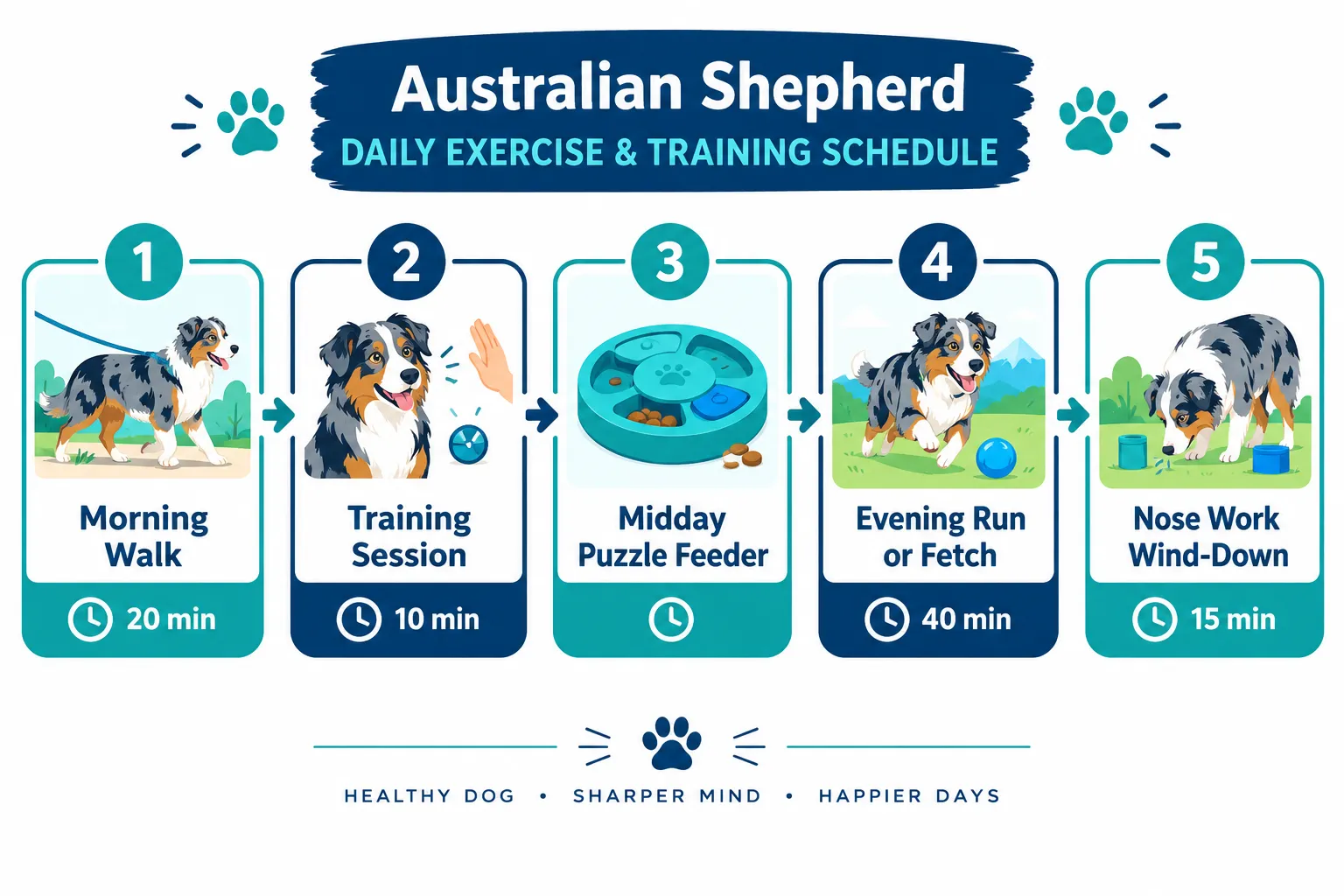
A busy household doesn’t need a perfect routine. It needs a realistic one. Here’s a sample blueprint adapted from 2026 lifestyle guidance for working breeds.[2][3]
The “Minimum” Day
For when life gets in the way:
- 45 minutes brisk walking
- 30 minutes fetch or frisbee
- 15 minutes training or puzzle work
The “Ideal” Day
When you have more time to invest:
- 60 minutes hike or structured run
- 30 minutes agility, herding-style drills, or sport play
- 15-30 minutes nose work or trick training
A Sample Split for Working Owners
Many owners juggle a full-time job, so here’s a routine that actually fits real life:[2][3]
- Morning (20 minutes): Quick walk or short training session to take the edge off before you leave
- Midday (if possible): A puzzle feeder or frozen Kong to keep the brain busy while you’re out
- Evening (40-60 minutes): Running, fetch, or sport work, the big energy burn of the day
- Wind-down (10-15 minutes): Calm training or a sniff-based game before bed
The goal every single day: your Aussie should end up mentally tired, not just physically worn out. Those are two different kinds of tired, and only one of them produces a dog that settles calmly on the couch at 8 p.m.
If your household also includes other high-energy breeds, the same principle of matching intensity to temperament applies broadly, see how it plays out in exercise routines designed for a Cane Corso’s energy level for a useful comparison point.
Mental Stimulation: The Non-Negotiable Second Pillar
Here’s the single most important idea in this entire Australian Shepherd Owner’s Handbook: Training, Exercise, and Mental Stimulation for Aussies: physical exercise alone will never fully satisfy this breed. Working-breed guidance from 2026 treats mental enrichment as a true second pillar, not a bonus activity.[7]
Recommended daily investment: 15-30 minutes of dedicated mental enrichment, or 40-60 minutes of mental work folded into the overall activity budget.[7]
Brain Games That Actually Work
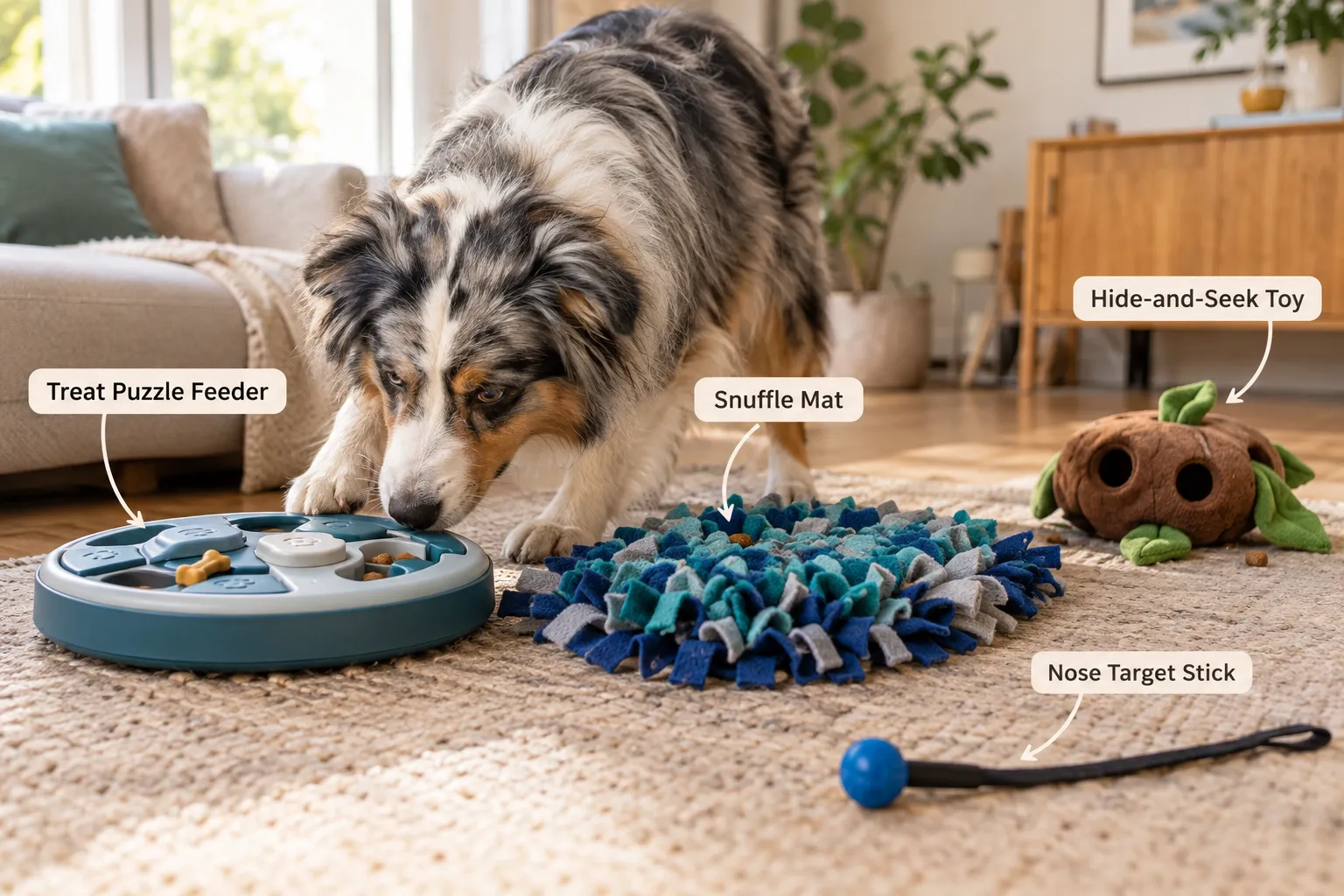
- Puzzle feeders and treat-dispensing toys, turn a 30-second meal into a 15-20-minute challenge[2]
- Scent-based “find it” games, hide treats around a room and let your Aussie’s nose do the work
- Hide-and-seek, you hide, your dog searches; simple, cheap, and surprisingly tiring
- Nose-target games, teach your dog to touch their nose to your hand or an object; channels working instincts without over-arousing them[2]
- Trick training rotations, new trick each week keeps the brain guessing
Build “Jobs” Into Regular Walks
You don’t need a separate session for every brain game. Practical 2026 exercise guides suggest weaving mental work right into the walk itself:
- Let your dog sniff-explore freely for part of the route
- Set up a mini obstacle course with cones or sticks
- Practice recall and trick cues mid-walk
- Play a quick hide-and-find game at a park
This “two birds, one walk” strategy is a lifesaver for busy households that can’t carve out separate exercise and enrichment blocks every single day.
Why This Matters So Much
Herding dogs like Aussies need what trainers call a “job.”[2] Without one, they invent their own, and their inventions usually involve your furniture, your garden, or relentless barking at nothing. Giving your dog structured mental work every day prevents frustration behaviors and is the real difference between a dog that’s truly tired and one that’s just quietly bored.[2]
Avoiding Behavior Issues in Busy Households
Most “problem” Aussie behaviors trace back to one root cause: unmet needs. Here’s how the common issues show up, and how this handbook’s approach prevents them.
Common Red Flags in Busy Homes
- Herding family members or kids, nipping at heels, circling, barking at movement
- Destructive chewing, targeting furniture, shoes, or drywall
- Obsessive behaviors, shadow-chasing, light-chasing, tail-chasing
- Excessive barking, at doorbells, passersby, or seemingly nothing
- Separation anxiety, pacing, whining, or destruction when left alone
Quick-Reference Prevention Table
| Behavior Issue | Likely Cause | Fix From This Handbook |
|---|---|---|
| Nipping/herding people | Excess energy + no outlet | Add structured fetch or sport work |
| Destructive chewing | Boredom + under-stimulation | Rotate puzzle toys, add nose work |
| Obsessive chasing | Insufficient mental work | Daily 15-30 min enrichment block |
| Excessive barking | Frustration, pent-up energy | Short training bursts throughout day |
| Separation anxiety | Lack of independence practice | Gradual alone-time training, enrichment toys left out |
Three Habits That Protect Busy Households
- Front-load the morning. A 20-minute walk or training session before you leave sets the tone for the whole day.[2][3]
- Leave “jobs” behind. A frozen puzzle feeder or snuffle mat buys you calm hours while you’re out.
- Close the day with calm engagement. A short, low-key training session before bed helps your dog settle instead of winding up.
Owners managing other strong, independent breeds alongside an Aussie will recognize familiar patterns, structure and consistency matter everywhere, which is part of why broader large breed training principles and general dog training tips apply so well across working breeds.
Conclusion
Raising a thriving Australian Shepherd isn’t about doing more. It’s about doing the right things, consistently. This Australian Shepherd Owner’s Handbook: Training, Exercise, and Mental Stimulation for Aussies boils down to three simple commitments:
- Exercise with intensity, not just duration, aim for 60-120-plus minutes of real movement daily.
- Train in short, frequent bursts that build focus, recall, and impulse control.
- Feed the brain every single day through puzzles, nose work, and problem-solving games.
Start small this week. Pick one puzzle feeder for mealtime. Add one 5-minute training session before breakfast. Swap one lazy walk for 20 minutes of real fetch. Your Aussie will notice the difference almost immediately, and so will your furniture, your floors, and your sanity.
A well-exercised, mentally fulfilled Aussie isn’t just easier to live with. It’s one of the most loyal, joyful, tail-wagging companions you’ll ever share a home with.
References
[1] Training – https://australianshepherds.org.au/training/ [2] How To Keep An Australian Shepherd Busy – https://www.puremajestypet.com/blogs/news/how-to-keep-an-australian-shepherd-busy [3] How To Keep A Dog Entertained – https://mylittleandlarge.com/how-to-keep-a-dog-entertained/ [4] Australian Shepherd Dog Breed Information Characteristics – https://animalso.com/australian-shepherd-dog-breed-information-characteristics/ [5] Australian Shepherd Dog Food Nutrition Guide – https://paws-tales.com/breed-profile/australian-shepherd-dog-food-nutrition-guide [6] Australian Shepherd Size Growth Guide – https://paws-tales.com/breed-profile/australian-shepherd-size-growth-guide [7] Dog Enrichment – https://www.pawhavenpets.org/dog-enrichment [8] How Much Exercise Does Australian Shepherd Need Daily – https://dogcarecompass.com/how-much-exercise-does-australian-shepherd-need-daily/ [9] Australian Shepherd – https://tailorpup.com/breeds/australian-shepherd [10] How Much Exercise Does Australian Shepherd Need – https://www.dogster.com/dog-health-care/how-much-exercise-does-australian-shepherd-need/
Australian Shepherd training, Aussie exercise needs, mental stimulation for dogs, herding dog behavior, puppy exercise schedule, dog enrichment activities, impulse control training, working breed care, dog puzzle toys, high energy dog breeds, Aussie puppy training, recall training