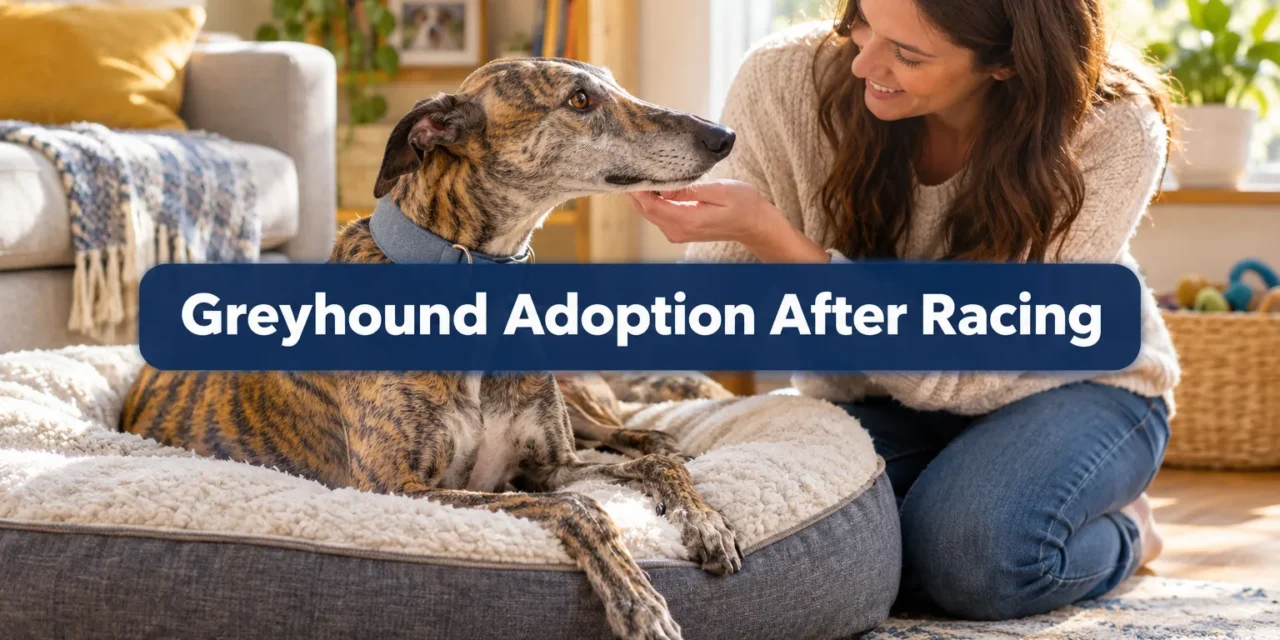
Here’s a number that might surprise you: in the United States alone, thousands of greyhounds leave the racing world every single year and land in pet homes instead [1]. Across the UK, Australia, and New Zealand, the story is the same. More retired racers are becoming couch-loving, tail-wagging family members than ever before [4][6][8].

But here’s the thing nobody tells you at the shelter counter: a racing greyhound isn’t a blank-slate puppy. This dog has lived a very different life. Kennels. Crates. Track routines. No stairs. No glass doors. No cats casually strolling through the living room.
Greyhound adoption after racing: what new owners should expect in the first 90 days comes down to one word, transition. These dogs need time, patience, and a little bit of your detective skills to figure out who they’re becoming at home. Good news? Most greyhounds turn into the calmest, most couch-potato-loving dogs you’ll ever meet. They just need a runway to get there.
This guide walks you through exactly what that runway looks like, day by day, week by week.
Key Takeaways
- 🐾 Greyhounds decompress on a timeline, not a schedule, expect the classic “3-3-3 rule”: 3 days to settle, 3 weeks to learn routine, 3 months to feel truly at home.
- 🏠 House skills won’t exist yet. Stairs, slick floors, glass doors, and potty training in a yard (instead of a pen) are all brand new experiences.
- 🐱 Prey drive is real and breed-typical. Cats, small dogs, and squirrels need careful, supervised introductions, forever, not just for 90 days.
- 📋 Regulated adoption programs now include vet work, paperwork, and support, but private, unregulated rehoming still carries real risks for new owners [7][10].
- 💛 Adoption groups offer follow-up support. Lean on them. They’ve seen it all before.
Before Day 0: How Greyhounds Actually Reach Their New Homes
Adoption didn’t always look this organized. Today, the path from track to couch runs through a much more structured pipeline, and that’s a genuinely good thing for both dogs and new owners.
In the UK, expanded regulated homing schemes now include financial support that helps charities cover vet costs and transport, directly shaping how many dogs successfully make it into pet homes [4]. Similar formal retirement pathways exist in Australia through Greyhound Racing Victoria’s dedicated rehoming programs [6], and New Zealand’s Racing Integrity Board publishes regular ministerial briefings tracking exactly how many greyhounds are rehomed each quarter [5][8].
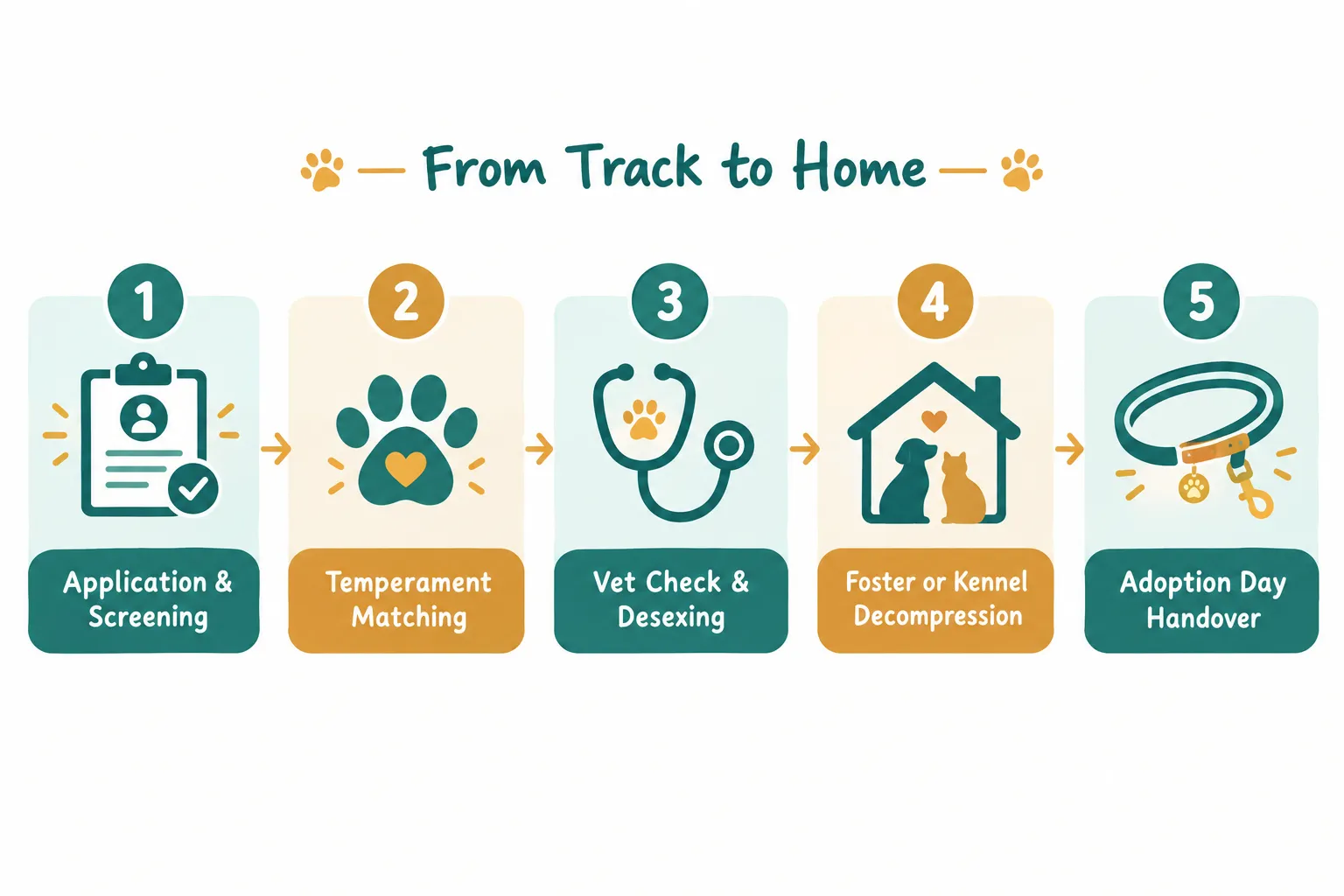
Here’s what the modern application process usually looks like:
- Application form. Expect questions about your home, yard, other pets, work schedule, and experience with dogs.
- Home check or video call. Many groups want to see your space, especially fencing height and flooring type.
- Temperament matching. Staff match personality, energy level, and cat/small-dog tolerance to your household.
- Meet and greet. You’ll usually meet the dog before committing.
- Approval and adoption day. Paperwork, supplies list, and a handover briefing.
This screening step matters more than most new owners realize. It’s the difference between a smooth first 90 days and a stressful mismatch.
Groups also report real variation in how many dogs move through their programs each year, some regional rescues place dozens annually, others place hundreds, depending on local racing activity and funding [2][3]. If you’re on a waitlist, that’s normal. Good matching takes time.
Up-Front Costs and What Vet Work Happens First
Budget talk time. Most reputable adoption programs complete a standard vet workup before the dog ever goes home. This typically includes:
- Spay or neuter surgery
- Dental cleaning (racing kennels aren’t exactly big on brushing)
- Heartworm and parasite testing
- Core vaccinations brought up to date
- Microchipping
- Sometimes: blood panel baseline, since greyhound bloodwork runs differently than other breeds
Adoption fees usually cover most of this work, which is a genuinely great deal compared to paying for it yourself. Still, plan for extra costs in the first few weeks:
| Expense Category | Why It’s Needed |
|---|---|
| Orthopedic dog bed | Greyhounds have almost no body fat, thin skin bruises on hard floors |
| Coat or jacket | Low body fat means they chill fast, even in mild weather |
| Martingale collar | Standard collars slip right off their narrow heads |
| Non-slip rugs | Racing kennels have textured floors; home floors are terrifyingly slippery |
| Calming aids | Helpful during the decompression window |
A quick note on that last one: many new owners find calming supplements or a snug Thunder Shirt genuinely helpful for a nervous dog during the first stressful nights.
Greyhound Adoption After Racing: What New Owners Should Expect in the First 90 Days, Week by Week
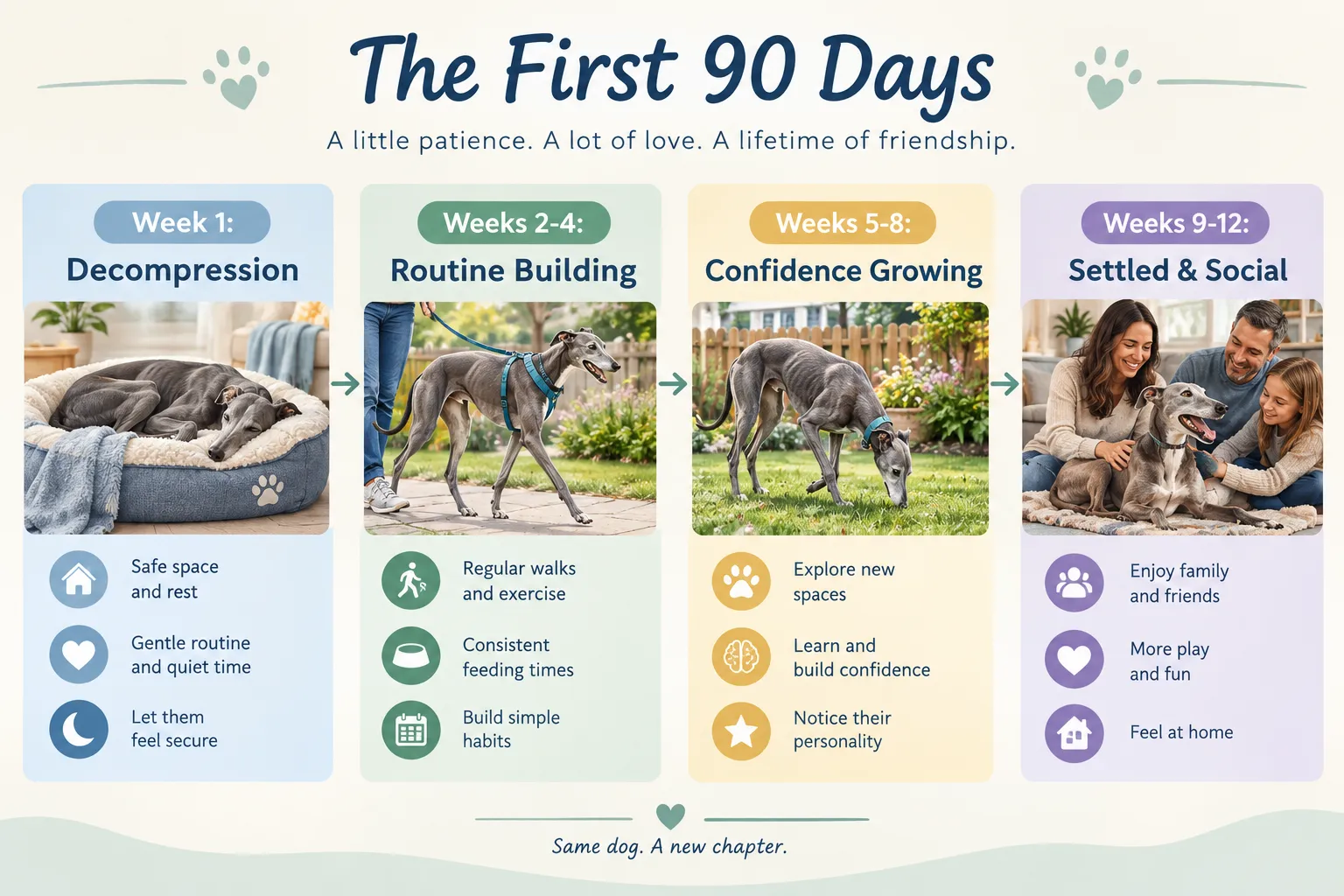
This is the heart of it. Let’s break the first 90 days into four realistic chunks, because expecting instant perfection is a recipe for disappointment, for you and the dog.
Week 1: Survival Mode (The “3-Day Freeze”)
Your new greyhound might barely move for the first day or two. This isn’t sadness. It’s sensory overload. Carpet, stairs, your couch, your other pets, it’s all brand new input.
Expect:
- Minimal eating at first (totally normal)
- Hiding or sticking close to one “safe” room
- Confusion around furniture, mirrors, and glass doors
- Accidents indoors (this dog has never had unrestricted indoor access)
Pull quote: “A quiet, boring first week is a good week. Resist the urge to introduce everyone and everything at once.”
Weeks 2-4: Pattern Recognition
By week two, most greyhounds start figuring out the house rhythm. This is when real dog training basics click into place.
- Leash walking improves (track dogs aren’t used to leash manners on sidewalks)
- Bathroom routine becomes more predictable
- Personality starts showing, goofy, cuddly, independent, or a mix
- Appetite normalizes
Weeks 5-8: Confidence Building
Now the dog starts testing boundaries a little, in a good way. This is growth, not regression.
- More vocal or playful behavior appears
- Prey drive toward squirrels, cats, or small dogs becomes more obvious as confidence grows
- Sleep settles into a predictable pattern (spoiler: it’s a LOT of sleep)
- Stairs and slick floors become manageable, though some dogs avoid stairs forever
Weeks 9-12: Settled and Social
By the 90-day mark, most greyhounds feel like permanent residents of your heart and home.
- Strong bond with primary caregiver
- Predictable daily rhythm
- Comfortable with household guests (with supervision)
- Clear sense of “their” bed, “their” spot on the couch
Here’s a simple snapshot to keep on the fridge:
🐾 The Greyhound 3-3-3 Decompression Guide
3 Days: Dog is overwhelmed, may not eat much, sticks close to one spot.
3 Weeks: Routine clicks. Bathroom schedule, leash walks, and feeding become predictable.
3 Months: True personality emerges. Full trust and bonding established.
Behavior and Decompression: Prey Drive, Stairs, and That Famous Greyhound Calm
Greyhounds are famously couch-loving once settled, but the first 90 days require real management, not just hope.
Prey Drive Is Not a Phase
This one deserves its own warning label. Greyhounds were bred and trained to chase. That instinct doesn’t disappear because the dog retired.
- Keep cats and small dogs separated with barriers at first
- Never let a newly adopted greyhound off-leash in an unfenced area
- Use a long leash in open spaces, never a retractable one
- Muzzle training during intros isn’t cruel, it’s smart management
Stairs, Glass, and Slippery Floors
Many racing greyhounds have never seen a staircase. Go slow:
- Carry small dogs up the first few times if needed, or guide gently with treats
- Block glass doors with decals so the dog doesn’t walk straight into them
- Add rugs or yoga mats on hardwood and tile
Sleep: A LOT of It
Expect 16-18 hours of sleep a day. This isn’t laziness, it’s breed-typical and totally healthy. Give the dog a quiet, draft-free bed away from high foot traffic.
Leash Skills Need Building From Scratch
Track dogs run in straight lines behind a mechanical lure. Casual neighborhood walking, stopping, sniffing, other dogs, traffic, is foreign. Short, calm sessions work best. If leash walking feels overwhelming at first, these thoughts every dog owner has during a walk might sound familiar sooner than expected.
Because greyhounds are a large breed with unique joint needs, following solid large breed training guidance (gentle, positive, low-impact) sets them up for long-term success.
Daily Care Expectations in the Early Weeks
Beyond behavior, daily logistics matter a lot in those first weeks.
Toileting
Racing kennels use turnout pens, not yards with grass and fences. Teach the concept of “this specific spot, this specific door” patiently and consistently. Reward every single success.
Weather Sensitivity
Low body fat means greyhounds run cold and overheat easily in direct sun. Short walks in extreme weather, a jacket for winter, and shade access in summer are non-negotiable basics.
Feeding Routine
Racing diets are performance-focused. Transition slowly to a balanced large breed dog food over 7-10 days to avoid stomach upset. Two smaller meals a day tend to work better than one large one for this deep-chested breed.
Mental Stimulation
Boredom plus a dog built for speed equals trouble. Low-impact enrichment games that actually work and a consistent enrichment routine help channel that brain power somewhere productive.
Legal Paperwork and Regulatory Obligations New Owners Must Manage
This part feels unglamorous, but it protects both the dog and the owner. When adopting through a regulated program, expect to receive:
- Microchip registration transfer documents
- Vaccination and vet history records
- Spay/neuter certification
- Adoption contract outlining return policies and ongoing responsibilities
- Local licensing requirements (varies by state, county, or council)
Regulated bodies like GBGB in the UK now publish detailed welfare strategy reports showing how rehoming paperwork and post-adoption standards are being tightened industry-wide [4]. Similar oversight structures exist in Australia and New Zealand, with government bodies issuing regular public briefings on retirement and rehoming outcomes [5][6][8].
Bottom line: keep every document. If a dispute, health issue, or re-homing situation ever arises, this paperwork is your proof of legitimate adoption.
Support and Follow-Up During the Adjustment Period
The best adoption groups don’t just hand over a leash and disappear. Reputable rescues typically offer:
- A post-adoption care guide covering decompression basics
- A dedicated contact for behavior questions
- Scheduled check-in calls at 1 week, 1 month, and 3 months
- A trial or foster-to-adopt period in some programs
Don’t be shy about using this support. Adoption counselors have rehomed hundreds of dogs. They’ve seen the weird quirks, the 3 a.m. zoomies, and the dramatic “I refuse to walk on this tile” standoffs before. You are not bothering them, this is literally their job, and most of them are obsessed with making it work.
The Persistent Risks of Unregulated Private Rehoming
Not every retired greyhound reaches a home through a formal program. Private, informal rehoming still happens, sometimes directly from trainers or owners outside of registered charities. This carries real risks that organizations like the Greyhound Adoption Action Alliance actively work to address [10], and recent rehoming review data highlights ongoing gaps in oversight and outcome tracking across informal placements [7].
Before accepting a privately rehomed greyhound, check for:
- ✅ Proof of vaccination and vet history
- ✅ Microchip registration in the dog’s actual name/details
- ✅ Any known health issues (racing injuries are common, ask directly)
- ✅ Behavioral history, especially around small animals
- ✅ A written agreement, even a simple one
Skipping these checks can leave new owners facing unexpected vet bills, legal ownership confusion, or a dog with untreated injuries from its racing career.
What’s Next: 2026-2028 and the Shift Toward Formal Adoption
The trend line is clear. Regulatory bodies across the UK, Australia, and New Zealand are pushing toward more formalized, well-documented adoption pipelines, with increased scrutiny on private rehoming practices expected through 2028 [4][5][6][7][8][10]. For prospective adopters, this is genuinely good news, expect:
- More standardized vet work before adoption
- Clearer paperwork trails
- Greater financial support for rescue groups, reducing adoption fees over time
- Stronger post-adoption follow-up requirements
Translation: adopting a retired greyhound is about to get even safer, smoother, and better supported than it already is [9].
Conclusion: Your Next 90 Days, Made Simple
Bringing home a retired racer is one of the most rewarding things a dog lover can do. These dogs go from kennel life to couch royalty faster than almost any breed out there, they just need you to guide them through the “firsts.”
Quick action checklist to keep this smooth:
- 📋 Adopt through a regulated, reputable program whenever possible
- 🛏️ Set up a quiet decompression space before day one
- 🐱 Introduce other pets slowly, with barriers and supervision
- 🚪 Block glass doors and add traction on slippery floors
- 📞 Keep your adoption group’s contact info handy for support
- 🗂️ File every piece of paperwork somewhere safe
Give it 90 days. By then, that quiet, confused dog from day one will be the goofy, couch-hogging, tail-wagging best friend bragging rights were made for. 🐾
References
[1] 2025 Gf Annual Report 04 26 – https://greyhound.org/wp-content/uploads/2026/05/2025-GF-Annual-Report-04-26.pdf [2] Annual Adoptions – https://galtx.org/annual-adoptions/ [3] Adoptions – https://foreverhomegreyhound.com/adoptions/ [4] Gbgb Publishes Upbeat Report On Welfare Strategy Aejbz4g5hjma – https://www.racingpost.com/greyhounds/gbgb-publishes-upbeat-report-on-welfare-strategy-aEJbZ4G5HJma/ [5] 202602 Rib Quarter 2 Ministerial Briefing Greyhound Review – https://racingintegrityboard.org.nz/wp-content/uploads/2026/03/202602-RIB-QUARTER-2-MINISTERIAL-BRIEFING-Greyhound-Review.pdf [6] Retirement From Racing – https://greyhoundcare.grv.org.au/retirement-from-racing/ [7] Rehoming Review Fy25 – https://greyhoundcoalition.com/report/rehoming-review-fy25/ [8] 202508 Rib Quarter 4 Ministerial Briefing Greyhound Review Final – https://racingintegrityboard.org.nz/wp-content/uploads/2025/09/202508-RIB-QUARTER-4-MINISTERIAL-BRIEFING-Greyhound-Review-FINAL.pdf [9] Adopting A Retired Greyhound In The Us Care Guide – https://www.trustmypets.com/en-us/adopting-a-retired-greyhound-in-the-us-care-guide [10] greyhoundadoptionactionalliance – https://www.greyhoundadoptionactionalliance.org/