Dogs do not ask for much. They do not care about your job title or your bank account. But a shocking number of dogs are missing something they truly need from the humans who love them most. Real love for a dog is not just treats and belly rubs. It is a daily job. This guide breaks down the 5 Acts of Love Your Dog Needs From You for Life, so your furry family member can live its best, happiest life, starting today.

These are not fluffy ideas. They are backed by how dogs actually think, feel, and bond. Let’s dig in.
1. Protect Their Body, Every Single Day
Love starts with the basics. Food, water, rest, and medical care are not boring chores. They are the foundation of every tail wag your dog gives you. A dog that is hungry, thirsty, sick, or exhausted cannot feel safe. And a dog that does not feel safe cannot feel loved, no matter how many pets you give it.

Think about what this looks like in real life. Fresh water needs to be available all day, not just when you remember. Meals should be consistent in timing and amount, matched to your dog’s size, age, and activity level [3]. Skipping vet checkups to save money might feel harmless, but small problems like dental pain or thyroid issues can quietly steal your dog’s quality of life for months before you notice anything is wrong [7][10].
Sleep matters just as much as food. Dogs need long stretches of uninterrupted rest to recover their bodies and minds. A dog that is constantly woken up by noise, kids, or a chaotic house can become cranky or anxious, even if it is getting enough hours total. Giving your dog a quiet, comfortable place to sleep is one of the simplest acts of love you can offer, and it costs almost nothing. This is the groundwork. Everything else on this list is built on top of it.
2. Build a Safe, Predictable Home and Guide With Respect
Dogs are creatures of habit. A home that feels unpredictable, loud, or scary is a home that keeps a dog on edge. Your dog needs to know its crate is a safe zone, its food bowl shows up at roughly the same time, and its humans are not going to suddenly yell or grab it out of nowhere [6][8]. Predictability is not boring to a dog. It is peace of mind.
This safety extends to how you teach and correct your dog. Old-school training leaned hard on fear and punishment. We know better now. Clear, fair communication works far better than scaring a dog into obedience [5]. If your dog jumps on guests, yelling or yanking the leash might stop the behavior for a minute, but it teaches your dog that you are unpredictable too. Instead, reward the calm behavior you want to see. Redirect before things go wrong. Stay consistent with your rules so your dog is not guessing what gets praise one day and punishment the next.
A real example: if your dog is scared of the vacuum, the loving move is not to force it to “get over it.” Let your dog retreat to another room. Pair the vacuum sound with treats over time. This builds trust instead of fear. A dog that trusts its home and its person is a dog that can relax, play, and truly be itself. That trust does not happen by accident. You build it one calm, predictable moment at a time.
3. Be Their Person, Through Thick and Thin
Here is something that might surprise you. Dogs can offer more emotional support to people than other humans sometimes do, according to recent research [2]. That bond goes both directions. Your dog needs you to be its steady, secure attachment figure too, the one being it can always count on.
This means real togetherness, not just sharing a house. Dogs read your comings and goings closely. A calm, warm reunion after you have been away, rather than big dramatic greetings or being ignored, helps your dog feel emotionally secure over time [1][9]. If you walk in the door and immediately scold your dog for barking, you are teaching it that your return is something to fear, not celebrate.
Isolation is the quiet enemy here. A dog left alone for long stretches, without being included in family life, can become anxious, bored, or withdrawn [1]. Picture a dog that spends all day in a backyard and all evening in a separate room while the family watches TV. That dog is fed and safe, but it is not loved in the way it needs. Bring your dog into the living room. Let it nap near your feet while you work. Talk to it. Include it in your daily rhythm. This consistent presence is what turns a pet into a true member of the family, and it is one of the most powerful acts of love you can give.
4. Move Their Body and Let Them Be a Dog
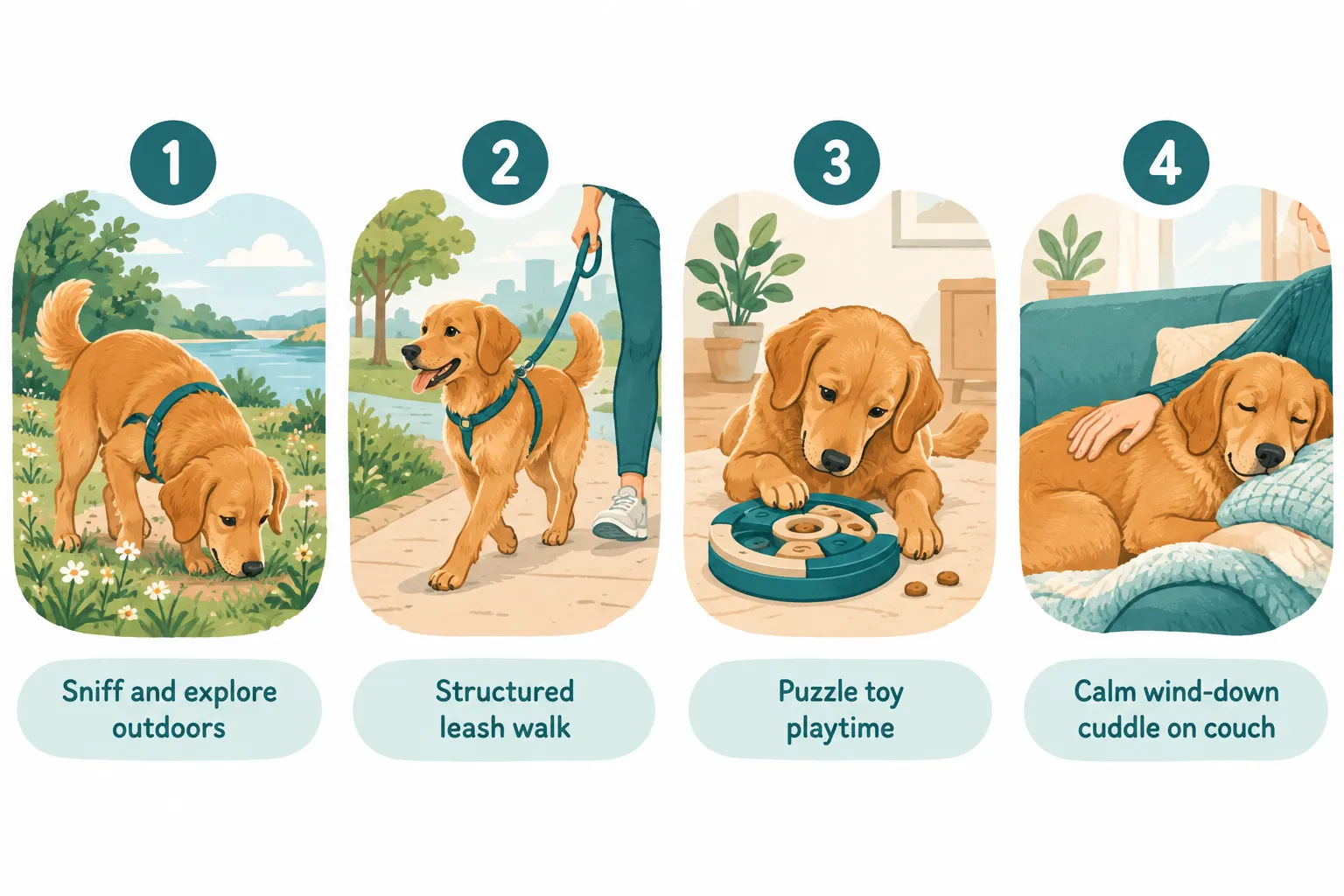
Exercise is not optional, and it is not one-size-fits-all. A senior Chihuahua and a young Border Collie have wildly different needs. Matching movement to your dog’s age, breed, and health keeps both its body and its brain in good shape [6][8]. A bored, under-exercised dog does not just get chubby. It can become destructive, anxious, or withdrawn.
But movement alone is not the whole story. Dogs need to be dogs. That means sniffing on walks instead of being rushed along. It means digging, chewing, chasing, and exploring, the natural behaviors that make a dog feel fulfilled [7]. A daily walk around the same block at the same pace might tire your dog’s legs, but it does little for its mind.
Try this instead. Let your dog sniff for a full five minutes before you quicken the pace. Add a puzzle feeder at mealtime so your dog has to work a little for its food. Rotate toys so nothing gets boring. Give your dog a safe spot in the yard to dig if digging is its thing. These small changes respect what your dog actually is, not just what is convenient for your schedule. A dog that gets to be a dog, fully and joyfully, is a dog living a genuinely good life.
5. Commit for Life and Keep Learning Their Language
Love is not a one-time decision. It is a promise that stretches across your dog’s entire life, through puppy chaos, adult routine, and the slower, gentler years of being a senior. Needs change as dogs age. A joint supplement that seemed unnecessary at age two might become essential at age ten. Planning ahead for these shifts, rather than scrambling when problems appear, is a quiet but powerful act of love [9].
Part of this lifelong commitment is simply understanding your dog better over time. Most people think they know what their dog is feeling, but body language is often misread [4]. A wagging tail does not always mean happy. A dog that is “smiling” might actually be stressed. Learning to read ears, posture, tail position, and vocal cues helps you respond to what your dog truly needs, not what you assume it needs.
Imagine your dog starts avoiding the stairs. It would be easy to assume laziness. But this could be early arthritis pain. A dog parent who is paying attention catches this early and gets ahead of it. Staying curious about your dog’s signals, and staying committed through every life stage, is the thread that ties all the other acts of love together. It is love that does not expire when things get harder or less convenient.
Conclusion
Loving a dog well is not complicated, but it does take effort. Protecting their body, building a safe home, staying emotionally present, keeping them active and enriched, and committing for their whole life are not separate tasks. They work together every single day. Start small. Pick one act from this list you could do a little better this week, and build from there. Your dog will notice, even if it cannot say thank you in words.
References
[1] File – https://journals.plos.org/plosone/article/file?id=10.1371/journal.pone.0314893&type=printable [2] Dogs Offer More Emotional Support Than Most People Study Finds – https://www.news-medical.net/news/20250422/Dogs-offer-more-emotional-support-than-most-people-study-finds.aspx [3] Responsible Pet Ownership – https://www.petsafe.com/blog/responsible-pet-ownership/ [4] How Well Do You Understand Your Pet – https://www.nytimes.com/2025/03/21/learning/how-well-do-you-understand-your-pet.html [5] dogbehavior.it – https://dogbehavior.it/dogbehavior/article/download/212/170 [6] Dogs And Their Needs – https://www.four-paws.org/our-stories/publications-guides/dogs-and-their-needs [7] Complete Dog Care Guide – https://worldanimalrescuenetwork.org/newsroom/complete-dog-care-guide/ [8] Dog Hierarchy Of Needs – https://www.hillspet.com.au/pet-care/resources/dog-hierarchy-of-needs [9] pubmed.ncbi.nlm.nih.gov – https://pubmed.ncbi.nlm.nih.gov/41086231/?fc=20250428013201&ff=20251015034226&v=2.18.0.post9+e462414 [10] The Basic Needs Of A Dog What Do You Know About Them And How Can You Meet Them – https://vetexpert.com/dog/the-basic-needs-of-a-dog-what-do-you-know-about-them-and-how-can-you-meet-them/
dog care, dog love, responsible pet ownership, dog behavior, dog enrichment, dog exercise, puppy to senior care, dog body language, pet bonding, dog training tips, dog wellness, furry family member