Here’s a number that should stop every dog parent in their tracks: 71% of owners called “whale eye” cute or curious, when it’s actually a stress signal. Another 58% thought lip-licking during a hug meant their dog was hungry. It doesn’t. And 52% read a fast, low tail wag as happy, when it often means the opposite.[7] These are not small mix-ups. They’re the kind of misread signals that can lead to a bite, a scared pup, or a missed chance to help a dog in distress. This article breaks down 5 strange dog behaviours you’re reading wrong, and shows what’s really going on underneath that fur.

Dogs can’t talk. But they are talking, all the time, with their bodies. Owners just need the right translation guide. Let’s get into it.
1. The Belly-Up Flop Isn’t Always a Belly Rub Request
Most dog parents see a dog roll onto its back and think one thing: rub my tummy. Sometimes that’s exactly right. But sometimes that same flop is a dog saying, “please don’t hurt me.”
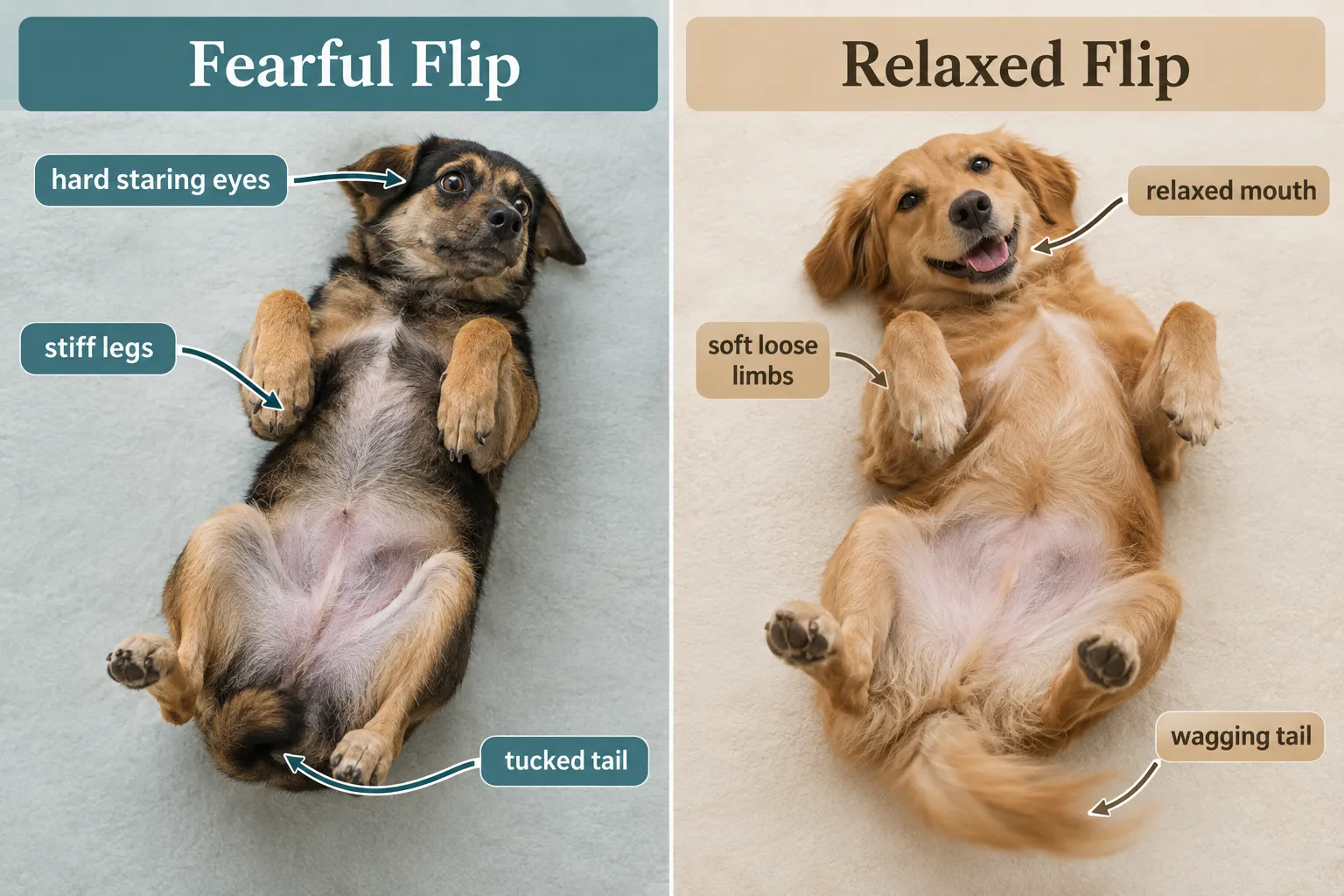
The difference is in the details. A happy, relaxed belly-up dog has loose limbs. Its mouth is soft and open. Its tail might even wag against the floor. A scared or submissive dog looks different. Its body is stiff. Its eyes are hard or wide. Its tail may be tucked tight between its legs. This dog isn’t inviting a belly rub. It’s trying to end a tense moment, often with another dog or a person it feels unsure about.[5]
Here’s where it gets tricky. Nearly half of dog owners surveyed read a fearful, belly-up dog as “relaxed and affectionate.”[7][5] That mix-up matters most around kids and strangers. A child who reaches for a scared dog’s tummy might get a nip, not because the dog is “bad,” but because the signal got crossed.
The fix is simple. Before reaching in, check the whole dog. Loose body, soft face, wiggly tail base? Go ahead and rub that belly. Stiff body, wide eyes, tucked tail? Give that dog space and let it come back to neutral on its own terms.
2. A Wagging Tail Doesn’t Always Mean “Happy”
This one surprises almost everyone. A wagging tail is not a universal happy sign. It’s an emotion dial. It shows a dog is feeling something strongly. That something could be joy. It could also be fear, frustration, or even a warning before a bite.[2]
Think about tail height, speed, and stiffness. A loose, wide wag at medium height, often called a “helicopter tail,” usually means true joy. A tail held high and stiff, moving fast in short twitches, often signals tension or arousal that could turn into aggression. A low, fast wag can mean a nervous, unsure dog, not a happy one.[2]
This is exactly why 52% of owners in one survey called a low, fast tail wag toward another dog “happy,” when trainers would call it a stress signal.[7] Picture two dogs meeting at the park. One dog’s tail is low and wagging fast, body hunched slightly forward. An owner nearby says, “Aw, they like each other!” But that dog might be bracing for a fight, not making a friend.
The smart move is to watch the whole tail story, not just the fact that it’s moving. Height, speed, and stiffness together tell the real tale. When in doubt, watch the rest of the body too. A soft, relaxed face paired with a loose wag is a good sign. A stiff body paired with any tail motion means it’s time to step back and give that dog room to breathe.
3. The Hug They Seem to “Love” Might Feel Like a Trap
Dog parents love hugging their dogs. It feels natural. It feels like love. But to a dog, a hug can feel like being pinned down.
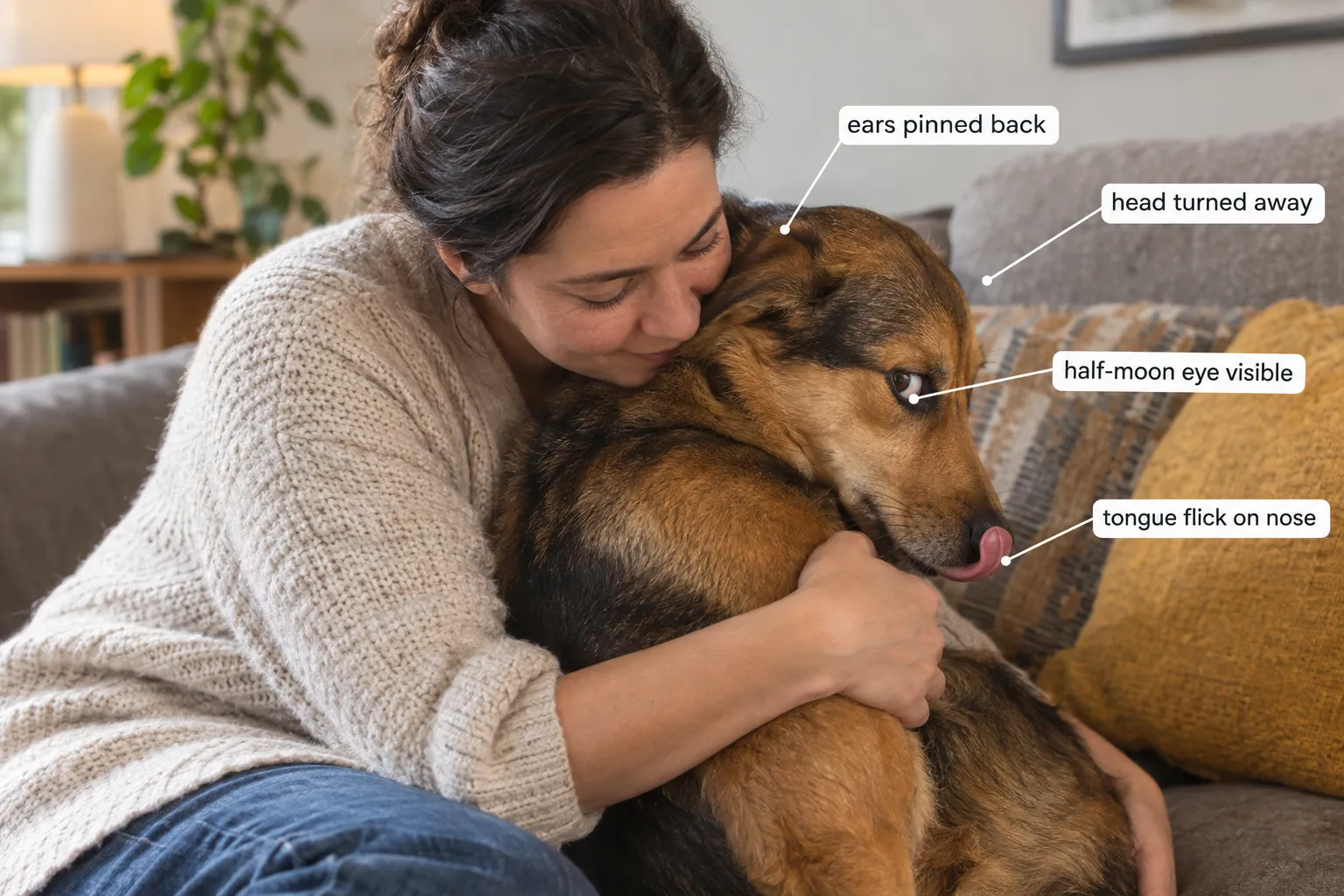
One video-based study looked closely at dogs being hugged by their owners. The results were eye-opening. In 68% of clips, the dog turned its head away. In 81% of clips, the dog blinked rapidly. Ear flattening showed up 60% of the time. And in 67.5% of the clips, the dog actually attempted to bite the person hugging it. Despite all that, observers still called most of these moments “positive.”[6]
That mismatch is the whole problem. A head turn, a lip lick, a quick blink, pinned-back ears. None of these look dramatic. They don’t look like growling or snapping. So people miss them. These are called distance-increasing signals. The dog is politely asking for space, long before it would ever need to growl or snap to get that message across.[2][5]
This doesn’t mean hugs are always bad. Some dogs, especially ones raised with lots of gentle handling, do tolerate or even enjoy them. The real fix is to watch the dog’s face during the hug, not just assume comfort because the dog isn’t struggling hard. A dog that goes stiff, turns its head, or licks its lips during a hug is asking to be let go. Listening to that request builds more trust than any hug ever could.
4. The Zoomies Aren’t a Sign Something Is Wrong
Every dog parent has seen it. The dog suddenly bolts across the yard, spins in tight circles, bounces off the couch, and tears around the living room like it lost its mind. New owners often panic. Is my dog having a meltdown? Is something wrong?
Relax. This burst of wild energy, often called “zoomies,” is completely normal.[5] It’s the dog’s way of letting off steam. Maybe it’s been cooped up too long. Maybe it just finished a stressful vet visit or a bath. Maybe it’s simply thrilled that its favorite human just walked in the door. Either way, zoomies are a release valve, not a red flag.
Picture a dog coming home from the groomer. It races around the backyard in tight loops for thirty seconds, then flops down panting happily. That’s not distress. That’s a dog shaking off a weird, slightly uncomfortable experience the fastest way it knows how.
There is one caveat worth knowing. If zoomies happen constantly, every single day, paired with other signs like pacing, panting at rest, or trouble settling down, that pattern might point to an energy or anxiety issue worth mentioning to a vet.[5] But the occasional post-bath or post-nap zoomie session? That’s just a dog being a dog. Give it space, let it run, and enjoy the show.
5. Growling and Raised Hackles Aren’t Automatic Danger Signs
Growling gets a bad reputation. Many owners hear it and think “aggressive dog.” Some even punish the growl to make it stop. That’s a mistake with real consequences.
Growling is communication, not a character flaw. Dogs growl during play. Dogs growl as a polite warning when they’re uncomfortable. Dogs growl to say “that’s enough” before things escalate further.[1] Punishing a growl doesn’t fix the underlying feeling. It just teaches the dog to skip the warning next time and go straight to a snap or bite.[1]
Raised hackles work the same way. That ridge of fur standing up along the spine, known as piloerection, simply means a dog’s body is highly aroused. That arousal could be excited and playful, like a dog bursting with energy at the dog park. Or it could be fearful and defensive.[2] Hackles alone don’t spell out which one it is. The rest of the body, loose and bouncy versus stiff and frozen, fills in the real story.
Here’s a useful comparison: a dog with raised hackles, a loose wiggly body, and a play bow is likely just thrilled to meet a new friend. A dog with raised hackles, a stiff frozen stance, and a low growl is asking for space, right now. Confusing “vicious” with “aroused” leads to bad handling choices, like forcing an interaction that should have been avoided.[2][8] The safest approach is to treat every growl as useful information, not bad behavior to shut down.
A Quick Word on Why These Mix-Ups Happen
Part of the problem is language. Words like “dominant,” “stubborn,” “jealous,” and “protective” get used constantly, but they mean different things to different people. That fuzzy vocabulary makes it easy to misjudge what a dog is actually feeling.[3]
Another part of the problem is focus. Most people lock onto a dog’s face and ignore the rest of the body. But tail carriage, weight shift, and overall body tension carry just as much meaning as a facial expression, sometimes more.[4] Kids are especially prone to this. One study found many children described snarling, teeth-baring dogs as “smiling” and said they’d happily cuddle them.[10] That gap between what a dog is showing and what a child sees is exactly why adults need to be the translators in the room.
Conclusion
Dogs are constantly sending messages with their whole bodies, not just their faces. A flopped belly, a wagging tail, a hug, a zoomie session, a growl. Each one tells a different story depending on the details around it. The real skill isn’t memorizing one meaning per behavior. It’s learning to read the whole dog, every time, before jumping to conclusions. Start small: next time the tail wags or the growl happens, pause and check the whole body first. That one habit can prevent a lot of misunderstandings, and build a whole lot more trust between dog and human.
References
[1] dovepress – https://www.dovepress.com/article/download/20621 [2] How To Read Dog Body Language – https://www.akc.org/expert-advice/training/how-to-read-dog-body-language/ [3] Pmc10571880 – https://pmc.ncbi.nlm.nih.gov/articles/PMC10571880/ [4] 472c814de29edf428abb6c6669485499af92 – https://pdfs.semanticscholar.org/a82b/472c814de29edf428abb6c6669485499af92.pdf [5] Is Your Dog Happy Ten Common Misconceptions About Dog Behaviour 97541 – https://theconversation.com/is-your-dog-happy-ten-common-misconceptions-about-dog-behaviour-97541 [6] S0168159124000546 – https://www.sciencedirect.com/science/article/abs/pii/S0168159124000546 [7] Dog Body Language Study 1000 Owners – https://dogly.accelar.io/blog/dog-body-language-study-1000-owners [8] How To Handle Aggressive Dog Safety Tips – https://www.latimes.com/companion-animals/dogs/care/story/how-to-handle-aggressive-dog-safety-tips [9] 08927936.2025 – https://www.tandfonline.com/doi/pdf/10.1080/08927936.2025.2551434 [10] 08927936.2025 – https://www.tandfonline.com/doi/full/10.1080/08927936.2025.2551434
dog behavior, dog body language, tail wagging, dog stress signals, canine communication, zoomies, dog growling, dog training tips, pet safety, dog hugging, whale eye, dog ownership