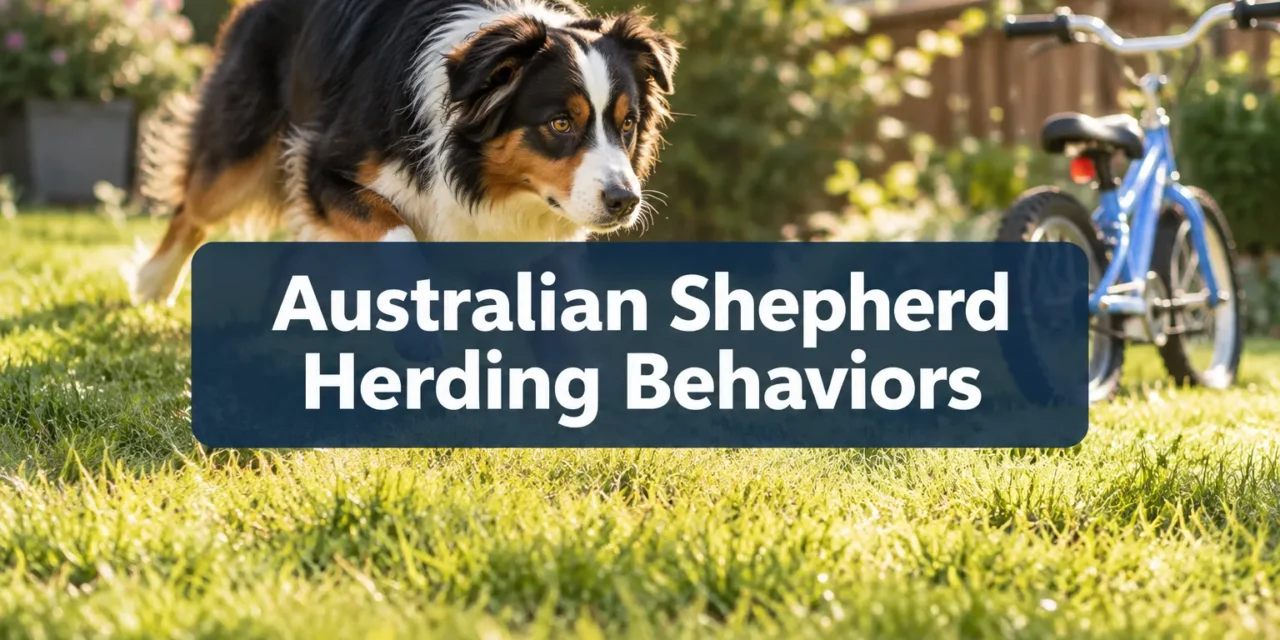
Here’s a number that surprises new Aussie owners: these dogs were bred for generations to control the movement of 2,000-pound cattle. Your toddler running across the living room? That’s a much easier target. Australian Shepherd herding behaviors at home, nipping, chasing, and safe redirection, aren’t bad manners. They’re a 150-year-old job description showing up on your kitchen floor.

This isn’t a dog being naughty. It’s a dog being exactly what breeders built. The good news? You don’t have to choose between a happy working dog and a safe household. You just need a plan.
Let’s build one together.
Key Takeaways
- Herding isn’t aggression. Nipping, staring, and chasing are inherited motor patterns, not random misbehavior.[2][3]
- Nipping at kids is a safety issue, not just a quirk. Close supervision around children is non-negotiable.[2]
- Interrupt, don’t yank. Freezing calmly works better than snatching your foot away mid-nip.[5][7]
- Give the drive a legal job. Flirt poles, structured fetch, and herding lessons satisfy the urge safely.[1][5][8]
- Watch the body language early. Intense staring and a lowered stance come before the chase, catch it there.[6][10]
Why Australian Shepherds Herd Family Members at Home
Aussies didn’t get their smarts and drive from nowhere. They were built to read movement, anticipate direction, and physically steer animals that outweighed them ten times over. That genetic wiring doesn’t clock out just because there’s no cattle in the backyard.
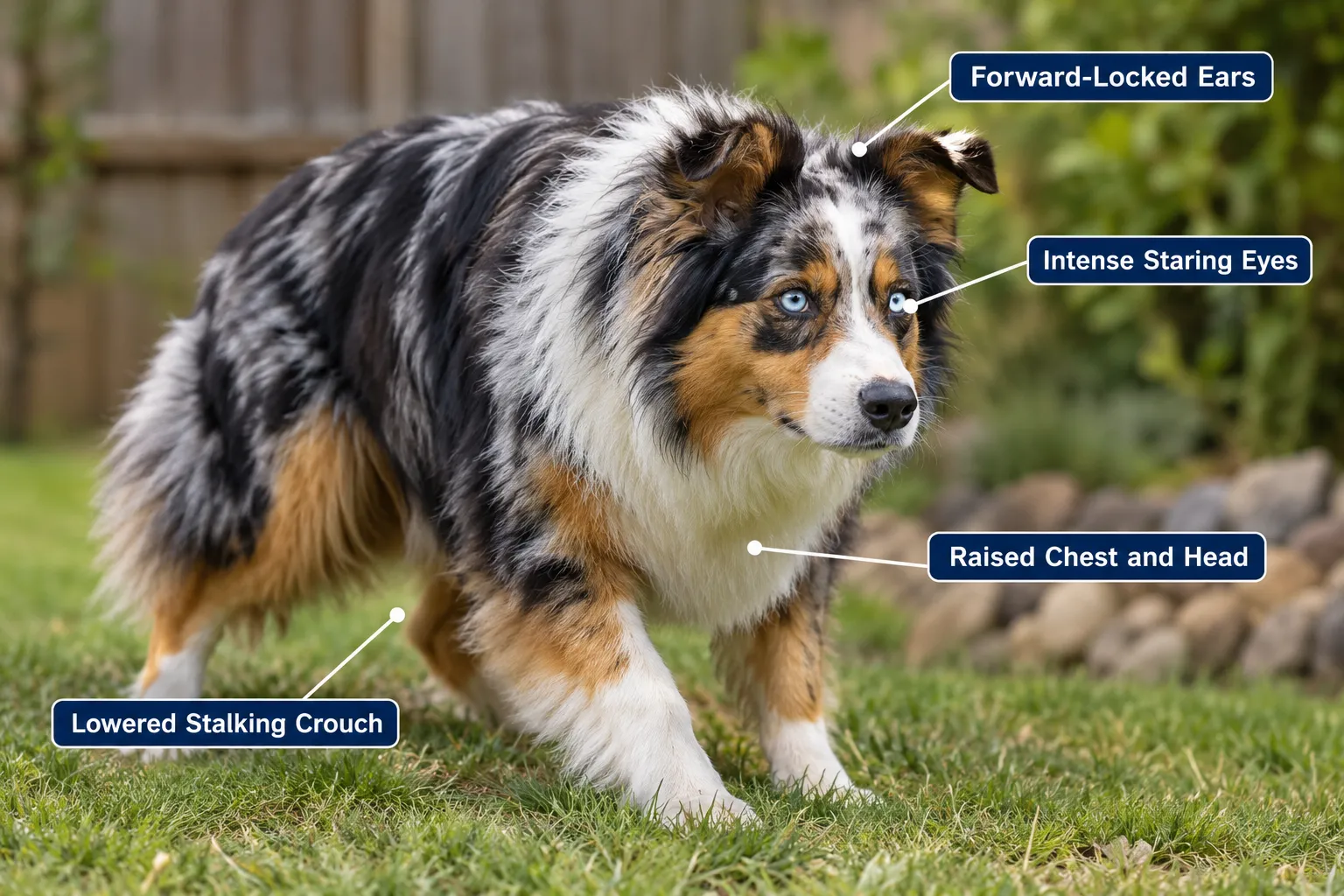
So what happens instead? Your kids become the flock. Your cat becomes a stray sheep. The mail carrier’s bike becomes a runaway steer. Australian Shepherd herding behaviors at home show up as staring, stalking, circling, blocking, chasing, and that classic heel-nip, all aimed at controlling movement, not causing harm.[2][3][10]
Here’s the part owners miss: this isn’t optional enthusiasm. It’s closer to a reflex. A fast-moving kid, a sprinting dog, a bike whizzing by, these trigger the same ancient circuitry that once moved livestock through a gate. The dog isn’t choosing to be difficult. The dog is doing its job on the wrong “flock.”
What this looks like day-to-day:
- Nipping at ankles or heels during play
- Chasing children, joggers, bikes, or skateboards
- Intense, locked-in staring at moving targets
- Circling behind people to “block” their path
- Herding smaller pets like cats or small dogs
- Barking or lunging at passing cars from a fence line
Knowing this isn’t “bad dog” behavior changes everything about how you respond. You’re not correcting a brat. You’re redirecting an athlete.
If your Aussie came from working lines, this drive can be even sharper. For a broader look at what makes this breed tick, check out our Australian Shepherd coverage.
Reading the Warning Signs Before the Nip
“The chase doesn’t start with the bite. It starts with the stare.”
Every herding sequence follows a pattern: eye, stalk, chase, nip, grip. If you only act at the nip stage, you’re already three steps behind. Catch the dog at “eye” or “stalk,” and you can redirect before anyone’s ankles get involved.
Watch for this body language:
| Signal | What It Means | Your Move |
|---|---|---|
| Hard, fixed stare at a moving target | “Eye” stage, dog is locking on | Call name, break eye contact |
| Lowered head, stiff crouch | “Stalk” stage, about to move | Cue a sit or recall |
| Raised chest, forward ears, tense body | Arousal building | Redirect to a toy or task |
| Sudden sprinting toward a person/animal | “Chase” stage | Use recall cue immediately |
| Mouth opening near heels or ankles | “Nip” stage | Freeze, don’t flee |
Learning to spot these cues takes practice, but it’s worth it. Our guide to reading your dog’s body language breaks down these subtle signals in more depth, and it pairs perfectly with herding-specific cues.
One more thing: a true herding nip is usually light, quick, and aimed at feet or heels. It’s different from defensive biting. If you see stiff posture, hard staring, growling, freezing, or an actual snap with pressure behind it, especially paired with fear, that’s not herding anymore. That’s a behavior concern that needs a professional set of eyes.[7][9][10]
The Real Difference Between Herding Nips and Problem Biting
This distinction matters more than almost anything else in this article. Get it wrong, and you’ll either punish a normal dog for normal behavior or ignore a real warning sign.
Typical herding nip:
- Light pressure, rarely breaks skin
- Aimed at heels, ankles, or clothing
- Happens during fast movement (running, biking, playing)
- Dog’s body is loose, excited, “bouncy”
- Stops or softens when the person stops moving
Potential problem bite:
- Breaks skin or leaves deep marks
- Targeted at children repeatedly despite correction
- Paired with stiff body, hard stare, growling, or snapping
- Happens even when the person is standing still
- Dog seems anxious, fearful, or defensive rather than excited
Nipping that breaks skin, targets kids specifically, or shows up alongside growling and freezing needs an honest conversation with a vet behaviorist or certified trainer, not a wait-and-see approach.[7][9][10]
If you have young children at home, supervision isn’t a suggestion, it’s the foundation of safety. Veterinary and breed guides are consistent on this point: Aussies need close monitoring around kids because herding instincts can look a lot like nipping or attempts to physically control a child’s movement.[2] If you’re weighing whether an Aussie fits your family at all, it’s worth comparing notes with our breakdown of dog breeds not good with kids, Aussies aren’t on that list, but understanding the spectrum helps set realistic expectations.
Safe Redirection Techniques That Actually Work
Here’s the mindset shift that changes everything: you’re not trying to shut the herding instinct off. You’re trying to give it somewhere better to go.
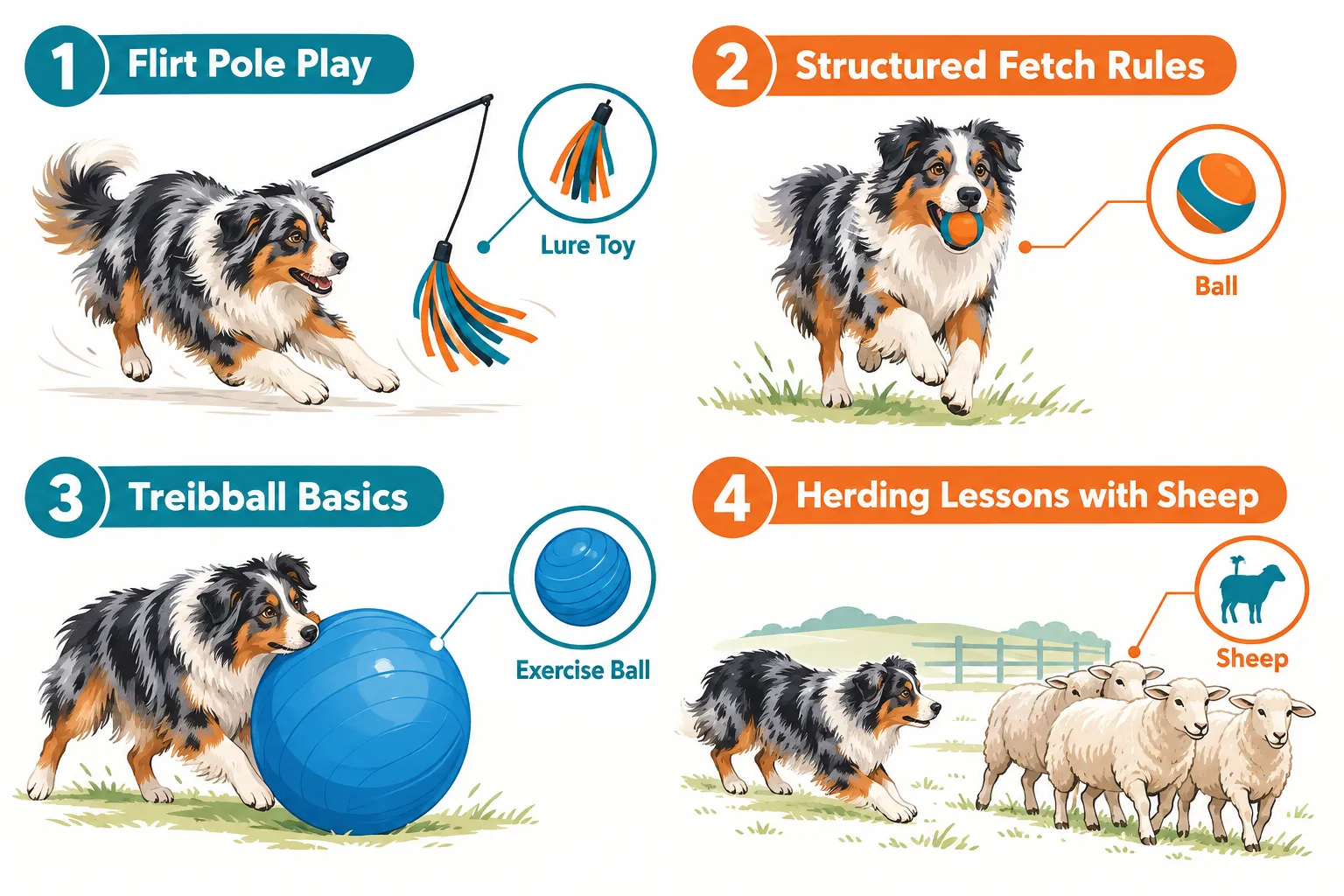
Suppressing the drive completely often backfires, bored, under-stimulated Aussies get more intense about chasing family members, not less. Instead, structured redirection teaches the dog when and where herding is welcome.[1][2][7][9]
Step 1: Interrupt Before the Nip
When your Aussie locks onto a moving target, don’t wait for contact.
- Use a cheerful, upbeat recall cue the second you spot “the stare”
- Try a verbal interrupt like “that’s enough” or “that’ll do”, said calmly, before the chase launches[1][2][7][9]
- Follow every successful interrupt with a reward: treat, toy, or praise
Step 2: Freeze, Don’t Flee
This one’s counterintuitive but crucial. If a nip happens, don’t yank your foot or leg away. Fast movement feeds the chase drive even more.
- Stop moving completely
- Stay calm and quiet
- Once the dog releases, calmly swap your foot or ankle for a toy or chew
Sudden jerking movements signal “prey is escaping” to a herding brain. Stillness signals “nothing to chase here.”[5][7][9]
Step 3: Redirect to a Trained Cue
Build a toolbox of go-to commands that pull focus off the moving target:
- “Go to your mat”, sends the dog to a designated spot
- Hand target, dog touches your palm with its nose, breaking eye contact with the trigger
- Trained recall, a rock-solid “come” that beats any squirrel, bike, or toddler
- Sit-stay, especially useful at doorways or gates
Practice these cues during calm moments first. Then test them with mild distractions before expecting them to work during a full-blown chase scenario.[1][2][7][9]
Step 4: Give the Drive a Legal Outlet
This is the step most owners skip, and it’s the one that makes the biggest difference long-term.
- Flirt poles let your dog stalk, chase, and “catch” a lure safely
- Structured fetch with rules (sit before throw, drop on cue) channels chase energy
- Treibball (herding a large exercise ball into a goal) scratches the itch indoors
- Formal herding lessons or agility classes give serious working-line dogs a real outlet
Trainers increasingly recommend these as non-negotiable parts of an Aussie’s weekly routine, not occasional treats.[1][5][8]
Step 5: Reward the Calm Moments
Every time your dog sees a running kid or a passing bike and doesn’t chase, that’s worth celebrating.
- Praise “four-on-the-floor” calmness around movement
- Reward loose body language near triggers
- Use food scatters or scent games to build impulse control in distracting environments[7][8][9]
This step is easy to forget because calm behavior doesn’t demand attention. Make it demand yours anyway.
Managing Triggers in Your Home and Yard
Training works best when you’re not constantly fighting an environment stacked against you. Smart management removes temptation before it becomes a habit.
Inside the house:
- Use baby gates to separate your Aussie from chaotic kid play when things get loud and fast
- Keep a drag line or house leash on during high-energy moments so you can calmly intervene
- Tether your dog near an adult during rowdy children’s games rather than letting it free-roam the action[1][5][7]
In the yard:
- Secure fencing prevents fence-running at joggers, cyclists, or cars, every repetition of that chase makes it stronger
- Avoid leaving your dog unsupervised where it can rehearse chasing passing traffic
- Controlled doorways and gates stop “blocking” behavior from escalating into confrontations[2][3]
On walks and outings:
- A front-clip harness or long line gives you better control near bikes and runners
- Cross the street or create distance before your dog fully locks onto a trigger
- Practice your interrupt cue on calm walks so it’s reliable before you need it near real distractions[1][2][6][7]
The theme across all of this: every uninterrupted chase is practice. Every redirected chase is progress. Management buys you time to train the behavior you actually want.
If your household includes other pets, this matters even more. Smaller animals can trigger the same chase-and-control response as children. Supervised, gradual introductions, paired with the redirection tools above, go a long way toward peaceful multi-pet homes.[2][3]
Building a Long-Term Plan for a Calmer, Happier Aussie
A one-time training session won’t rewire a genetic drive. But a consistent daily routine absolutely can shape how that drive shows up.
Daily non-negotiables for a herding breed:
- Physical exercise, at least 30-60 minutes of real activity, not just a backyard potty break
- Mental work, puzzle toys, scent games, or trick training to tire the brain, not just the body
- Structured outlet time, flirt pole, fetch, or treibball sessions a few times a week
- Consistent cues, the same recall and interrupt words used by every family member, every time
Experts agree there isn’t a mountain of hard statistics on how often herding nips turn into real incidents. What there is, though, is strong consensus: early socialization, daily mental stimulation, predictable routines, and a clear redirection plan dramatically reduce problem behaviors like chronic heel-nipping and chasing family members.[2][6][7][9]
Think of it less like “fixing” your dog and more like giving a talented athlete the right training program. A bored Aussie with nowhere to put its energy will find its own outlet, usually your ankles. A busy, engaged Aussie channels that same drive into games, sports, and genuine partnership with you.
Early socialization matters here too. Dogs that meet a wide range of people, kids, bikes, and other animals in controlled, positive settings tend to generalize calm behavior better than dogs that only encounter these triggers in uncontrolled chaos. For a deeper dive into building those social skills, see our resource on dog socialization.
When to Call in a Professional
Reach out to a certified trainer or veterinary behaviorist if:
- Nipping breaks skin or leaves marks
- Your dog targets the same child repeatedly despite redirection
- You see growling, snapping, or freezing alongside the nipping
- The behavior is getting worse, not better, over weeks of consistent management
- You feel unsafe or overwhelmed managing it alone
There’s no shame in bringing in backup. A working breed with strong drive sometimes needs a working-breed specialist to fine-tune the plan.
Conclusion
Australian Shepherd herding behaviors at home, nipping, chasing, and safe redirection, aren’t a flaw in your dog’s character. They’re a feature, just one that needs a job site. Your dog isn’t broken. Your living room just isn’t a cattle ranch, and that’s okay.
Here’s your action plan, starting today:
- Learn the body language. Spot the stare before the chase starts.
- Freeze, don’t flee when a nip happens.
- Build an interrupt cue and practice it in calm moments.
- Give the drive a job,flirt pole, fetch, treibball, or herding lessons.
- Supervise closely around kids and smaller pets, always.
- Reward calm. Four-on-the-floor deserves just as much praise as a perfect recall.
Give your Aussie the outlet it’s genetically wired to need, and you’ll see the nipping fade while the partnership gets stronger. That’s the goal: not a suppressed dog, but a fulfilled one, tail wagging, job done, family safe.
References
[1] Managing Herding Instinct Companion Dogs – https://herdinginstinctinstitute.org/articles/managing-herding-instinct-companion-dogs/ [2] Australian Shepherd Dog Breed Information Characteristics – https://animalso.com/australian-shepherd-dog-breed-information-characteristics/ [3] Why Australian Shepherds Herd People – https://australianshepherds.org.au/why-australian-shepherds-herd-people/ [5] Puppy Biting Feet Ankles – https://www.dogtrainingandobedience.info/blog/puppy-biting-feet-ankles [6] How To Train An Australian Shepherd – https://www.dogster.com/dog-training/how-to-train-an-australian-shepherd/ [7] Dog Herding Behavior Management – https://spectrumcare.pet/dogs/training/dog-herding-behavior-management [8] Training Herding Breeds – https://www.paksocial.app/articles/training-herding-breeds [9] Herding Dog Behavior Problems – https://www.zubairkhalid.com/knowledge/veterinary-medicine/behavior/herding-dog-behavior-problems [10] Why Does My Australian Shepherd Herd Me – https://www.pethownd.com/blog/why-does-my-australian-shepherd-herd-me
australian shepherd, herding behavior, dog nipping, dog training tips, puppy biting, dog socialization, impulse control training, herding instinct, dog body language, flirt pole training, large dog training, dog and human bond