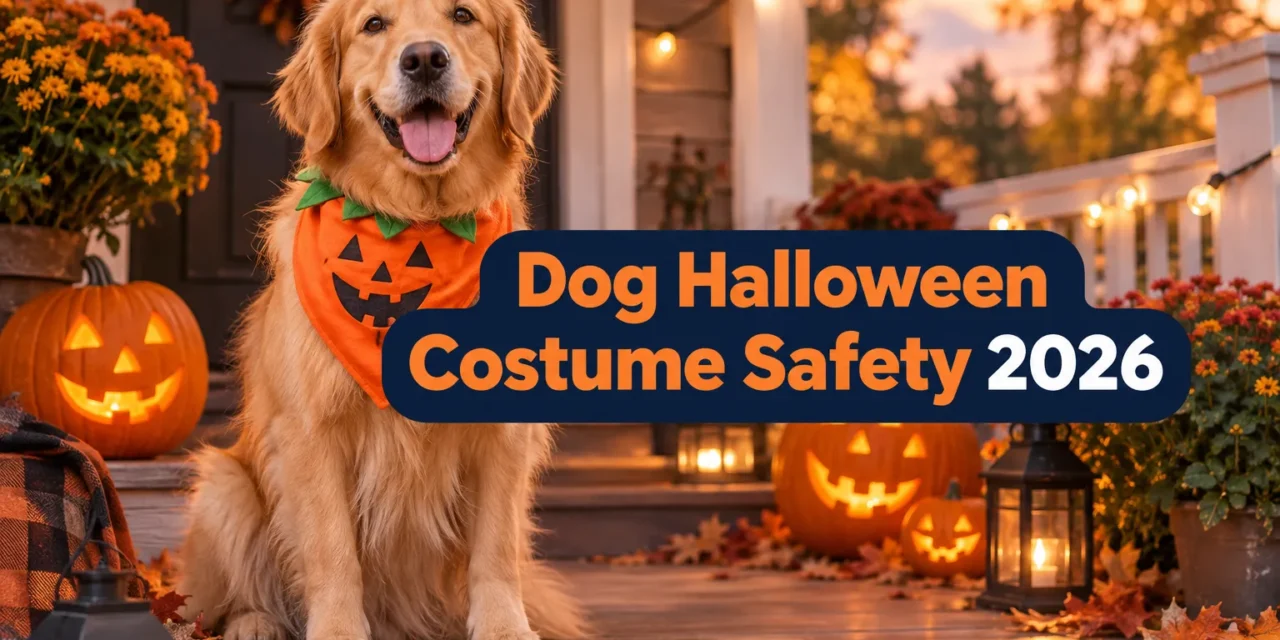
A costume can look adorable in a photo and still be a hazard in real life. That’s the hard truth behind Dog Halloween Costume Safety 2026: Fit, Candy, Decorations, Stress Signals, and Escape Prevention. Every year, vets see the same preventable emergencies: dogs who swallowed a button off a costume, dogs who bolted from a porch full of strangers, dogs who got into the candy bowl when nobody was looking.
None of that has to happen to your furry family member. This guide walks through exactly what to check before you snap that cute photo, fit, choking risks, candy, decorations, stress signals, and how to keep your pup from slipping out the door. Think of it as the best-friend checklist you wish someone had handed you last Halloween.
Key Takeaways
- Fit matters more than cute: A costume must never block your dog’s eyes, nose, mouth, or movement.[1][2]
- Small parts are big risks: Buttons, bells, and ribbons can be chewed off and swallowed, causing choking or blockages.[6][3]
- Candy is toxic territory: Chocolate and xylitol (found in sugar-free treats) are two of the most dangerous Halloween foods for dogs.[2][3]
- Watch your dog’s body language: Tucked tails, lip licking, and freezing in place mean it’s time to lose the costume.[5][9]
- Open doors are Halloween’s hidden danger: Trick-or-treaters mean a revolving front door, make sure your dog can’t slip out unnoticed.[1]
Dog Halloween Costume Safety 2026: Fit, Candy, Decorations, Stress Signals, and Escape Prevention Starts With Fit
Here’s the number one rule for Dog Halloween Costume Safety 2026: Fit, Candy, Decorations, Stress Signals, and Escape Prevention: if a costume changes how your dog moves, breathes, sees, or sounds, it’s not safe. Period.
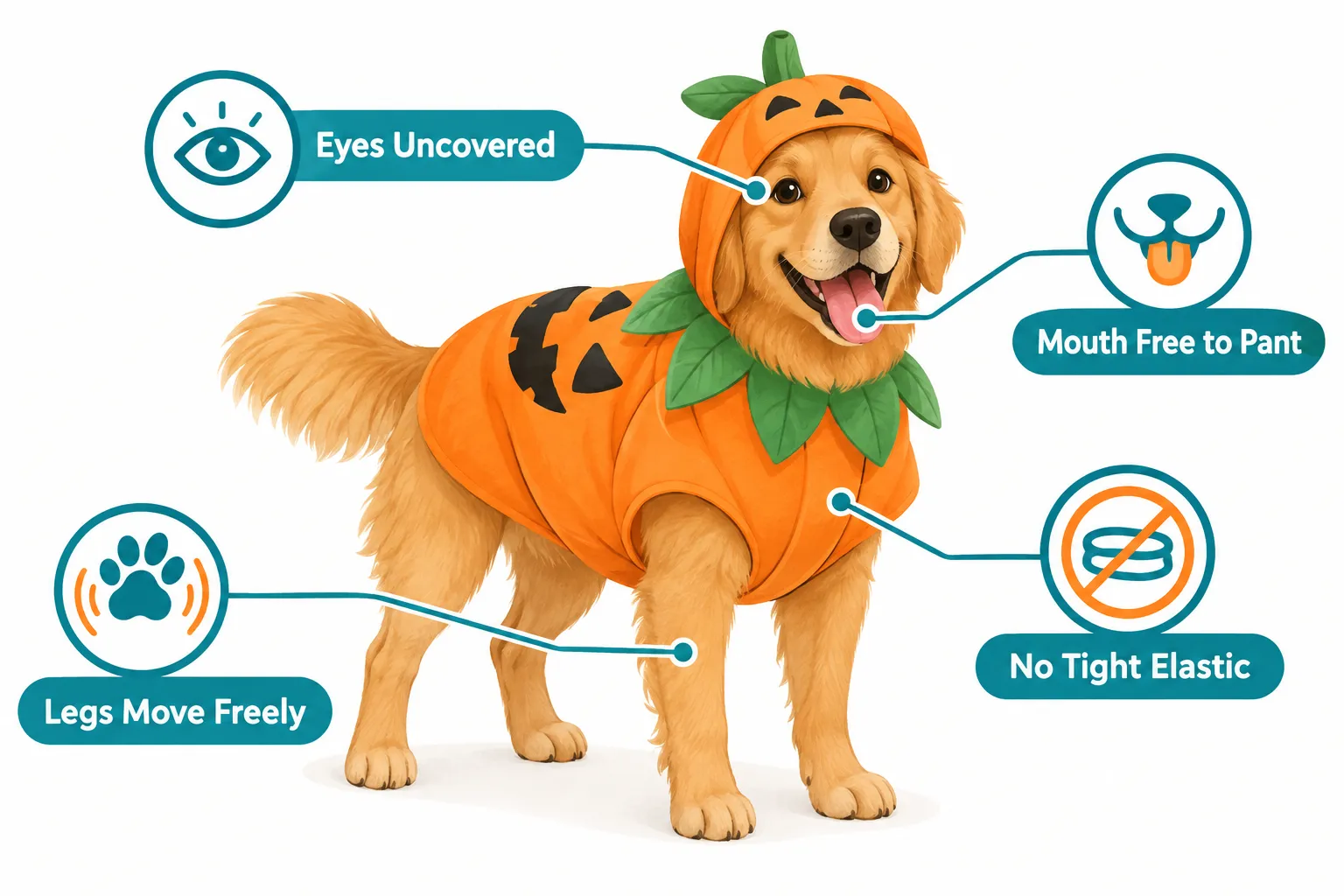
The ASPCA puts it plainly, don’t dress your dog in a costume unless you’re sure they actually enjoy it, and any costume must never limit movement, sight, breathing, or the ability to bark.[1] The AKC backs this up, warning that costumes should never block a dog’s eyes, nose, or mouth, and masks are a hard no.[2][9]
What “Good Fit” Actually Looks Like
A costume that passes the test should let your dog:
- See fully in every direction, no hoods, masks, or hats that dip over the eyes
- Pant and bark normally, nothing wrapped around the muzzle or neck
- Walk, run, and sit without stumbling, no fabric binding the legs or hips
- Shake off and scratch, if the costume restricts a full-body shake, it’s too tight
A humane society safety update notes that costumes which are too tight restrict movement, while loose ones cause tripping or tangling.[1] Both extremes are problems. You want a Goldilocks fit, snug enough to stay on, loose enough to move naturally.
The Overheating Trap
Here’s something a lot of pet parents forget: your dog is already wearing a fur coat. Piling heavy fabric, hoods, or layers on top can cause overheating fast, even on a cool autumn night.[1] This is especially risky for:
- Flat-faced breeds (already prone to breathing trouble)
- Senior dogs
- Thick-coated breeds like Bernese Mountain Dogs or Saint Bernards
If your pup has a double coat, check out these grooming tips to keep a Bernese Mountain Dog fluffy and fabulous for ideas on managing heat and coat maintenance year-round.
Quick fit test: Put the costume on for five minutes indoors first. Watch your dog walk, sit, and shake. If anything looks off, skip the costume, a festive bandana is plenty paw-some.
Choking Hazards Hiding in Costumes and Candy
This is the part of Dog Halloween Costume Safety 2026: Fit, Candy, Decorations, Stress Signals, and Escape Prevention that catches even experienced dog owners off guard. It’s not the costume itself, it’s the tiny pieces attached to it.
Veterinary experts warn that small, dangling costume parts like buttons, bells, ribbons, elastic bands, beads, and sequins can be chewed off and swallowed.[3][6] That can mean choking in the moment, or worse, an intestinal blockage days later that requires emergency surgery.
Decorative extras make things riskier. Glitter, dyes, and other costume decorations can irritate skin or cause harm if swallowed. Small accessory props, like a plastic spider or fake bone attached to a harness, can be a choking hazard and may contain materials that aren’t safe if chewed.[9][6]
Costume Red Flags Checklist
Before you buy or DIY a costume, scan for these warning signs:
| Red Flag | Why It’s Risky | Safer Swap |
|---|---|---|
| Buttons or snaps | Easily chewed off and swallowed | Velcro or sewn seams |
| Bells, sequins, beads | Choking hazard, sharp edges | Plain fabric trim |
| Dangling ribbons | Tangling and ingestion risk | Short, tucked ribbon |
| Glitter or loose dye | Skin irritation, toxic if licked | Pre-dyed, sealed fabric |
| Attached small props | Chewable, possible toxic plastic | Skip accessories entirely |
A good rule: if you wouldn’t want your toddler putting it in their mouth, don’t put it on your dog.
Candy Wrappers Count Too
The choking risk doesn’t stop at costumes. Candy wrappers and other inedible packaging can cause dangerous intestinal blockages if swallowed, so keep trick-or-treat bags zipped and off low tables.[1] A curious nose plus a dropped wrapper is a classic Halloween emergency room visit.
Decorations, Candy, and Other Household Hazards
Halloween turns your home into a hazard course, cords, cobwebs, carved pumpkins, candles, and of course, candy. Let’s break down the biggest threats so you can Halloween-proof your space.
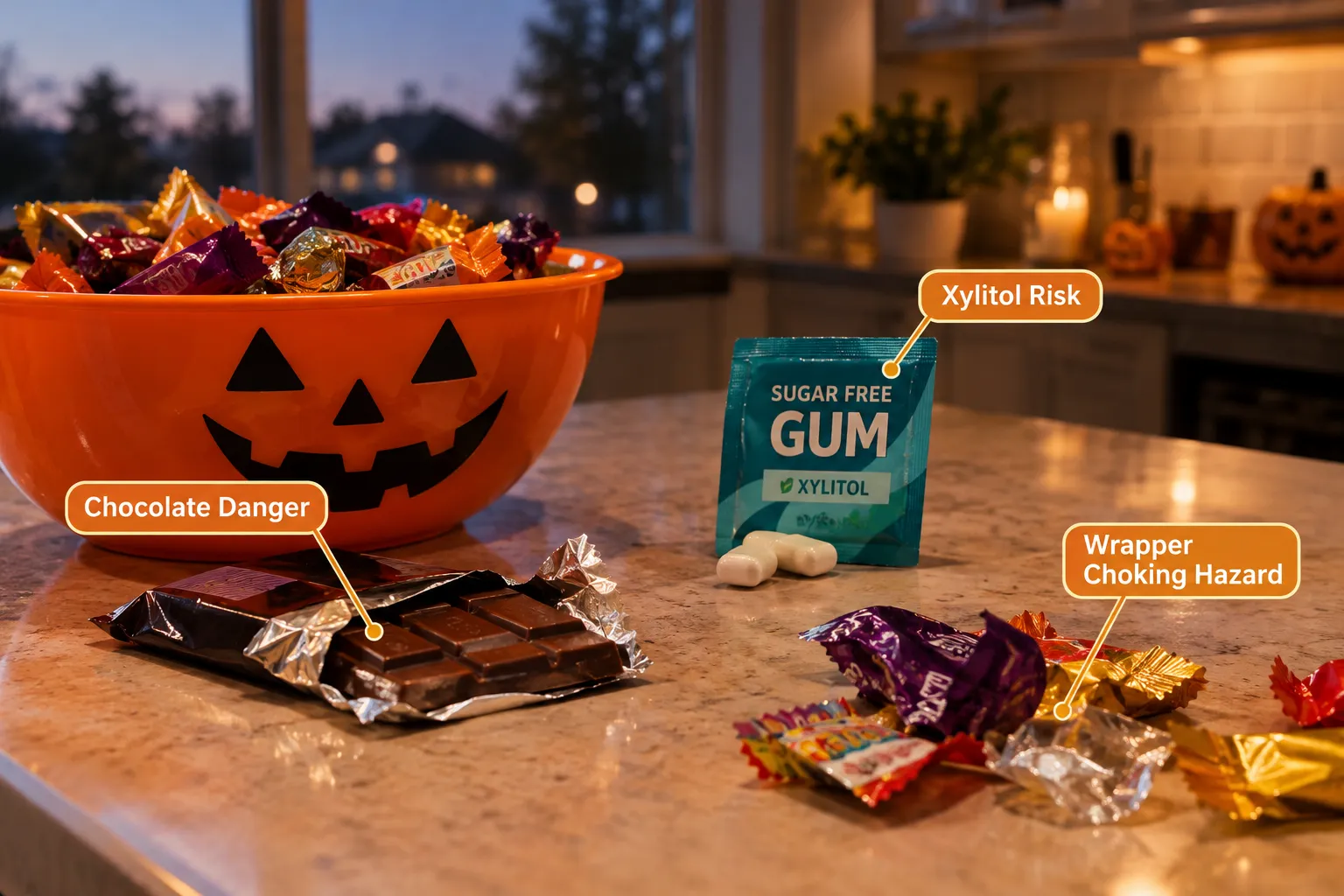
Chocolate and Xylitol: The Big Two
If you remember nothing else from this guide, remember this: chocolate and xylitol are the top two Halloween toxins for dogs.
- Chocolate contains theobromine, which dogs can’t process like we can. Any chocolate ingestion warrants an immediate call to your vet, an emergency clinic, or a pet poison hotline.[2][3]
- Xylitol, a sugar substitute common in sugar-free candy and gum, can cause a dog’s blood sugar to crash dangerously low and may lead to liver damage.[3]
Both are common enough in Halloween candy bowls that vets recommend keeping every bowl and every trick-or-treat bag completely out of reach, not on a coffee table, not on the floor, not “just for a second” on the counter.[3]
🐾 Vet tip: If your dog eats any amount of chocolate or a sugar-free product, don’t wait for symptoms. Call your vet or a poison control hotline right away.
Other Decoration Dangers
| Hazard | Where It Hides | Safety Move |
|---|---|---|
| Carved pumpkins (moldy) | Porch, yard | Toss after a few days outside |
| Candles in jack-o’-lanterns | Entryways | Use battery-operated lights instead |
| Fake cobwebs | Doorways, bushes | Keep out of reach, dogs can get tangled or swallow fibers |
| Glow sticks/jewelry | Trick-or-treat loot | Keep sealed; chemicals inside can upset stomachs |
| Electrical cords for lights | Yard displays | Tape down or route out of paw’s reach |
A Halloween-themed home should feel festive, not like an obstacle course for your pup’s nose and curiosity. Doing a quick walk-through at dog height, literally crouch down and look around, helps you spot things you’d otherwise miss.
If your dog tends to get into things they shouldn’t, it might help to review common feeding mistakes that raise disease risk so you know what symptoms to watch for after any accidental snack.
Stress Signals: Does Your Dog Actually Want This Costume?
Here’s a question most costume guides skip: does your dog actually like wearing it? Not every pup is a willing fashionista, and that’s totally okay.
The AKC notes that dogs experience Halloween very differently than we do, strange costumes, constant doorbell rings, and a parade of masked strangers can be genuinely stressful.[5] Add a costume on top of all that, and some dogs reach their limit fast.
Signs Your Dog Wants the Costume OFF
Watch for these body language cues. They’re your dog’s way of saying “please, no”:
- 🐕 Frozen posture, standing stiff and not moving at all
- 👅 Excessive lip licking or yawning (classic stress signals, not tiredness)
- 🙈 Tail tucked low or completely between the legs
- 👂 Ears pinned back flat against the head
- 🐾 Pawing at the costume repeatedly, trying to remove it
- 🏃 Trying to hide under furniture or behind you
- 😬 Whale eye, showing the whites of the eyes
Learning to spot these signals is one of the most useful skills any dog parent can build. Our guide on how to read your dog breaks down these cues in more detail, and understanding general dog behavior patterns makes it easier to tell the difference between excitement and genuine distress.
What To Do If Your Dog Is Stressed
If you spot any of these signs, take the costume off immediately. There is zero shame in this. A relaxed, costume-free dog having a great Halloween beats a stressed dog in an adorable outfit every single time.
For dogs who get anxious around Halloween noise and chaos in general, not just costumes, consider these calming options:
- A thundershirt for dogs can provide gentle, comforting pressure during loud doorbell nights
- Calming music for dogs played in a back room can drown out doorbell chaos
- Vet-approved calming supplements for dogs may help especially anxious pups (always check with your vet first)
- Simply setting up a quiet room away from the front door supports your dog’s mental health during high-stimulation holidays
If your dog is already a nervous type, this piece on how to calm a nervous dog is worth bookmarking well before October 31st rolls around.
Escape Prevention for Dog Halloween Costume Safety 2026
Let’s talk about the risk that has nothing to do with costumes at all: the front door.
Halloween night means a revolving door of trick-or-treaters, strangers in weird outfits, and constant doorbell rings. For a lot of dogs, that’s the scariest part of the whole night, and a startled, scared dog near an open door is a recipe for a bolt.
Door Safety Basics
- Confine your dog to a back room during peak trick-or-treat hours, away from the front door entirely
- Use a baby gate as a backup barrier even if your dog is normally great with guests
- Ask family members to announce “dog alert!” before opening the door, so everyone’s prepared
- Keep a leash by the door for quick grabs if your dog does slip past
ID Is Non-Negotiable
Even with the best door plan, accidents happen. That’s why identification is step one of escape prevention, not a backup plan.
- Make sure your dog’s collar tag is current and legible
- Confirm your microchip info is up to date with your current address and phone number
- Consider a temporary Halloween-specific tag with your cell number, just in case
A dog who’s already prone to bolting or who gets overly attached when stressed might benefit from extra attention this time of year. If your pup is a classic velcro dog who panics when separated from you, keep them close and calm rather than relying on costume cuteness to keep them settled.
If Your Dog Does Get Out
Act fast but stay calm (your dog can sense panic):
- Call your dog’s name in your normal happy voice, not a panicked shout
- Check the yard, porch, and immediate street first
- Notify neighbors doing trick-or-treating that your dog is out
- Call your microchip company to flag the loss immediately
- Post to local lost-pet groups with a recent photo
Escape prevention isn’t about ruining the fun, it’s about making sure every member of your family, four-legged included, makes it through Halloween night safely.
Quick-Reference Safety Checklist
Save this table or screenshot it before Halloween night gets busy:
| Category | Check This | Source-Backed Concern |
|---|---|---|
| Fit | Eyes, nose, mouth fully uncovered | Blocks sight, breathing, barking[1][2] |
| Fit | No restriction on walking/running | Tripping, overheating[1] |
| Parts | No buttons, bells, ribbons, beads | Choking, obstruction[3][6] |
| Decor | No glitter, loose dye, small props | Skin irritation, toxic ingestion[9] |
| Candy | Chocolate and xylitol locked away | Theobromine and blood sugar crash[2][3] |
| Candy | Wrappers in sealed trash | Intestinal blockage[1] |
| Stress | Watch for lip licking, tail tuck, freezing | Dog may not enjoy costume[5] |
| Escape | Confine dog away from front door | Door bolts during trick-or-treating |
| ID | Collar tag + microchip current | Fast recovery if dog escapes |
Print it, stick it on the fridge, and check each box before the first trick-or-treater rings the bell.
Conclusion
A great Halloween with your dog doesn’t need a perfectly matched costume or a viral-worthy photo. It needs a dog who can see, breathe, move, and relax without fear of swallowing something dangerous or bolting out the door.
Here’s your action plan: do the five-minute fit test before any costume goes on for real. Lock up candy and wrappers like they’re contraband. Walk your decorations at dog height to spot hidden hazards. Watch your pup’s body language all night long, and don’t hesitate to pull the costume off the second they ask you to. Keep that collar tag updated and that back room ready in case the doorbell chaos gets to be too much.
Your furry family member doesn’t need a costume to have a tail-wagging Halloween. They just need you paying attention. That’s the real trick to a treat-filled, safe night for everyone.
References
[1] Halloween Safety Tips – https://www.aspca.org/pet-care/general-pet-care/halloween-safety-tips [2] Halloween Safety Tips For Dog Owners – https://www.akc.org/expert-advice/vets-corner/halloween-safety-tips-for-dog-owners/ [3] Halloween Hazards – https://www.lsu.edu/vetmed/news/2026/halloween_hazards.php [5] What Do Dogs Really Think About Halloween – https://www.akc.org/expert-advice/lifestyle/what-do-dogs-really-think-about-halloween/ [6] Dont Get Tricked These Pet Hazards Halloween – https://www.aspca.org/news/dont-get-tricked-these-pet-hazards-halloween [9] Costumes For Dogs Dressed Up – https://www.akc.org/expert-advice/lifestyle/costumes-for-dogs-dressed-up/