

Rottweilers rank among the top 10 most popular dog breeds in the United States — and they also appear on many insurance companies’ “restricted breeds” lists. That contrast tells you everything. These dogs are powerful, loyal, and incredibly smart. But without proper training, that power can become a real problem. The good news? With the right commands, a Rottweiler becomes one of the most obedient and trustworthy dogs you’ll ever meet. This guide covers the 10 Rottweiler Training Commands Every Owner Must Teach to help your dog become a safe, happy, and well-behaved companion in 2026 and beyond.

Key Takeaways
- 🐾 Start early. Puppies as young as 8 weeks can begin learning basic commands.
- 🧠 Rottweilers are fast learners. Consistent, positive training gets results quickly.
- 🦺 Safety depends on training. Commands like “Leave It” and “Stay” can prevent dangerous situations.
- 🎯 Short sessions work best. Keep training to 5–15 minutes to hold your dog’s attention.
- ❤️ Positive reinforcement wins. Treats, praise, and play motivate Rottweilers far better than punishment.
Why Training Is Non-Negotiable for Rottweilers
Rottweilers are not like most dogs. They are big. They are strong. And they have a natural instinct to protect. A 100-pound dog that doesn’t listen is not just inconvenient — it can be dangerous.
Here’s a quick look at why training matters so much for this breed:
| Reason | Why It Matters |
|---|---|
| Size & Strength | An untrained Rottweiler can knock over adults and children easily |
| Protective Instinct | Without guidance, they may guard aggressively toward strangers |
| High Intelligence | Smart dogs get bored and destructive without mental stimulation |
| Social Expectations | Well-trained dogs are welcome in more places and situations |
| Legal Liability | Many areas have strict rules about “dangerous breeds” |
💬 “A well-trained Rottweiler is not just a pet — it’s a partner.”
Training is not about control for its own sake. It’s about building a language between you and your dog. When your Rottweiler understands what you want, they feel more confident and less anxious. That’s a win for everyone.
When Should You Start Training?
Start as soon as your puppy comes home — usually around 8 weeks old. Young puppies absorb information like sponges. Even older Rottweilers can learn new commands, but earlier is always better.
Pro tip: Keep early sessions short. Five minutes, three times a day is better than one long 30-minute session.
The 10 Rottweiler Training Commands Every Owner Must Teach
Here they are — the essential commands every Rottweiler owner needs to teach. These are listed roughly in order of importance, starting with the most critical ones.
Command 1: Sit 🐕
“Sit” is the foundation of everything.
This is usually the first command owners teach, and for good reason. A dog that sits on command is easier to manage in almost every situation — at the vet, greeting guests, waiting for food.
How to teach it:
- Hold a treat close to your dog’s nose.
- Slowly move your hand up. The dog’s bottom will lower naturally.
- Once they’re sitting, say “Sit” clearly.
- Give the treat and praise right away.
- Repeat 5–10 times per session.
Why it matters for Rottweilers: A sitting Rottweiler is a calm Rottweiler. This command helps interrupt excited or pushy behavior instantly.
Command 2: Stay 🛑
“Stay” can literally save your dog’s life.
Imagine your front door opens accidentally. Without a solid “Stay,” your Rottweiler could bolt into traffic. This command teaches impulse control — one of the most important skills for a powerful breed.
How to teach it:
- Ask your dog to Sit.
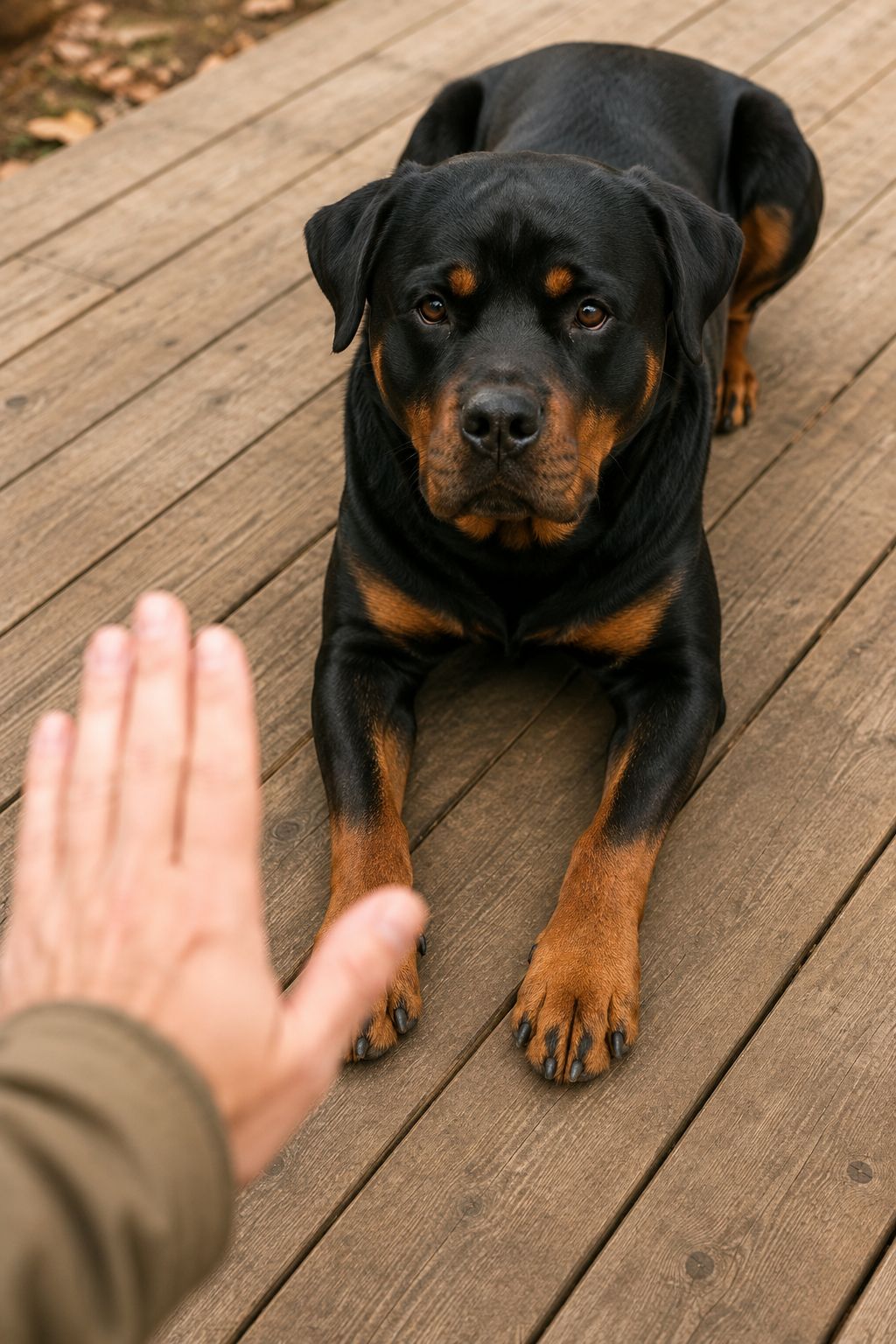
- Open your palm toward them like a stop sign and say “Stay.”
- Take one step back. If they stay, return and reward.
- Gradually increase distance and time.
- Always return to the dog to reward — don’t call them to you at first.
Key rule: Never reward a dog that breaks the stay. Simply reset and try again with a shorter distance.
Command 3: Come (Recall) 📣
A reliable recall is your most important safety tool.
“Come” means “drop everything and get to me right now.” For a Rottweiler, this command is critical in dog parks, on trails, or any time they’re off-leash.
How to teach it:
- Start in a small, enclosed space.
- Crouch down, open your arms, and say “Come!” in a happy, excited voice.
- When they reach you, give a big reward — treats AND praise.
- Never call your dog to punish them. That destroys the recall.
💡 Golden rule: “Come” should always mean something wonderful happens. Never use it before a bath they hate or to end playtime abruptly.
Command 4: Down (Lie Down) 😴
“Down” is a calming command that shows real trust.
Getting a dog to lie down is harder than getting them to sit. It requires more submission. For a Rottweiler, mastering “Down” shows they truly trust and respect you.
How to teach it:
- Start with your dog in a Sit.
- Hold a treat at their nose, then slowly move it down to the floor between their paws.
- As they follow the treat down, say “Down.”
- Once their elbows touch the floor, reward immediately.
Patience is key here. Some Rottweilers resist this command at first. Stay calm and consistent. Never push them down physically.
Command 5: Leave It 🚫
“Leave It” protects your dog from eating dangerous things.
Dogs explore the world with their mouths. Rottweilers are no different. “Leave It” teaches them to ignore anything you don’t want them to touch — from chicken bones on the sidewalk to a child’s toy.
How to teach it:
- Place a treat in each hand.
- Close one fist and hold it near the dog’s nose. Let them sniff and lick.
- When they stop trying, say “Leave It” and give the treat from the OTHER hand.
- Practice until they back away from the closed fist immediately.
Upgrade the challenge: Practice with treats on the floor, then with real-world distractions.
Command 6: Heel 🚶
Walking a 100-pound dog that pulls is exhausting — and dangerous.
“Heel” teaches your Rottweiler to walk calmly beside you without pulling on the leash. This makes walks enjoyable instead of a workout.
How to teach it:
- Hold treats in your left hand at your hip.
- Start walking and say “Heel.”
- Reward your dog every few steps when they stay beside you.
- Stop walking every time they pull. Only move forward when the leash is loose.
Consistency is everything. If you let pulling slide sometimes, the dog learns that pulling works.

Command 7: Off 🙅
Jumping up is cute in puppies. In adult Rottweilers, it’s a hazard.
A 100-pound dog jumping on an elderly person or a child can cause serious injury. “Off” teaches your dog to keep all four paws on the ground.
How to teach it:
- When your dog jumps up, turn your back and ignore them completely.
- The moment all four paws are on the floor, say “Off” and reward.
- Ask everyone in the household — and guests — to do the same.
Important: Don’t say “Down” for this. “Down” means lie down. Use “Off” specifically for jumping. Keeping commands separate prevents confusion.
Command 8: No (or Enough) ❌
Every dog needs to understand a clear “stop that” signal.
“No” or “Enough” is a general correction command. It tells your dog that whatever they’re doing right now needs to stop. This is different from “Leave It” (which is about objects) — it covers all unwanted behaviors.
How to teach it:
- When your dog does something unwanted, say “No” in a calm, firm voice. Not loud. Not angry. Just clear.
- Redirect them to a behavior you DO want.
- Reward the correct behavior.
💬 “The goal isn’t to punish — it’s to redirect. Always show your dog what TO do, not just what NOT to do.”
Command 9: Place (Go to Your Spot) 🛏️
“Place” gives your Rottweiler a job and gives you peace.
“Place” means “go to your bed or mat and stay there until released.” This is a game-changer for managing your dog during meals, when guests arrive, or when you need a break.
How to teach it:
- Set up a dog bed or mat in a specific spot.
- Lead your dog to it and say “Place.”
- When all four paws are on the mat, reward generously.
- Add duration slowly — ask them to stay there longer each session.
- Use a release word like “Free” or “Okay” to let them leave.
Why Rottweilers love this command: It gives them a clear role. Rottweilers are working dogs at heart. Having a “job” to do makes them feel purposeful and calm.
Command 10: Watch Me (Focus) 👀
If your dog isn’t looking at you, they’re not listening to you.
“Watch Me” teaches your Rottweiler to make eye contact on command. This is the secret weapon for managing distractions — other dogs, squirrels, strangers — in public.
How to teach it:
- Hold a treat between your eyes and say “Watch Me.”
- The moment your dog makes eye contact, reward them.
- Gradually increase the duration of eye contact before rewarding.
- Practice in increasingly distracting environments.
Real-world use: When your Rottweiler spots another dog and starts to fixate, “Watch Me” breaks that focus and brings their attention back to you instantly.
How to Practice the 10 Rottweiler Training Commands Every Owner Must Teach
Knowing the commands is one thing. Building them into daily life is another. Here’s a simple weekly training schedule that works for busy owners:
| Day | Focus | Duration |
|---|---|---|
| Monday | Sit + Stay | 10 min |
| Tuesday | Come + Watch Me | 10 min |
| Wednesday | Down + Leave It | 10 min |
| Thursday | Heel (leash walk) | 15 min |
| Friday | Off + No | 10 min |
| Saturday | Place + Review all | 15 min |
| Sunday | Free play + light review | 10 min |
Training Tips That Actually Work
✅ Use high-value treats. Small pieces of chicken, cheese, or hot dog work better than dry kibble for tough commands.
✅ End on a win. Always finish a session with something your dog does well. This keeps them excited for next time.
✅ Train before meals. A slightly hungry dog is a motivated dog.
✅ Be consistent with words. Pick one word per command and stick to it. Don’t say “sit” sometimes and “sit down” other times.
✅ Involve the whole family. Every person in the house should use the same commands and rules. Mixed signals confuse dogs.
❌ Never train when frustrated. Dogs read emotions. If you’re stressed, take a break.
❌ Don’t repeat commands. Say “Sit” once. If they don’t respond, help them into position. Repeating commands teaches dogs to ignore the first one.
Common Mistakes Rottweiler Owners Make
Even well-meaning owners make these training mistakes. Watch out for them:
1. Skipping socialization
Training commands alone isn’t enough. Rottweilers need exposure to different people, animals, and environments from a young age. A well-socialized Rottweiler is far less reactive and easier to train.
2. Using punishment-based methods
Harsh corrections can make Rottweilers shut down, become anxious, or — in some cases — become defensive. Positive reinforcement is not just kinder. It’s more effective.
3. Giving up too soon
Some commands take days. Others take weeks. “Place” and “Heel” often take the longest. Stay patient.
4. Inconsistent rules
Letting your Rottweiler on the couch sometimes but not others creates confusion. Decide on your rules and stick to them — always.
5. Not proofing commands
A dog that sits perfectly in the kitchen may ignore “Sit” at the dog park. Practice commands in many different places and with increasing distractions. This is called “proofing.”
Why Positive Reinforcement Works Best for Rottweilers
Science backs this up. Studies in animal behavior consistently show that reward-based training produces faster learning, better retention, and fewer behavioral problems than punishment-based methods.
For Rottweilers specifically, positive reinforcement works so well because:
- 🧠 They are highly food-motivated
- ❤️ They crave approval from their owners
- 💪 They are sensitive despite their tough appearance
- 🎯 They thrive on having clear expectations
💬 “Rottweilers don’t need to be dominated. They need to be guided.”
The old idea that you must “dominate” or “alpha roll” a Rottweiler is outdated and harmful. Modern dog trainers and veterinary behaviorists agree: force-free methods build stronger bonds and better-behaved dogs.
When to Get Professional Help
Sometimes, even the most dedicated owner needs backup. Consider working with a certified professional dog trainer if:
- Your Rottweiler shows aggression toward people or other animals
- Basic commands aren’t sticking after several weeks of consistent practice
- Your dog has severe anxiety or fear reactions
- You’ve adopted an adult Rottweiler with unknown history
Look for trainers who use positive reinforcement methods and have experience with large or working breeds. Certifications to look for include:
- CPDT-KA (Certified Professional Dog Trainer – Knowledge Assessed)
- KPA CTP (Karen Pryor Academy Certified Training Partner)
- IAABC (International Association of Animal Behavior Consultants)
Conclusion
The 10 Rottweiler Training Commands Every Owner Must Teach — Sit, Stay, Come, Down, Leave It, Heel, Off, No, Place, and Watch Me — are not just tricks. They are the building blocks of a safe, happy life with one of the world’s most impressive dog breeds.
Training a Rottweiler takes time, patience, and consistency. But the payoff is enormous. A well-trained Rottweiler is a joy to live with — calm, confident, and deeply bonded to their family.
Here are your actionable next steps:
- 🎯 Start today — pick one command (Sit is easiest) and practice for 5 minutes.
- 📅 Use the weekly schedule above to build a consistent routine.
- 🏆 Celebrate small wins — every successful repetition is progress.
- 👥 Get the whole family involved — consistency from everyone speeds up learning.
- 🐾 Consider a group obedience class — great for socialization AND training at the same time.
Your Rottweiler wants to please you. Give them the tools to do it, and they’ll reward you with a lifetime of loyalty.
References
- American Kennel Club. (2022). Rottweiler Dog Breed Information. https://www.akc.org/dog-breeds/rottweiler/
- Blackwell, E. J., Twells, C., Seawright, A., & Casey, R. A. (2008). The relationship between training methods and the occurrence of behavior problems, as reported by owners, in a population of domestic dogs. Journal of Veterinary Behavior, 3(5), 207–217.
- Herron, M. E., Shofer, F. S., & Reisner, I. R. (2009). Survey of the use and outcome of confrontational and non-confrontational training methods in client-owned dogs showing undesired behaviors. Applied Animal Behaviour Science, 117(1–2), 47–54.
- Pryor, K. (2002). Don’t Shoot the Dog: The New Art of Teaching and Training. Ringpress Books.
- Ziv, G. (2017). The effects of using aversive training methods in dogs — A review. Journal of Veterinary Behavior, 19, 50–60.
Tags: Rottweiler training, dog training commands, Rottweiler obedience, positive reinforcement dog training, large breed training, dog training tips, Rottweiler behavior, basic dog commands, puppy training, dog obedience, working dog breeds, dog training schedule