A single bite. That’s all it can take. Death cap mushrooms and dogs are a combination that can turn a happy backyard romp into an emergency room sprint in under 24 hours. Fall’s damp, cool weather is prime mushroom season, and these fungi love to pop up in the most ordinary places: your lawn, your mulch beds, even your local dog park.

Death cap mushrooms and dogs: how to spot yard risks and respond after ingestion isn’t a topic to skim past. This is one of the few true “minutes matter” emergencies in dog ownership. Let’s get you paw-repared.
Key Takeaways
- Death caps are fast and deadly. They can cause severe liver and kidney damage within 24-48 hours, and poisoning is often fatal without rapid treatment.[1][2]
- Yards and parks are real risk zones. Multiple 2026 dog deaths happened in residential yards and county parks, not deep forests.[3][4]
- Symptoms can trick you. A “honeymoon phase” of feeling better can hide the fact that organ failure is already starting.[5][6]
- Never wait for symptoms. Call a vet or poison helpline immediately after ingestion, don’t wait to “see what happens.”[3][6]
- Prevention is simple but essential. Regular yard checks and supervised outdoor time dramatically cut your pup’s risk.[6][7]
Why Death Cap Mushrooms and Dogs Are a Dangerous Combination
Here’s the hard truth: death cap mushrooms (Amanita phalloides) are considered one of the most poisonous mushrooms on the planet.[2][5] For dogs, who sniff, chew, and taste-test everything, that’s a scary mix.
These mushrooms carry amatoxins, nasty compounds that attack the liver cells directly. Veterinary toxicologists warn that acute liver failure can start within just 24 hours of a dog eating one.[2][5] Kidney damage and intestinal injury often follow close behind.[5]
This isn’t a rare, far-off danger either. In 2026, news outlets reported several heartbreaking cases:
- An 8-week-old puppy in California died after death cap exposure (June 1, 2026).[3]
- A family dog died after eating a death cap in a Southern California county park (May 8, 2026).[4]
- Another dog death was reported on August 18, 2026, with vets again warning owners about the risk.[1]
Wait, swap that for the real image slot:
North Carolina State University’s veterinary school puts it bluntly: toxicity from this species carries a “very poor prognosis” and is nearly 100% fatal without fast intervention.[6] That’s a sobering statistic, but it’s also exactly why knowing what to look for, and acting fast, saves lives.
What Death Cap Mushrooms Actually Look Like
Before you can protect your family friendly dogs or companion dogs from this threat, you need to know the enemy. Death caps have a few signature features:
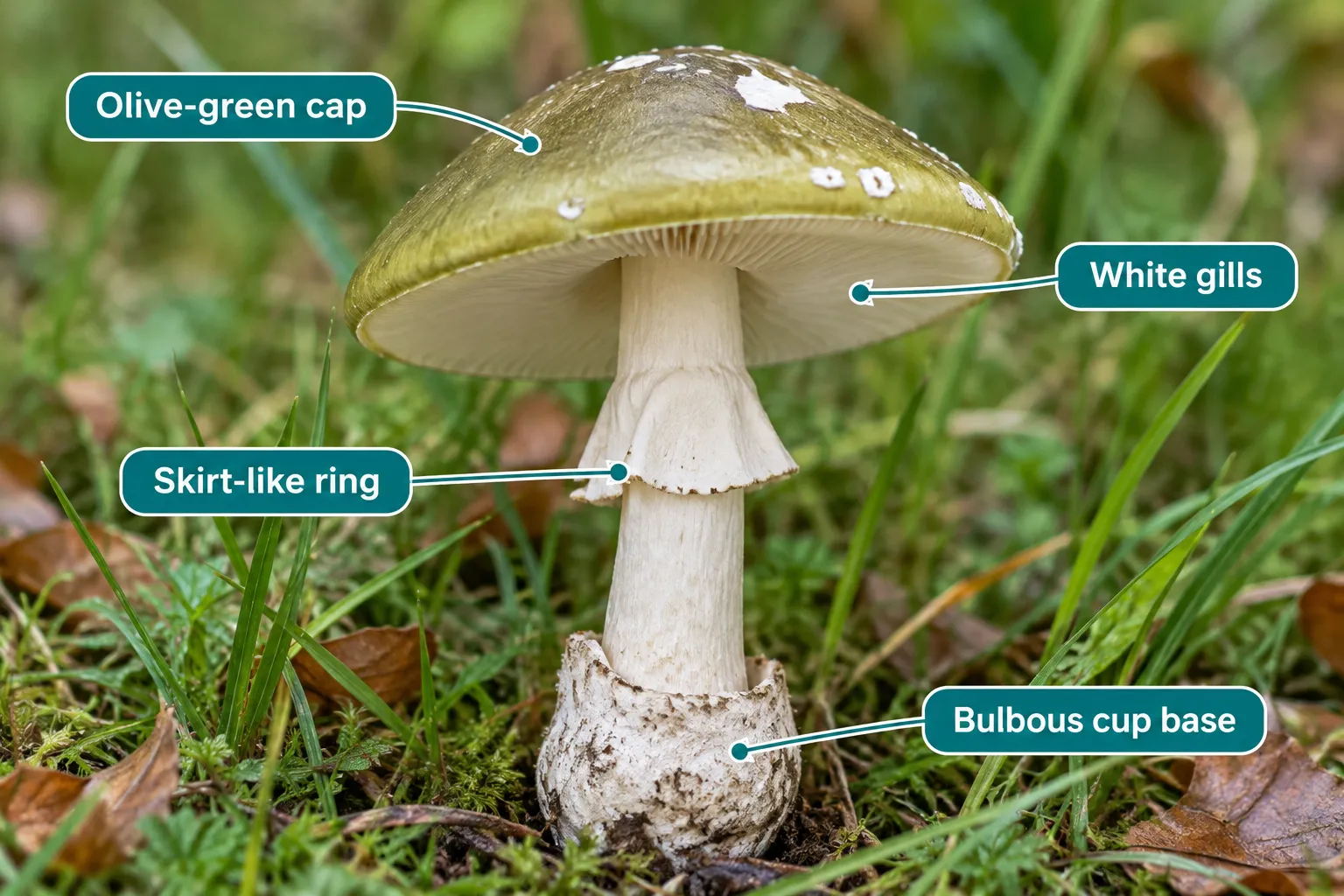
- Cap color: Smooth, olive-green, yellow-green, or tan.[2]
- Gills: White, and they stay white even as the mushroom ages.[2]
- Stem: White, with a skirt-like ring near the top.
- Base: Bulbous, sitting inside a cup-like structure (called a volva), often half-buried in soil.[2]
Here’s the golden rule: if a mushroom in your yard has any of these traits, treat it as suspicious. Don’t poke it, don’t move it with bare hands, and definitely don’t let your dog near it.
Death Caps Aren’t the Only Troublemaker
Death cap mushrooms and dogs get the most headlines, but they aren’t alone. Amanita ocreata (“destroying angel”) is a close cousin that’s just as deadly, a toxicology report tied to the North American Mycological Association documented six separate incidents involving eight dog deaths in California from these two species alone.[8]
There’s also Galerina marginata, nicknamed the “deadly skullcap.” It’s small, brown, and easy to overlook, but it carries the exact same amatoxins as death caps. A June 2026 alert from the Animal Poisons Helpline specifically warned pet owners about this lookalike danger.
European pet-care guidance adds a few more names to the watch list: other Amanita species, plus certain Cortinarius and Inocybe mushrooms, all linked to fatal dog poisonings.[9]
“Any mushroom-related illness in a dog should be treated as potentially serious, even if it looks small or harmless.”
How to Spot Yard Risks Before Your Dog Does
The biggest myth about toxic mushrooms? That they only grow deep in the woods. Not true. A 2021 review in the Journal of the American Veterinary Medical Association looked at 59 canine mushroom poisoning cases and found that many affected dogs had access to ordinary yards and grassy parks. This is exactly why death cap mushrooms and dogs sharing the same backyard is such a common, and preventable, tragedy.
Fall Is Prime Danger Season
Cool, damp weather is a mushroom’s best friend. That means autumn, with its wet mornings and falling leaves, is exactly when yard checks matter most.[6][7] Here’s your season-specific action plan:
Daily and Weekly Yard Patrol Checklist 🍂
- Walk the entire yard every morning, especially after rain.
- Check mulched garden beds and shaded corners, mushrooms love moisture and shade.
- Look under decks, near compost piles, and along fence lines.
- Remove any mushroom you find immediately, don’t wait for “later.”
- Wear gloves when pulling mushrooms; some toxins can irritate skin.
- Bag and trash removed mushrooms; don’t compost them.
- Re-check the same spots every few days, mushrooms regrow fast.
Supervised Outdoor Time Isn’t Optional
Dogs are natural foragers. A loose, unsupervised dog in a mushroom-prone yard is a recipe for disaster. Keep these habits in your routine:
- Stay outside with your dog during bathroom breaks this time of year.
- Use a leash on walks through parks, even familiar ones.
- Train a solid “leave it” cue, it’s one of the best impulse control skills your pup can learn.
- Watch extra closely with curious breeds and puppies, who explore mouth-first.
- Be especially cautious with dogs under 10 pounds, smaller body weight means toxins hit harder, faster.
Small dogs and tiny toxic doses are a brutal combo. Even a nibble can be enough.
Spotting Symptoms: The Sneaky Timeline of Death Cap Poisoning
This is the part that catches so many loving dog parents off guard. Death cap poisoning doesn’t look like a straight line from “sick” to “sicker.” It moves in phases, and one of those phases is designed to fool you.
| Phase | Timing After Ingestion | What You’ll See |
|---|---|---|
| GI Phase | 6-24 hours | Vomiting, diarrhea (sometimes bloody), drooling, abdominal pain, weakness, staggering [5][6][7] |
| “Honeymoon” Phase | ~24-48 hours | Symptoms seem to improve, dog looks better, but organ damage is quietly progressing [5][6] |
| Hepatic Crisis Phase | 48-72 hours | Spiking liver enzymes, low blood sugar, bleeding problems, jaundice, seizures, coma [5][6] |
That middle “honeymoon” stage is the cruelest trick in this whole poisoning. Your dog might wag their tail, eat a little, act almost normal, right while their liver is failing behind the scenes.[5][6] This is exactly why “let’s just wait and see” is the worst possible plan.
Signs to Watch For, Stage by Stage
- Early: vomiting, diarrhea, drooling, lethargy, stumbling or uncoordinated movement.[5][6][7]
- Later: yellowing of the skin, gums, or eyes (jaundice), seizures, collapse, coma.[5][6][7]
If your dog shows ANY of these after being outside, especially in fall, treat it as an emergency, not a “let’s monitor it” situation.
Death Cap Mushrooms and Dogs: How to Spot Yard Risks and Respond After Ingestion in Real Time
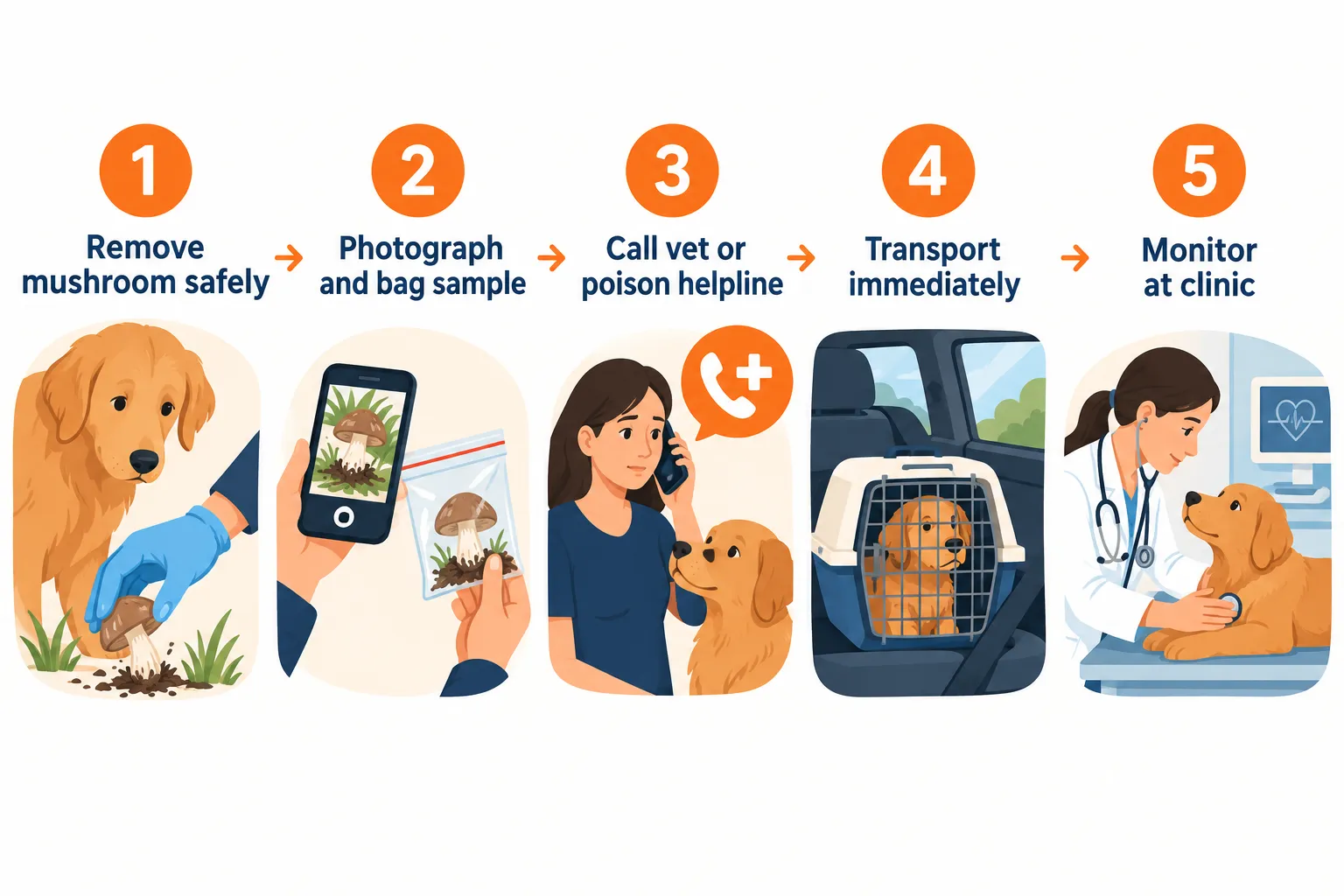
So it happened. Your dog grabbed a mushroom before you could stop them. Here’s exactly what to do, step by step. No panic, just action.
- Remove any remaining mushroom from your dog’s mouth, only if it’s safe to do so without getting bitten.[3][6]
- Photograph the mushroom where it was growing, and if possible, collect a sample in a bag or paper towel. This helps vets identify the species fast.[3][6]
- Call your vet or the nearest emergency animal clinic immediately, don’t wait for symptoms.[3][6]
- Call an animal poison helpline if you can’t reach local care right away.[3][6]
- Transport your dog to care right away, bringing the mushroom sample and photo with you.
Why “Wait and See” Is the Wrong Move
Remember that sneaky honeymoon phase? It’s exactly why speed matters so much here. Veterinary guidance is consistent: early decontamination and supportive care give the best, and sometimes only, chance at survival.[3][6]
Treatment, when started early, usually includes:
- Aggressive IV fluid therapy
- Blood product support, like plasma transfusions
- Close monitoring of liver and kidney function
- Management of bleeding and neurological symptoms[5][10]
Even with this intensive care, some dogs still progress to liver failure and die within 24-48 hours.[5][10] That’s not meant to scare you into hopelessness, it’s meant to light a fire under you to act fast and lean on prevention as your real superpower here.
Building a Mushroom-Safe Yard Routine for Good
Prevention beats emergency care every single time. Here’s how to build mushroom safety into your regular dog-parent routine, not just during a scare.
Seasonal Safety Habits
- Inspect your yard year-round, with extra vigilance during warm, damp stretches.[6][7]
- Remove mulch piles that stay consistently wet, or rake them regularly.
- Keep grass mowed short, shorter grass makes mushrooms easier to spot.
- Fence off compost areas your dog can’t access.
- Teach a reliable “drop it” and “leave it” command early.
- Consider calming tools, like calming supplements or calming music, for anxious dogs who tend to forage out of stress or boredom.
- Give your pup plenty of mental stimulation indoors with enrichment games so they’re less tempted to go snack-hunting outside.
- Learn to read your dog’s body language so you catch early signs of discomfort fast.
The simplest rule of all? Never let your dog eat any wild mushroom, even if it looks like something people eat.[6][7] It’s just not worth the gamble.
This advice applies across the board, whether you’ve got small white dogs, a floppy-eared goofball, or a sturdy Cane Corso built like a tank. Toxins don’t discriminate by breed.
Conclusion: Protect Your Furry Family Member This Fall
Death cap mushrooms and dogs is a scary pairing, but it’s one you now know how to handle. The science is clear: these mushrooms can cause liver failure fast, sometimes within 24 to 48 hours, and the risk doesn’t live only in forests. It lives in backyards, parks, and the shady corner by your fence.[1][3][4]
Here’s your next move, starting today:
- Walk your yard this week and remove every mushroom you find.
- Save your vet’s emergency number and a poison helpline number in your phone right now.
- Supervise outdoor time closely through the fall season.
- If ingestion ever happens, skip the waiting game, call for help immediately.
Your dog trusts you to keep their world safe. A quick yard check and a fast phone call can be the difference between a close call and a tragedy. Stay alert, stay prepared, and give your tail-wagging best friend the safest yard possible this season.
References
- Owner Sounding Alarm After Dog Dies Dangerous Mushroom. 21alivenews.com.
- Mushroom Toxicity Dogs. healthtopics.vetmed.ucdavis.edu.
- Article315941478. sacbee.com.
- Dog Dies Death Cap Mushroom La County Park. cbsnews.com.
- 060519 Final Presentation Handout 1. petpoisonhelpline.com.
- Pet Owner Alert Toxic Mushrooms Claim Dogs Lives What You Should Know. cvm.ncsu.edu.
- Can Dogs Eat Mushrooms. petmd.com.
- 2014 Nama Toxicology Committee Report North American Mushroom Poisonings. namyco.org.
- Champignons Chien Manger Malade Especes Surveiller 572296. monjardinmamaison.maison-travaux.fr.
- Vets Warn Pet Owners to Watch Out for Death Cap Mushrooms. cbsnews.com.