Here’s a number that might surprise you: breed only explains part of whether a dog and cat will get along. Individual history, training, and daily management matter just as much.[1][2][3] That means picking the “right” breed is step one, not the whole plan.

If you’re building a multi-pet household, finding the best dog breeds for families with cats: prey drive, introductions, and daily management requires looking at three things together. You need a dog with low prey drive, a slow and careful introduction, and a long-term management routine that keeps everyone safe and happy. Skip any one of these, and things can go sideways fast.
Good news, though. Thousands of families live happily with dogs and cats under one roof. 🐾 You can absolutely be one of them, with the right breed choice and a little patience.
Key Takeaways
- Golden Retrievers, Labradors, Cavaliers, Basset Hounds, Pugs, and Poodles consistently rank as the most cat-friendly breeds thanks to low reactivity and strong trainability.[3][4][5][6]
- Prey drive is the #1 risk factor for dog-cat households, high-energy, chase-driven breeds like Huskies, Cattle Dogs, and many terriers need extra caution.[1][7][8]
- Slow introductions win. Scent swapping, then visual barriers, then supervised leashed meetings is the gold-standard protocol.[1][8]
- Management is forever, not just a phase. Feeding stations, escape routes, and gates should stay in place long-term for dogs with any chase history.[1][2][8]
- Individual personality trumps breed stereotypes. Even “safe” breeds can struggle, and some “risky” breeds can thrive with careful selection.[1][7][8]
Understanding Prey Drive: The Real Factor Behind Best Dog Breeds for Families With Cats
Prey drive is basically a dog’s built-in urge to chase, stalk, or grab anything that moves fast and small. It’s instinct, not bad behavior. Some breeds have it cranked way up. Others barely notice a scampering cat at all.
Experts agree: prey drive is the single biggest risk factor when adding a dog to a cat’s home.[1][8] A dog that’s already chased squirrels, birds, or outdoor cats carries that same instinct indoors. Training helps. It doesn’t erase the wiring.[1][8]
Watch for these prey-drive warning signs:
- Intense staring or “locking on” to the cat 👀
- Stiff body posture, raised hackles
- Stalking or creeping low to the ground
- Tail held high and twitching
- Lunging toward sudden movement
If your dog has seriously pursued or injured a small animal before, plan on permanent physical separation when you’re not actively supervising.[1][8] That’s not pessimism, that’s just smart, loving pet parenting.
On the flip side, breeds bred for companionship rather than hunting tend to have naturally lower prey drive. That’s why gentle, people-focused dogs dominate every “good with cats” list in 2026.[3][4][5][6]
The Best Dog Breeds for Families With Cats: Prey Drive Rankings by Temperament
Let’s break down who’s who. These rankings reflect real-world patterns, not guarantees, every dog is an individual.
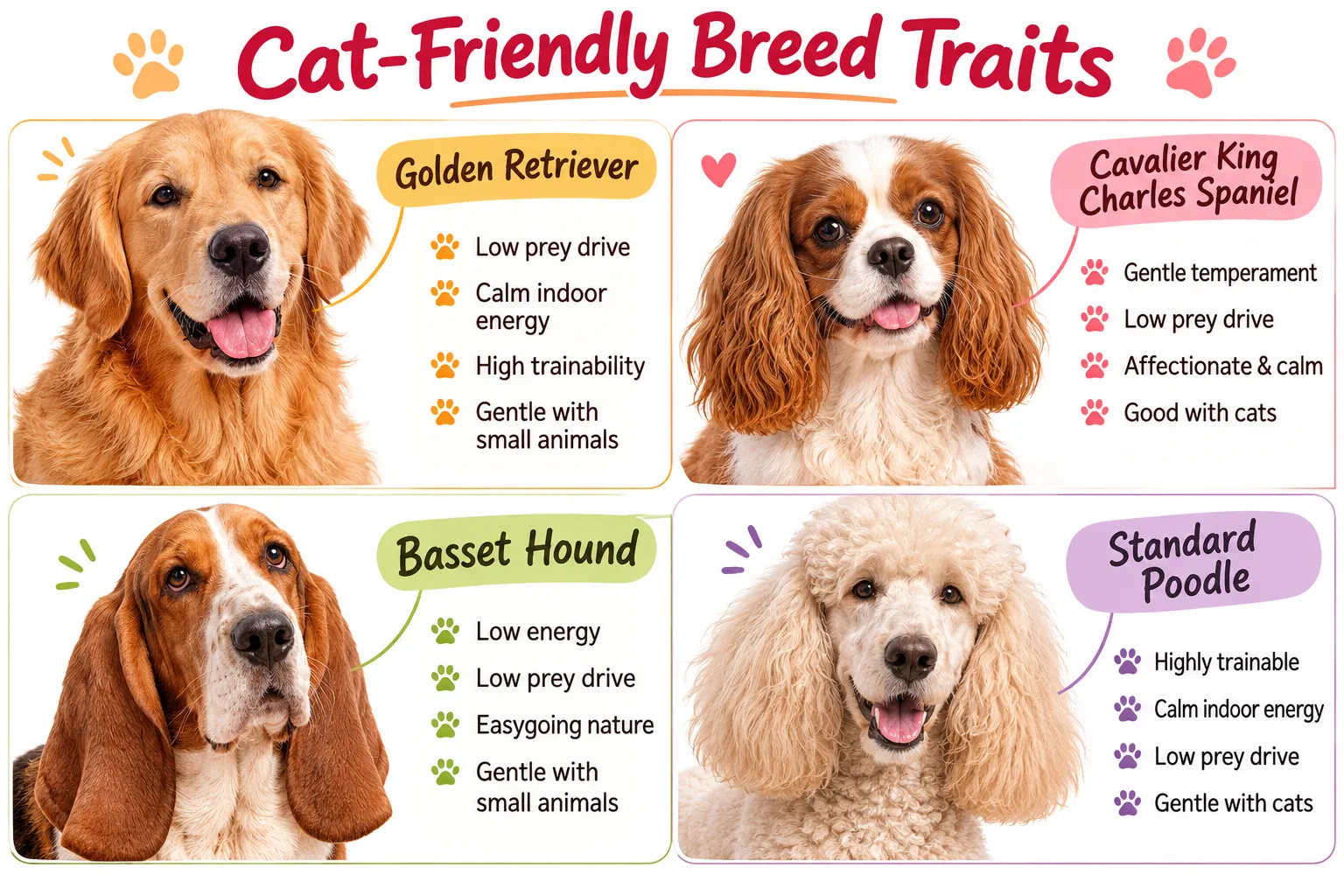
Top-Tier Cat-Friendly Breeds (Low Prey Drive, High Trainability)
| Breed | Energy Level | Why It Works With Cats |
|---|---|---|
| Golden Retriever | Moderate | Gentle, social, eager to please[3][4][5] |
| Labrador Retriever | Moderate-High | Friendly, trainable, food-motivated for redirects[3][4] |
| Cavalier King Charles Spaniel | Low | Affectionate, calm lap-dog temperament[3][4][6] |
| Basset Hound | Low | Laid-back, low chase instinct[3][4] |
| Pug | Low | Social, non-territorial, low prey drive[4] |
| Poodle (Standard, Mini, Toy) | Moderate | Highly trainable, intelligent, adaptable[3][4][5] |
| Bernese Mountain Dog | Low-Moderate | Composed, rarely guards space, gentle giant[2] |
| Tibetan Spaniel | Low | Small, calm, respects cats’ personal space[2] |
| Maltese | Low | Tiny, gentle, good with calm cats[3] |
Want more info on calm, family-friendly giant breeds? Check out why so many families swear by Bernese Mountain Dogs as the best family dogs, and browse these adorable Bernese Mountain Dog puppies for a glimpse of that gentle giant energy.
The “Depends on the Dog” Middle Tier
Beagles land here. They’re pack-oriented and sweet, but bred for hunting small game.[3][5][7] The difference-maker? Early, positive exposure to cats. Beagles raised alongside cats from puppyhood often grow into total homebodies who treat the cat like a sibling.[3][5]
This is a great reminder: socialization timing matters as much as breed. A puppy that meets calm, confident cats early builds healthy associations for life.
Breeds That Need Extra Caution Around Cats
A mid-2026 analysis flagged several breeds as frequent mismatches for cat households, mainly due to strong chase instincts and intense play styles.[7]
- Siberian Huskies, bred to run and chase, high prey drive[7]
- Australian Cattle Dogs, herding instinct can morph into chasing[7]
- Many terrier breeds, originally bred to hunt vermin[7]
- Certain sighthounds, built for high-speed chase[7]
This doesn’t mean these dogs can never live with cats. It means they need more training, more management, and more realistic expectations.[7] If you’re drawn to a higher-energy breed, go in with eyes open and a solid plan.
For families specifically weighing a Beagle or working breed, remember: a dog’s individual history always outweighs breed stereotypes.[1][7][8] A mellow Husky mix might do fine. A twitchy-eyed Golden might not. Assess the actual dog in front of you.
If you’re a first-time dog owner trying to navigate all of this, our guide to cute dog breeds for first-time owners can help you pick a manageable match overall, and our best dogs for beginners roundup covers even more low-stress options.
A Step-by-Step Introduction Protocol That Actually Works
Rushing introductions is the #1 mistake families make. Slow down. Your cat (and your new pup!) will thank you.

Step 1: Scent Swapping First
Before any face-to-face meeting, swap bedding or blankets between the dog and cat.[1][8] This lets both animals get familiar with each other’s smell in a low-stress way. No pressure, no eye contact, just scent.
Step 2: Visual Contact Through a Barrier
Once scent swapping feels normal, introduce visual contact. Use a baby gate or cracked door.[1][8] Keep sessions short, just a few minutes. Watch body language closely.
Signs things are going well:
- Relaxed posture, soft eyes
- Curious but calm sniffing
- Normal tail position
Signs to pause and back up:
- Staring, stalking, stiff body (dog)
- Hissing, puffed tail, hiding (cat)
- Tail lashing or growling from either animal
Step 3: Short, Leashed, On-Leash Sessions
Only move to in-person meetings once both animals seem relaxed during barrier sessions.[1][8] Keep the dog leashed. Keep sessions brief and positive. End on a good note, always.
Step 4: Supervised Free Time
Gradually extend unleashed, supervised time together. Still watch closely. Still have an exit plan, a gate, a door, a quick “leave it” cue ready to go.
Throughout this whole process, train key cues: “leave it,” “stay,” and a rock-solid recall.[1] These commands let you interrupt fixation before it becomes a chase. Reward calm behavior around the cat generously. Skip punishment-based training, it tends to increase anxiety and can actually make reactions less predictable.[1]
“The goal isn’t a fast introduction. The goal is a safe one.”, a sentiment echoed across every major animal welfare organization’s guidelines.[1][8]
Daily Management for Best Dog Breeds for Families With Cats: Long-Term Household Habits
Here’s the part people forget: management doesn’t end after a successful introduction. It’s a permanent part of multi-pet life, especially for dogs with any prey drive history.[1][2][8]
Build these habits into your daily routine:
- 🍽️ Separate feeding areas. Food competition creates tension fast.[1][2][8]
- 🪜 Vertical space for your cat. Cat trees, shelves, and high perches give cats an escape route and a sense of control.[1][8]
- 🚪 Gates and closed doors when unsupervised. Never leave a dog with any chase history alone with your cat.[1][2][8]
- 🦮 Leash or tether indoors for dogs still working on impulse control around the cat.[1][2][8]
- 🏃 Clear escape routes throughout the house so your cat never feels cornered.
These small habits add up to a home where everyone feels safe, and that safety is what actually builds real affection between pets over time.
Calm, composed breeds make this easier. Dogs described as rarely food-guarding and naturally respectful of a cat’s space, like Bernese Mountain Dogs and Tibetan Spaniels, tend to move through shared management routines with less friction.[2] But even the chillest breed still needs structure. Management isn’t a sign something’s wrong. It’s just good pet parenting.
If your home is already a cozy multi-pet situation, you might also enjoy learning what it means when your dog sleeps with you, bonding behaviors like that often show up once a dog feels fully settled with the whole family, cats included.
Choosing the Right Dog for Your Specific Household
Before you fall in love with a breed on paper, be honest about your household variables:
Ask yourself:
- Is my cat young, confident, and adaptable, or older, anxious, and set in their ways?
- Do I have time for weeks (sometimes months) of gradual introductions?
- Can I commit to permanent management habits, not just a temporary phase?
- Am I getting a puppy (easier to socialize early) or an adult rescue dog (needs a known history)?
A confident, dog-savvy cat adjusts to almost any calm breed. A timid, skittish cat needs an extra-gentle, low-energy dog and a much slower timeline. There’s no shame in taking things slow, it’s the responsible move.
If you’re drawn to smaller companion breeds for an easier fit, browse small dog breeds or toy dog breeds for size-appropriate, typically lower-energy options that often pair well with cats.
Conclusion: Building a Tail-Wagging, Purr-fect Household
Finding the best dog breeds for families with cats comes down to three honest steps: pick a breed known for low prey drive and gentle temperament, follow a slow and deliberate introduction protocol, and commit to management habits that last a lifetime, not just the first few weeks.
No breed guarantees instant harmony. But Golden Retrievers, Labradors, Cavaliers, Basset Hounds, Pugs, and Poodles consistently give families the best shot at a peaceful multi-pet home.[3][4][5][6] Meanwhile, high-energy, high-prey-drive breeds aren’t off the table, they just need realistic expectations and extra management.[7]
Your next steps:
- Research your shortlist breed’s real-world temperament, not just its reputation.
- Meet the actual dog (not just the breed) before committing.
- Start scent swapping before any face-to-face meeting.
- Build permanent management habits from day one.
- Celebrate small wins, every calm, curious sniff is progress. 🐶🐱
Your furry family, all of it, paws and whiskers included, deserves a home built on patience, structure, and a whole lot of love.
References
- How Introduce Cats Dogs. bestfriends.org.
- Dog Breeds Ideal for Homes with Dogs and Cats. worldanimalfoundation.org.
- Dogs Breeds Good with Cats. postoffice.co.uk.
- Dogs That Are Good with Cats. akc.org.
- Dogs That Are Good with Cats. dogster.com.
- Dogs That Like Cats 2026. scotsman.com.
- Worst Dog Breeds for Cats. dogster.com.
- Introducing Dogs and Cats. arl-iowa.org.
dog breeds good with cats, prey drive, dog cat introductions, multi-pet household, golden retriever, cavalier king charles spaniel, beagle temperament, pet safety tips, cat friendly dogs, family dog breeds, dog training cues, animal behavior