A dachshund’s back can go from “totally fine” to “emergency surgery” in the time it takes to jump off a couch. That’s the harsh truth behind Dachshund & Wiener Dog Health Issues: 15 Problems Owners Miss Until It’s Too Late. These goofy, loyal, sausage-shaped pups steal hearts everywhere they waddle. But their adorable long bodies come with some serious hidden risks.

One study tracking over 43,000 companion dogs found dachshunds had the highest lifetime rate of owner-reported spinal disc disease of any breed tested, 15.3%.[1] That’s not a small number. That’s roughly one in six wiener dogs.
This guide breaks down the 15 health problems dachshund parents miss most often, and exactly what to watch for before things get scary.
Key Takeaways
- IVDD (disc disease) is the #1 threat to dachshunds, affecting up to 25% over a lifetime, driven by the CDDY gene.[2]
- Early warning signs, stiffness, hesitation to jump, mild wobbling, get brushed off as “aging” until paralysis hits.[3]
- Obesity quietly amplifies almost every other condition on this list, especially spine and joint problems.
- Skin allergies, dental disease, heart issues, and eye disease progress slowly and are often ignored until advanced.[4][5]
- Routine vet checks, weight management, and spinal screening can catch most of these problems early.[6]
Why Dachshunds Face So Many Hidden Health Risks
That long back everyone loves? It’s actually the root of most dachshund health drama. Breeding for short legs and a stretched-out spine created a genetic quirk called chondrodystrophy. It gives dachshunds their iconic look. It also calcifies their spinal discs early in life.[2]

Genetics researchers have pinpointed a mutation called CDDY as the main culprit.[7] Dogs carrying two copies of this gene show dramatically higher rates of calcified discs. Translation: their spine ages faster than the rest of their body.
Owners who want the full breed history can check out Dachshunds: Bred to Fight Badgers & Their Wild History for context on how this body shape came to be.
Now let’s get into the 15 issues that catch dachshund parents off guard.
1. Intervertebral Disc Disease (IVDD), The Big One
IVDD tops every list of dachshund & wiener dog health issues for good reason. It happens when a spinal disc bulges or ruptures, pressing on the spinal cord. The result? Pain, wobbly legs, or full paralysis.
Early signs owners miss:
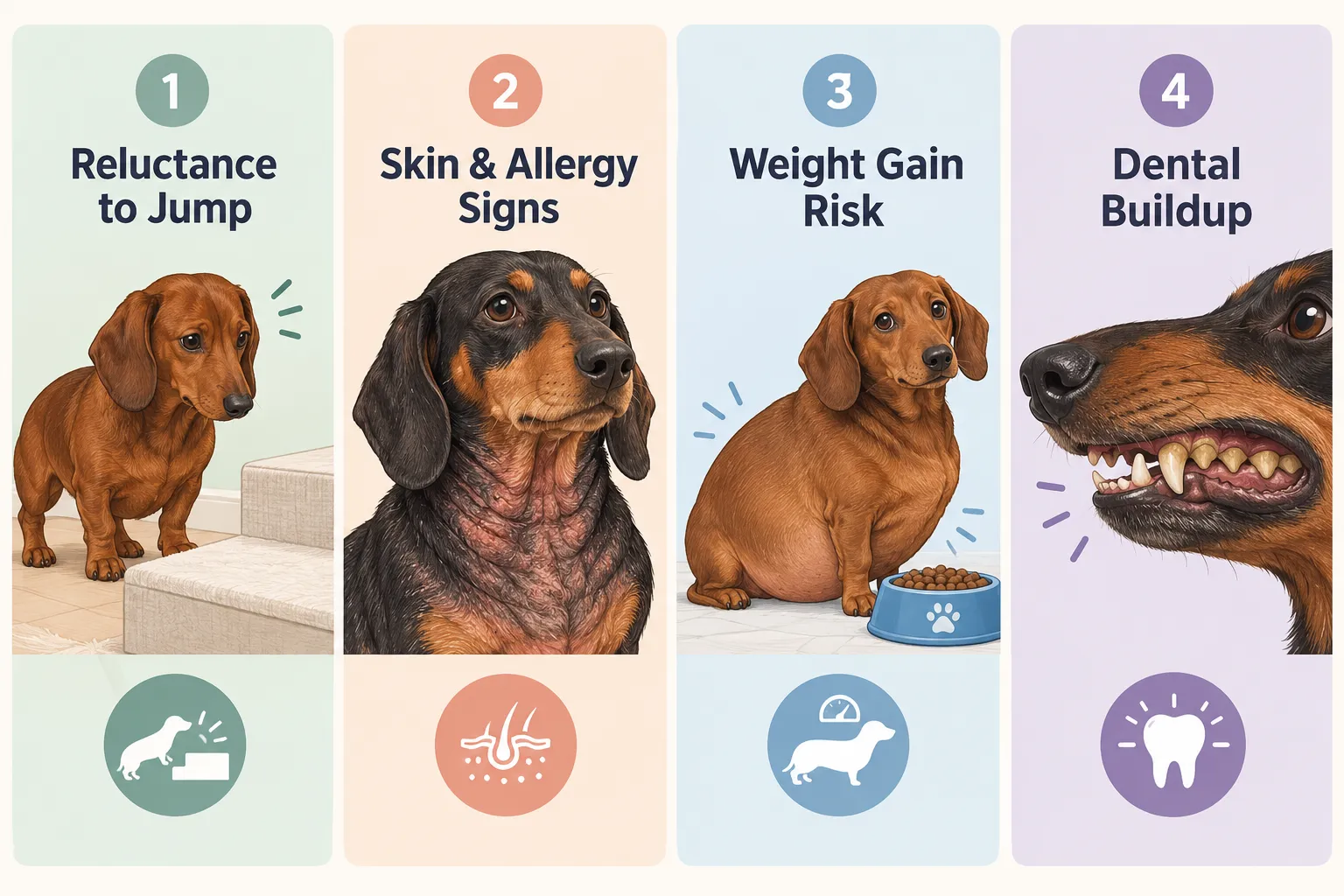
- Reluctance to jump on furniture
- Hunched back or tucked tail
- Mild stiffness after naps
- Yelping when picked up
A 2025 multicenter study found IVDD lesions in dachshunds mostly occur in the thoracolumbar spine, the middle-to-lower back.[8] That’s different from some other breeds, so hind-leg weakness can be mistaken for “just getting old” instead of a spinal emergency.[3][8]
🐾 “A wobble today can mean paralysis tomorrow. Don’t wait to call the vet.”
For a deeper breed-specific breakdown, check 11 Weiner Dog Health Issues Every Owner Must Know.
2. Disc Calcification Caught Too Late
Here’s a stat that should make every dachshund parent sit up: dogs aged 7+ with heavy disc calcification (Grade 3 on spinal X-rays) were 12 times more likely to suffer an IVDD incident compared to lower grades.[6]
The problem? Most owners never get imaging done until after a crisis. Proactive screening, especially for middle-aged dogs with any back pain history, can flag risk years in advance.[3][6]
3. The CDDY Gene and Breeding Risk
Because CDDY is now a known genetic marker, responsible breeders can test for it.[7] If a wiener dog’s parents carry two copies, that pup faces a much higher lifetime IVDD risk. Ask breeders about genetic screening before bringing home a puppy.
4. Obesity, The Silent Amplifier
Extra weight is brutal on a dachshund’s long spine. Even a few pounds puts serious stress on discs and joints, turning a mild IVDD risk into a near-certainty.
Signs of creeping weight gain:
- No visible waist from above
- Difficulty feeling ribs
- Slower on walks
- Reluctance to climb stairs
Vet-reviewed guidance is blunt: portion control and daily low-impact exercise aren’t optional extras, they’re medical necessities for this breed. Browse the Sausage Dog Problems tag for more on body-shape-specific risks.
5. Chronic Skin Allergies
Allergies generate more dachshund vet visits than almost anything else.[5] Itchy paws, red skin, and recurring ear infections often get treated with a quick cream and forgotten.
Watch for:
- Constant licking or chewing paws
- Red, irritated armpits or groin
- Recurrent “yeasty” smell
6. Acanthosis Nigricans (Dark, Thickened Skin)
This condition causes thick, dark, leathery patches, usually in the armpits and groin.[4] It’s uncomfortable and often progressive. Many owners assume it’s just “dirt” or a minor rash, delaying real treatment.
7. Recurrent Ear Infections
Floppy ears trap moisture and debris. Combined with allergies, dachshunds are prone to repeat ear infections that owners treat once and ignore when symptoms return.[5]
8. Heart Disease That Hides in Plain Sight
Mitral valve disease and dilated cardiomyopathy are both common in dachshunds, and both can be silent for years.[3]
Subtle clues:
- A soft, occasional cough
- Getting tired faster on walks
- Slightly faster breathing at rest
Dachshunds are also over twice as likely to develop patent ductus arteriosus (PDA), a congenital heart defect that can be fatal without early treatment. Puppy wellness checks that include a heart listen are genuinely life-saving here.
9. Eye Diseases Owners Catch Too Late
Cataracts, glaucoma, cherry eye, corneal ulcers, and dry eye all show up disproportionately in this breed.[3] Dry eye is especially sneaky, it’s frequently linked to underlying diabetes or thyroid issues.[3]
Early red flags:
- Occasional eye rubbing
- Mild discharge
- Bumping into furniture at night
10. Progressive Retinal Atrophy (Night Blindness)
Dachshunds have a genetic predisposition to generalized progressive retinal atrophy (GPRA), where retinal cells slowly die off. It often starts as trouble seeing in dim light before progressing to full blindness. Regular eye screening catches this long before owners notice behavior changes.
11. Paroxysmal Dyskinesia (Movement Episodes)
This one surprises a lot of owners. A case series of 62 dachshunds documented episodes of involuntary movements, stiffening, odd gait, brief “freezing” spells, with brain scans often coming back normal.[9] These episodes get mistaken for pain flares or quirky behavior instead of a real neurological condition.
12. Idiopathic Epilepsy and Seizures
Seizure disorders show up fairly often in dachshunds and are typically managed with daily medication once diagnosed. Short, confusing episodes, a blank stare, brief collapse, odd twitching, deserve a vet visit, not a shrug.
13. Diabetes and Cushing’s Disease
Endocrine issues creep up slowly. Diabetes can contribute to cataracts, dry eye, and chronic infections.[3][4] Cushing’s disease, caused by excess cortisol, brings increased thirst, a pot-bellied look, muscle loss, and skin problems. Both conditions are easy to dismiss early, but untreated, they cause irreversible organ damage.[3][4]
14. Patellar Luxation and Joint Disease
A dachshund’s unusual leg structure makes luxating kneecaps and hip abnormalities common.[4] Many dogs limp on and off for months before owners get it checked, letting arthritis set in permanently.
Common signs:
- Occasional skip-hop while walking
- Stiffness after rest
- Avoiding stairs
Explore the Dog Joint Health tag for more on spotting joint pain early.
15. Dental Disease With Whole-Body Consequences
Plaque and tartar buildup are extremely common in dachshunds, and periodontal disease doesn’t stay in the mouth. It’s linked to heart and kidney stress over time. Yet daily brushing often doesn’t start until teeth are already in rough shape.
Quick Reference: Signs vs. Action
| Symptom | Could Mean | What To Do |
|---|---|---|
| Reluctant to jump | Early IVDD | Vet exam + possible imaging |
| Dark, thick skin folds | Acanthosis nigricans | Dermatology check |
| Occasional cough | Heart disease | Vet heart exam |
| Night bumping into things | Retinal disease | Eye specialist referral |
| Brief stiffening spells | Neurological disorder | Neuro work-up |
| Pot-bellied look, more thirst | Cushing’s / diabetes | Bloodwork |
| Skip-hop in back legs | Patellar luxation | Orthopedic exam |
Prevention Checklist for Dachshund Parents
- ✅ Keep weight lean, ribs should be easy to feel
- ✅ Limit jumping on/off furniture; use ramps or steps
- ✅ Schedule annual spinal and heart checks after age 5
- ✅ Brush teeth several times a week
- ✅ Watch for subtle eye and skin changes monthly
- ✅ Ask breeders about CDDY genetic testing
- ✅ Don’t ignore “mild” wobbling, call the vet
New dachshund owners might also find 15 Best Small Dog Breeds for First-Time Owners (2026) and New Dog Owner Tips helpful for building healthy routines early. For ongoing breed research, follow Pet Health 2026.
Conclusion
Dachshunds are tiny dogs with giant personalities, and giant hidden health risks. The list of Dachshund & Wiener Dog Health Issues: 15 Problems Owners Miss Until It’s Too Late proves one thing: early detection changes everything. IVDD, obesity, heart disease, and dental decay all share one trait, they progress quietly before exploding into emergencies.
The fix isn’t complicated. Keep weight in check. Watch for small changes in movement, skin, eyes, and energy. Book regular vet visits, even when nothing seems wrong. A proactive dachshund parent can catch 90% of these problems while they’re still manageable.
Start today: schedule a wellness check, feel for your pup’s ribs, and watch how they move on the next walk. That simple habit could add years to their tail-wagging life.
References
- pubmed.ncbi.nlm.nih.gov. pubmed.ncbi.nlm.nih.gov.
- Be Careful What You Select for. bsmpartners.net.
- Dachshund Health Problems. animalfriends.co.uk.
- Never Buy Dachshunds or Dachshund Mixes. peta.org.
- Dachshund. dutch.com.
- Launching the 2025 Dachshund Health Report. dachshundhealth.org.uk.
- Omia000157. omia.org.
- pubmed.ncbi.nlm.nih.gov. pubmed.ncbi.nlm.nih.gov.
- Aalag195. academic.oup.com.