14.5% of six‑month‑old puppies pace. 7.6% whine. 6.9% spin in circles. And that’s just the behaviors owners can see on camera. What really happens to your dog when you leave them alone goes deeper than a chewed shoe or a puddle on the floor. It’s a mix of biology, emotion, and instinct that scientists are still unpacking.

You might think your dog snoozes the day away. For some lucky pups, that’s true. But for many others, those quiet hours are filled with confusion, anxiety, and physical stress. The good news? Once you understand what’s really going on, you can take simple steps to help your furry family member feel safe and calm.
Key Takeaways
- Many dogs show subtle stress signals when left alone, even if they don’t destroy the couch.
- Separation anxiety is a real clinical condition, but mild distress can also chip away at your dog’s wellbeing.
- Small tweaks, like calm goodbyes and long‑lasting chews, can dramatically improve alone time.
- A camera is your best tool for uncovering what your dog won’t tell you.
The Emotional Reality of Being Left Alone
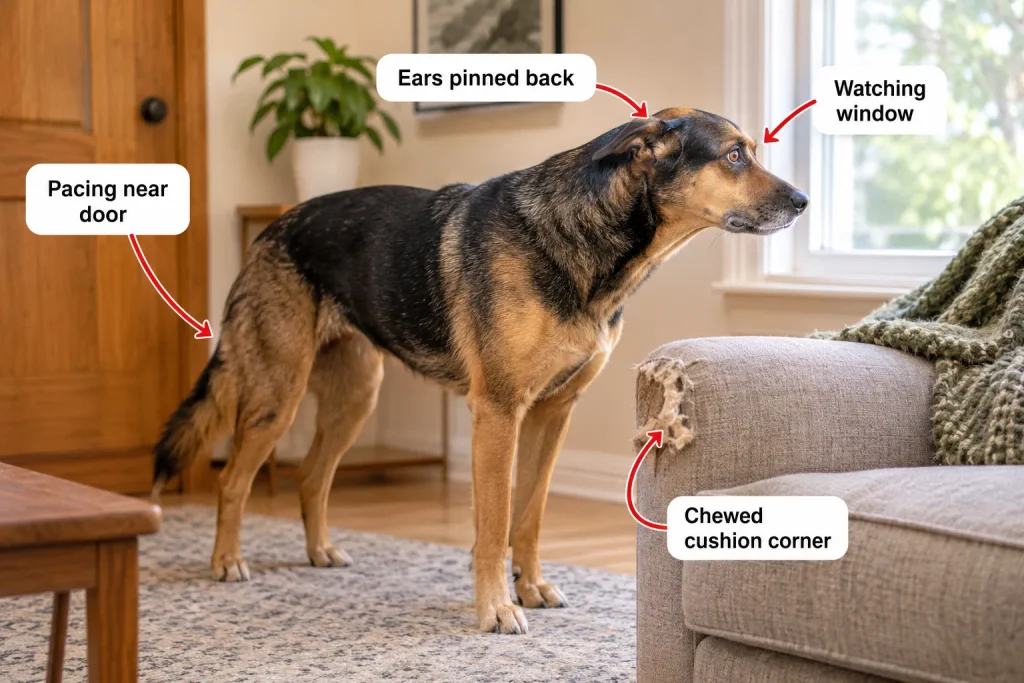
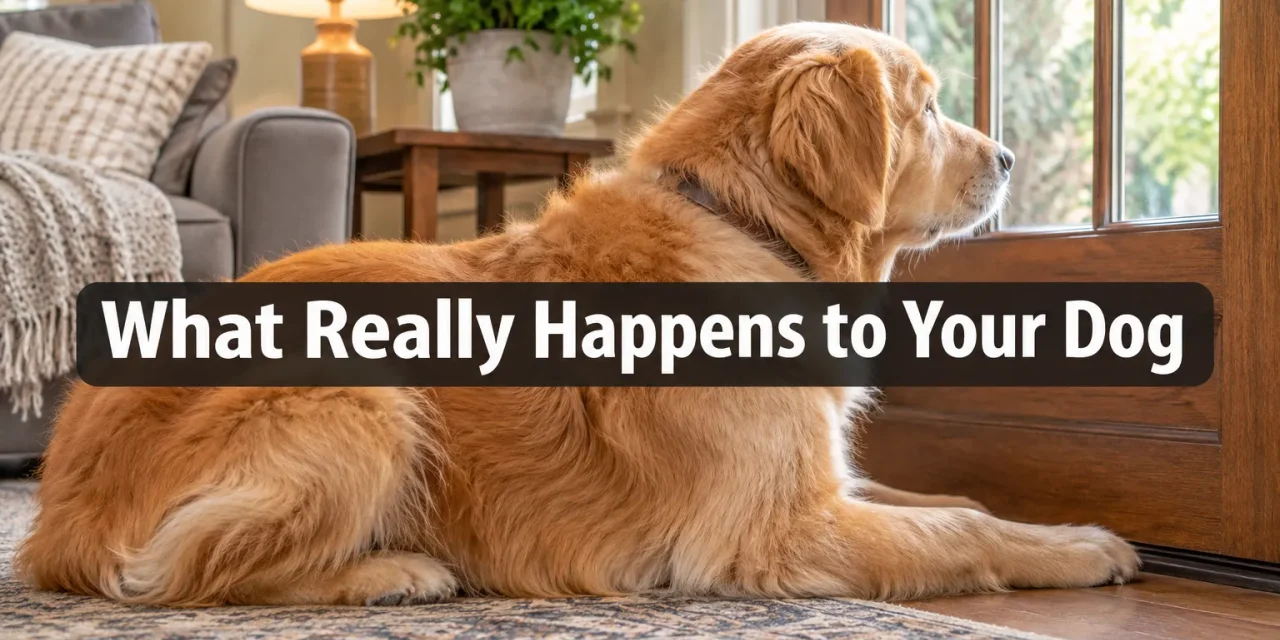
Dogs are social creatures. In the wild, being separated from the pack meant danger. That instinct still hums under the surface of your pampered pooch. When you walk out the door, your dog doesn’t know you’ll be back in an hour or a week. Their internal clock isn’t like yours.
Research shows that dogs form deep attachment bonds with their humans. A 2026 study used a “Strange Situation” test, the same method used to study human infants, to measure how dogs react when their owner leaves. Dogs with an anxious attachment style showed a strong stress response the moment they were alone. Their heart rate climbed. Their body temperature rose. Salivary cortisol, a stress hormone, spiked [1].
In contrast, dogs with a secure attachment stayed calmer. They might watch the door, but their bodies didn’t go into overdrive. This tells us something important: what really happens to your dog when you leave them alone depends heavily on the emotional bond you share.
What Really Happens to Your Dog When You Leave Them ALONE: Attachment Matters
That same 2026 study highlighted a key difference. Dogs with an anxious attachment didn’t just feel sad, they experienced acute physiological stress. It’s the canine equivalent of a panic attack. And it can happen even if you’re only gone for ten minutes [1].
Another clinical study compared dogs diagnosed with separation anxiety to those without. When left alone, anxious dogs spent significantly more time at the door the owner used to exit. They paced, panted, and stayed on high alert. Non‑anxious dogs, on the other hand, often settled near the owner’s chair, even though the owner wasn’t in it [2].
So if your dog waits by the door for hours, it’s not just loyalty. It’s a sign their brain is stuck in “search” mode.
Signs of an anxious attachment might include:
- Following you from room to room when you’re home
- Panicking when you pick up keys or put on shoes
- Excessive excitement upon your return, even after short absences
- Refusing to eat treats or food when alone
If these sound familiar, your dog may be telling you that alone time feels unsafe.
The Physical Signs You Might Miss
You come home to a wagging tail and a wiggly butt. Everything seems fine. But what happened while you were gone?
A Swedish study recorded twelve pet dogs at home on three different occasions. Researchers tracked behavior and cardiac activity when the dogs were left alone. The results? Many dogs showed increased heart rate and restless behavior that owners never witnessed [3].
That’s the tricky part. Dogs are masters at hiding discomfort. In the wild, showing weakness made you a target. Your dog still carries that programming. So even if they greet you with a toy, they might have spent the last hour pacing, whining, or freezing in place.
What Really Happens to Your Dog When You Leave Them ALONE: A Body Under Stress
Here’s what stress can look like on the inside:
- Elevated heart rate, A dog’s resting heart rate can jump 30-50 beats per minute during alone time [1][3].
- Increased cortisol, This stress hormone floods the bloodstream, preparing the body for fight or flight.
- Higher body temperature, Stress literally heats up the body, a sign the nervous system is in overdrive [1].
- Digestive upset, Stress can cause loose stools or vomiting, sometimes hours after you return.
These aren’t just numbers. They’re proof that your dog’s body is working hard to cope. Over time, chronic stress can weaken the immune system and lead to other health problems.
To make this clearer, here’s a quick comparison:
Note: Actual values vary by breed and size. Always consult your vet for your dog’s normal ranges.
Why Some Dogs Struggle More Than Others
Not every dog panics when left alone. So what tips the scales?
Genetics play a role. Some breeds are more prone to separation anxiety, including Labrador Retrievers, Border Collies, and Cavalier King Charles Spaniels. But any dog can develop it.
Early life experiences matter too. Puppies who were separated from their littermates too early or who had multiple homes may be more vulnerable.
Routine changes are a huge trigger. A UK study looked at dogs’ alone time before, during, and after COVID‑19 lockdowns. Dogs whose alone time decreased the most during lockdown were at the highest risk of developing new separation‑related behaviors, like barking, howling, toileting indoors, and destructiveness, once owners started leaving again [4].
That explains why so many “pandemic puppies” struggled when the world reopened. They’d never learned to be alone.
The definition of separation anxiety helps clarify things. According to a 2026 synthesis of major animal welfare organizations, separation anxiety is distress that appears specifically when the dog is away from their primary bonded person. It’s not about boredom or lack of training. It’s a panic response [5].
Other risk factors include:
- Age: Adolescent dogs (6-18 months) and senior dogs with cognitive decline are at higher risk.
- Trauma: Dogs who’ve experienced abandonment or long shelter stays often carry that fear.
- Single‑pet households: Dogs without another animal companion may rely more heavily on human contact.
The Pandemic Puppy Phenomenon
If you adopted a dog during 2020-2021, you’re not alone in facing separation challenges. Many of those dogs spent their first months with owners home 24/7. They never learned that being alone is normal. When life returned to offices and schools, these dogs were blindsided.
The UK study found that the dogs most affected were those whose alone time dropped to near zero during lockdown. When alone time suddenly increased, they didn’t have the coping skills. The result? A spike in separation‑related behaviors [4].
This isn’t your fault. It’s a predictable outcome of a global event. But it does mean you may need to put in extra work to teach your dog that alone time is safe.
What Really Happens to Your Dog When You Leave Them ALONE: Spotting the Hidden Signs

Most owners underestimate what happens when they’re not home. That’s why experts now recommend setting up a camera [6][7][8].
When you watch the footage, you might see:
- Pacing or circling
- Whining, howling, or barking
- Drooling or lip‑licking
- Shaking or trembling
- Destructive chewing focused on exit points (doors, windows)
- Inappropriate toileting despite being house‑trained
- Freezing or hiding
These behaviors often start within minutes of your departure. Some dogs escalate over time. Others shut down and appear “frozen”,a sign of extreme stress that’s easy to misinterpret as calmness.
A recent practitioner guide notes that many owners are shocked when they first watch the video. “I had no idea he cried for an hour,” is a common reaction [8].
What really happens to your dog when you leave them alone isn’t always loud destruction. Sometimes it’s silent suffering.
The Camera Doesn’t Lie
A Wi‑Fi pet camera is more than a gadget. It’s a window into your dog’s private world. Set it up, leave the house, and watch from your phone. You might notice:
- Your dog starts panting within 90 seconds of your departure.
- They ignore a stuffed Kong that they’d normally devour.
- They move from window to window, searching.
- They let out low, mournful howls you’ve never heard before.
This information is gold. It tells you exactly where your dog is on the stress scale and whether your training is working.
A Minute‑by‑Minute Breakdown
Here’s what often happens when an anxious dog is left alone:
- 0-2 minutes: Dog watches the door, ears up, body tense.
- 2-10 minutes: Pacing begins. Whining or low barking starts. Some dogs scratch at the door.
- 10-30 minutes: If no one returns, the dog may escalate to howling, destructive chewing, or toileting. Salivary cortisol rises.
- 30+ minutes: Some dogs exhaust themselves and lie down, but remain vigilant. Others continue the cycle.
This pattern, observed in multiple studies, shows that the first half hour is critical. If your dog can stay calm for that period, they’re likely to settle.
Boredom vs. Anxiety: Know the Difference
A destroyed pillow could mean “I was bored” or “I was panicking.” The two look similar but need different solutions.
Boredom behaviors tend to be:
- Random destruction (not focused on exits)
- Digging in the trash
- Chewing on furniture legs
- Happening after hours of alone time
Anxiety behaviors are often:
- Destruction around doors or windows
- Happening within the first 30 minutes
- Accompanied by vocalizing, panting, drooling
- Occurring even when the dog has plenty of toys
If your dog is bored, more exercise and enrichment usually fix it. If they’re anxious, you need a desensitization plan. Treating anxiety like boredom won’t help, and can make things worse.
Practical Ways to Make Alone Time Better
The goal isn’t to never leave your dog. It’s to teach them that being alone is safe. Here’s what the science says actually works.
1. Keep Departures and Reunions Calm
A study from the Royal Veterinary College found that owners who kept their goodbyes and hellos low‑key had puppies that spent more time resting quietly when alone. The advice? No big emotional scenes. A simple “be right back” and a quiet exit [9].
When you return, wait until your dog is calm before greeting them. This teaches that comings and goings are no big deal.
2. Build Alone Time Gradually
Start with seconds, not hours. Walk to the mailbox. Come back. Then try five minutes. Gradually increase the duration as your dog stays relaxed. This is called desensitization, and it’s the gold standard for treating separation anxiety [8].
A sample desensitization plan might look like:
- Day 1-3: Step outside for 30 seconds, return.
- Day 4-6: Leave for 2 minutes.
- Day 7-10: Leave for 5 minutes.
- Day 11-14: Leave for 10 minutes.
- And so on, always returning before your dog shows distress.
The key is to stay under your dog’s threshold. If they panic at 5 minutes, go back to 3 minutes and build slower.
3. Offer a Long‑Lasting Chew
A 2023 study tested different enrichment items during brief alone periods. Long‑lasting chews (like bully sticks or stuffed Kongs) produced the most positive and calm emotional states. Treat‑dispensing toys helped, but the chew kept dogs engaged longer and lowered stress more effectively [10].
Chewing releases endorphins. It’s a natural stress reliever. Give your dog a special chew that only appears when you leave. Soon, your departure becomes a cue for good things, not panic.
4. Use Background Noise
Soft music or white noise can mask outside sounds that trigger alertness. Many dogs relax to classical music or reggae, yes, there’s research on that too. A study from the Scottish SPCA found that dogs spent more time resting and less time standing when classical music played.
5. Consider a Camera
We already mentioned it, but it’s worth repeating. A Wi‑Fi camera lets you check in without coming home. Some models even dispense treats. Watching the footage helps you track progress and spot setbacks [7].
6. Exercise Before You Leave
A tired dog is a calmer dog. A brisk walk or play session before alone time can take the edge off. Mental exercise counts too, 10 minutes of training or puzzle games can tire a dog out as much as a 30‑minute walk.
7. Create a Safe Zone
Some dogs feel more secure in a crate or a small room. If your dog is crate‑trained and sees the crate as a den, it can be a sanctuary. Leave the door open so they can choose it. Add a comfy bed and an item that smells like you.
8. Practice “Fake” Departures
Your dog has learned that certain cues, jingling keys, putting on shoes, grabbing a bag, predict your departure. For an anxious dog, those cues trigger stress before you even open the door. Break the association by doing those actions randomly without leaving. Pick up your keys, then sit on the couch. Put on your coat, then make a cup of tea. Over time, these cues lose their power.
9. Use Calming Aids as a Support
Products like Adaptil diffusers release a synthetic version of the pheromone mother dogs produce to calm puppies. Some dogs respond well. Calming supplements with L‑theanine or casein may also help. These aren’t magic bullets, but they can lower baseline anxiety enough for training to stick. Always consult your vet first.
10. Never Punish
If you come home to destruction, take a deep breath. Your dog isn’t being naughty. Punishment, yelling, crating as discipline, rubbing their nose in mess, only confirms their fear that being alone is dangerous. It can shatter their trust in you. Instead, manage the environment (use baby gates, remove valuable items) and double down on training.
When to Call in the Pros
If your dog’s distress is severe, destruction that causes injury, non‑stop vocalization, self‑harm, it’s time to bring in reinforcements. A veterinary behaviorist or a certified separation anxiety trainer can create a customized plan.
Medication is sometimes part of the picture. Just like humans with panic disorder, some dogs need pharmaceutical support to bring their anxiety down to a level where training can work. This isn’t a failure. It’s a tool.
The American Veterinary Society of Animal Behavior emphasizes that punishment has no place in treating separation anxiety. Scolding your dog for destruction only adds fear to an already terrified mind [5].
Red flags that warrant professional help:
- Your dog injures themselves (broken teeth, bloody paws).
- They escape from crates or rooms and risk injury.
- They eliminate indoors despite being house‑trained.
- They vocalize non‑stop for more than 30 minutes.
- You’ve tried gradual training for weeks with no improvement.
The Cost of Ignoring the Problem
Mild separation distress doesn’t always stay mild. Without intervention, it can escalate. Chronic stress suppresses the immune system, making dogs more vulnerable to infections. It can lead to behavioral issues like aggression or compulsive disorders. And it strains the human‑animal bond, living with a dog who panics every time you leave is exhausting for both of you.
Addressing separation anxiety early is an investment in your dog’s long‑term health and happiness. It’s also a gift to yourself: the peace of mind that your furry family member is truly okay when you’re away.
What the Latest Research Tells Us
Science is constantly refining our understanding of canine separation. Here are a few key takeaways from recent studies:
- Puppyhood is critical. The Generation Pup longitudinal study found that separation‑related behaviors often appear by six months of age. Early intervention can prevent a lifetime of struggle.
- Not all “stress signals” are linear. A 2026 Veterinary Quarterly paper noted that behaviors like lip‑licking or yawning don’t always increase in a straight line with stress. Context matters.
- Home alone doesn’t mean miserable. The Swedish study emphasized that many dogs cope well, especially if they’ve been gradually accustomed to alone time [3].
- Enrichment matters. The chew study [10] and others confirm that giving a dog something to do changes their emotional state.
The bottom line? Your dog’s experience of alone time isn’t fixed. It can improve with the right approach.
Conclusion
Your dog’s alone time doesn’t have to be a mystery. The research is clear: many dogs experience real stress when left alone, but you have the power to change that. Start small. Watch the camera. Adjust your routine. Celebrate the wins, every quiet minute is a victory.
Your furry family member trusts you to keep them safe, even when you’re not in the room. With a little knowledge and a lot of love, you can turn those lonely hours into peaceful, tail‑wagging naps.
References
- S41598 026 60741 1. link.springer.com.
- Javma.20.08.0462. avmajournals.avma.org.
- The Effect of Time Left Alone at Home on Dog Welfare. research.slu.se.
- Pmc8868415. pmc.ncbi.nlm.nih.gov.
- Dog Separation Anxiety. furfam.club.
- Dog Separation Anxiety. hempmypet.com.
- Dogs and Separation Anxiety. anker.com.
- Separation Anxiety in Dogs Complete Guide to Treatment Training Prevention. dogcare.com.
- Keep Calm and Carry on New Study From the Rvc Offers Clues for How to Ease Puppy Separation Stress. rvc.ac.uk.
- Pmc9951671. ncbi.nlm.nih.gov.