A dog’s nose gets all the credit. But here’s the surprising part: a dog’s eyes and ears are doing wild things too, every single second, right next to you. While a human brain tunes out “boring” background noise, a dog’s brain is picking up whistles no one blew, hums no one made, and flickers no one else saw. This list of 10 things only dogs can see and hear (you can’t) will change how you look at your furry family member on your next walk.

1. Ultrasonic Whistles and Squeaks Humans Will Never Hear
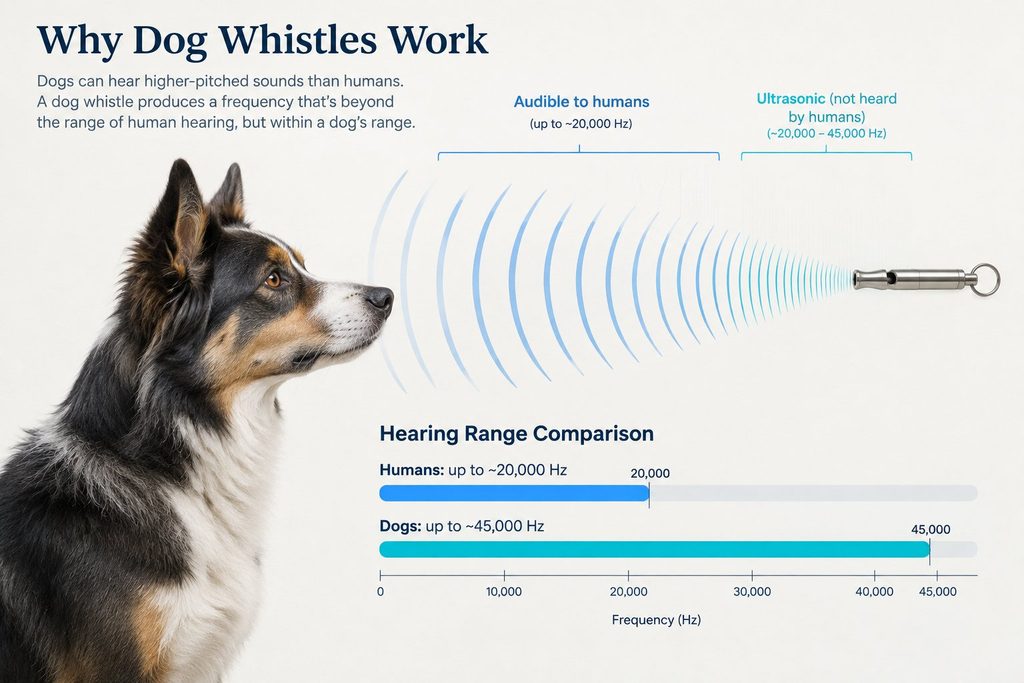
Dog whistles aren’t a gimmick. They work because dogs hear sound frequencies far above the human ceiling. Humans top out around 20,000 Hz. Dogs can pick up sounds reaching into the 45,000 Hz range [1][2].
That gap matters more than most owners realize. A mouse squeaking behind the wall, an insect buzzing in the grass, even certain electronic devices humming at a pitch too high for human ears—dogs hear all of it. That’s why a dog can snap to attention in a silent room for what looks like no reason at all.
Next time a dog suddenly stares at an empty corner, it’s probably not a ghost. It’s just a frequency problem.
2. Faint Sounds From Hundreds of Yards Away
A dog’s hearing range isn’t just about pitch. It’s also about distance. Dogs can detect faint sounds from roughly four times farther away than humans, with some estimates putting that at up to 400 meters out [1][2].
Picture a quiet backyard. A human hears nothing. A dog’s ears rotate, lock onto a direction, and start tracking something a human can’t even confirm exists yet—a car turning onto the street, a neighbor’s gate creaking open, a squirrel three yards over. This is part of why dogs often “predict” visitors before the doorbell rings.
This long-range hearing is one reason working dogs excel at guarding property. They’re not guessing. They’re hearing real sound a human body simply cannot pick up.
3. Split-Second Timing Differences Between Sounds
Dogs don’t just hear more sounds—they hear sound timing with sharper precision. Their ears and auditory processing can detect tiny differences in when a sound arrives at each ear, letting them pinpoint a sound’s exact location faster than a human brain can [3][4].
This is why a dog can spin around and look directly at the spot where a treat bag crinkled, even from another room, without hesitation. The brain is comparing split-second arrival times between both ears and calculating location almost instantly.
It’s a small advantage with a big payoff: faster reactions to squeaky toys, faster alerts to danger, and that uncanny ability to find a dropped crumb before it even hits the floor.
4. Tiny, Fast Movements That Look Like Nothing to Humans
Human eyes are great at spotting slow, obvious motion. Dog eyes are built differently. Dogs are especially good at catching quick, subtle movement—flickers that register to a human as stillness [5][6].
A twitch of a squirrel’s tail in tall grass. A fly’s first wingbeat before takeoff. The barely-there shift of a toy rolling an inch on carpet. A human glancing at the same scene might see nothing happening at all. A dog’s eyes are already locked on.
This motion sensitivity traces back to a dog’s history as a hunter. Catching fast, small movement used to mean the difference between eating and going hungry, and that wiring is still very much active today.
5. Shapes and Movement in Near-Total Darkness
Turn off the lights and a dog’s world doesn’t go dark the way a human’s does. Dog eyes have more rod cells and a reflective layer called the tapetum lucidum, which bounces light back through the retina for a second pass [5][6].
That means a dog walking through a dim hallway at 2 a.m. can still make out shapes, furniture edges, and movement that looks like pure black to a human stumbling around with hands out. It’s part of why dogs rarely bump into things at night and why they can still play fetch in a yard that seems pitch black.
This low-light advantage made total sense for a dog’s wild ancestors, who hunted at dawn and dusk. Good night vision meant survival. For a modern house dog, it just means confidently finding the water bowl in the dark.
6. Ultraviolet Light and Traces Invisible to the Human Eye
Here’s one most dog owners have never heard: some evidence suggests dogs can perceive ultraviolet light, a wavelength completely invisible to the human eye [5][6].
This could mean dogs pick up patterns on flowers, certain stains, or even urine marks left by other animals in ways no human ever will. Urine and certain biological markers can reflect UV light, so what looks like plain grass to a person might carry a visible “trail” to a dog.
It’s a reminder that a dog’s world isn’t just louder—it’s visually richer in ways that don’t translate to the human experience at all. A sniff isn’t the only tool a dog uses to read a yard; the eyes are working too.
7. Blue and Yellow Color Contrasts Humans Miss in Dim Light
Dogs don’t see color the way humans do. Where humans have three types of color receptors, dogs mainly have two, making them strongest at telling apart blues and yellows [5][6].
In bright daylight, this difference barely matters for everyday life. But in low light or at a distance, dogs can pick up blue-yellow contrast that a human eye blends together into gray mush. A yellow tennis ball against green grass at dusk might be nearly invisible to a person but still pop for a dog’s eyes.
This is a handy fact for picking dog toys, too. Bright blue or yellow items tend to stand out far better to a dog than red or green ones, which can look dull or washed out in a dog’s color range.
8. A Much Wider View With Peripheral Motion Built In
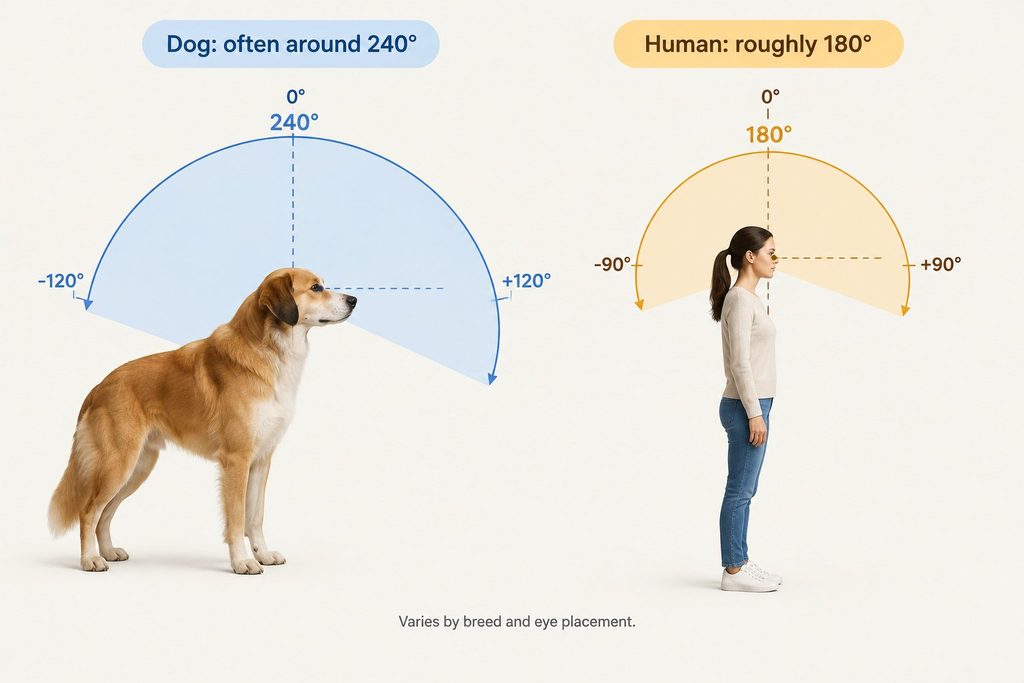
Dogs have a wider field of view than humans—often around 240 degrees compared to a human’s roughly 180 degrees, depending on the breed and eye placement [5][6].
That extra range means dogs catch peripheral movement humans flat-out miss. A hand reaching toward a dog bed from the side, a person approaching from an angle, a bird darting past at the edge of the yard—dogs often react to these before a human even turns their head.
The tradeoff is a little less sharp detail straight ahead compared to humans. But for a creature built to notice threats and movement from almost every direction at once, that tradeoff is clearly worth it.
9. Subtle Shifts in a Human’s Voice, Posture, and Scent
This one isn’t about a single sense—it’s about how a dog blends several at once. Dogs are remarkably tuned in to small, layered changes in a human’s tone of voice, body posture, breathing, and body scent, often stacking these cues together faster than a human could consciously notice them in themselves [7][8][9].
A person might think they’re hiding stress behind a calm voice. The dog already knows. A slightly stiffer posture, a faster heartbeat’s scent signature, a tighter tone—dogs pick up the combination and respond, sometimes by leaning in close or refusing to settle down.
This is part of why dogs seem almost psychic around grief, anxiety, or illness. They’re not reading minds. They’re reading a flood of small physical signals that most humans never learn to notice in each other.
10. Hidden Structure Inside Barks, Growls, and Other Animal Calls
Human ears hear a bark as just a bark. Dog ears and dog brains likely process far more structure inside that sound—pitch shifts, rhythm changes, and tonal patterns that may carry different meaning depending on context [3][4][10].
A low, drawn-out growl during play might carry a totally different internal “signature” than a defensive growl, even if both sound similar to a human. Dogs may also catch structural detail in other animal calls—birds, other dogs blocks away, even wildlife—that blends into generic noise for a human listener.
This complexity hints that dog vocal communication, and the animal world they listen to, is far more detailed than it sounds to the human ear. What seems like simple barking may actually be layered information only another dog—or a very sensitive microphone—could fully decode.
Bonus Context: The Environment Adds Even More
Beyond these ten senses lies one more wrinkle: the environment itself. Dogs often react to background mechanical whines, electronic hums, or device sounds that blend into silence for human ears but register clearly for a dog [2]. Combined with motion, scent, and emotional cues, a dog’s brain often reacts to a scene well before a human sees any obvious trigger at all [9].
Conclusion
A dog isn’t being dramatic when it stares at an empty hallway or perks up before a car turns the corner. Its senses are simply built differently—sharper hearing range, better night vision, wider peripheral view, and a gift for reading tiny human cues most people miss in themselves. Understanding even a few of these things only dogs can see and hear makes it easier to trust a dog’s instincts instead of second-guessing them. Next time a furry best friend reacts to “nothing,” consider that it might be reacting to something very real.
References
- Dogs Strongest Senses. adoptapet.com.
- Dog Senses Smell Hearing Vision Statistics. dogeats.in.
- pubmed.ncbi.nlm.nih.gov. pubmed.ncbi.nlm.nih.gov.
- pubmed.ncbi.nlm.nih.gov. pubmed.ncbi.nlm.nih.gov.
- Pmc13540256. pmc.ncbi.nlm.nih.gov.
- Dogs Vision Hearing Comparison Senses 075012 20251119. unilad.com.
- Joss.70124. onlinelibrary.wiley.com.
- Joss.70124. onlinelibrary.wiley.com.
- Things Dogs Can Sense. paradepets.com.
- 2026.06.26.734637v1. biorxiv.org.
dog senses, dog hearing range, dog vision, ultrasonic sounds, canine behavior, dog night vision, dog whistles, dog communication, pet care tips, dog ears, dog eyesight, animal senses