Eight weeks. That’s how young most Golden Retriever puppies are when they come home, and that’s also the golden window (pun intended) for shaping a lifetime of good behavior. Miss it, and you’re playing catch-up for years. Nail it, and you get the dream dog everyone imagines when they picture a Golden Retriever.

This guide breaks down Golden Retriever Obedience Training: Step-by-Step Guide from Puppy to Polite Adult into real milestones: 8 weeks, 6 months, and 1 year. No fluff. Just a clear roadmap for raising a sweet, trainable, world-class good boy or girl.
Key Takeaways
- Start early. The socialization window closes around 3 months old, classes should begin at 7-8 weeks [1][2].
- Reward, don’t punish. Positive reinforcement beats e-collars and choke chains for building trust and real obedience [1][3].
- Hit the milestones. 8 weeks = foundations, 6 months = impulse control, 1 year = off-leash reliability.
- Golden-specific quirks like mouthing and jumping need targeted fixes, not just general training.
- Prevention beats correction. Teaching good habits early saves months of fixing bad ones later [3].
Why Golden Retriever Puppies Need Training to Start Early
Golden Retrievers are smart, eager-to-please, and bursting with energy. That combo is paw-some for training, but only if owners start fast. Experts agree the critical socialization period runs from birth to about 3 months old [1][2]. During this window, puppies form their lifelong view of what’s “normal” and safe.
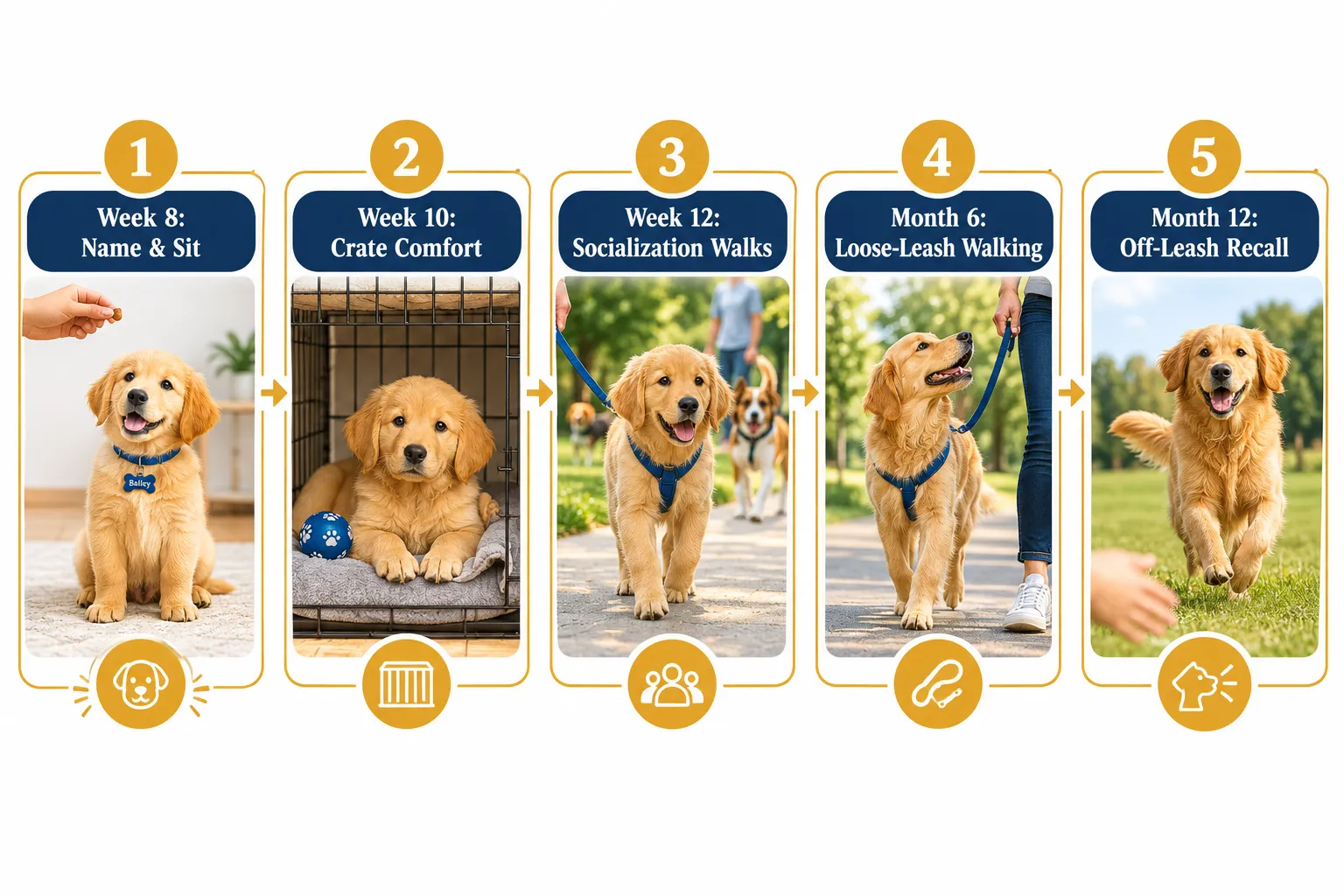
Puppy classes should begin around 7 to 8 weeks, as long as pups have had their first round of vaccines [2]. Waiting until 4 or 5 months to start socializing or training means missing the easiest, most absorbent learning phase of a dog’s life.
Here’s the honest truth: a Golden’s friendliness is a gift, but it can tip into chaos without guidance. An untrained adult Golden might jump on grandma, body-slam toddlers, or drag owners down the street chasing squirrels. The fix starts in puppyhood.
The Science-Backed Case for Positive Reinforcement
Modern trainers and veterinary behaviorists strongly favor reward-based methods over aversive tools like e-collars and chain collars [1][3]. Why? Fear-based training can create anxiety, aggression, or a dog that only “behaves” when a correction tool is attached. Reward-based training builds a dog who wants to cooperate, not one who’s just avoiding pain.
For a breed as emotionally sensitive as the Golden Retriever, this matters even more. Goldens bond hard with their people. Harsh corrections can bruise that trust fast. Reward-driven methods tap into exactly what makes Goldens tick: food, praise, and attention from their favorite human.
Golden Retriever Obedience Training: Step-by-Step Guide from Puppy to Polite Adult (8 Weeks)
This is ground zero. Everything from here builds on these first lessons.
Days 1-14: Settling In
- Name recognition. Say the puppy’s name, reward eye contact. Repeat constantly.
- Crate introduction. Make the crate a cozy den, not a punishment box. Feed meals inside it.
- Potty routine. Take the puppy out every 1-2 hours, after meals, and after naps.
- Bite inhibition basics. Yelp softly when nipped, then redirect to a toy.
“A well-managed crate routine isn’t just about potty training, it’s the foundation for calm alone-time behavior later.”
Crate training does double duty. It supports house training and helps prevent separation-related anxiety down the road. Puppies who learn that alone time in a crate is safe and boring (in a good way) are far less likely to develop stress-related behaviors as adults [3].
Weeks 3-8: First Real Cues
Once the puppy is settling in, start layering in simple cues using treats and a clicker or marker word:
- Sit, lure with a treat up and back over the nose.
- Come, say the name, then “come,” reward big every single time.
- Look at me, builds focus, which is the base skill for everything else.
- Leave it, critical for a breed that will try to eat literally anything.
This is also when puppy classes should begin. Structured, supervised play with other vaccinated puppies builds social skills fast, and a good class also teaches owners how to train, not just what to teach [1][2]. For general early-stage guidance, check out more puppy training tips to round out this phase.
Golden Retriever Obedience Training: Step-by-Step Guide from Puppy to Polite Adult (6 Months)
By six months, the cute baby puppy has a lot more energy, bigger teeth, and a stronger will. This is where impulse control becomes the main event.
Core Skills to Build
| Skill | Goal | Training Tip |
|---|---|---|
| Stay | Hold position 30+ seconds | Add distance before duration |
| Loose-leash walking | No pulling on walks | Stop moving the second the leash tightens |
| Wait at doors | No bolting outside | Reward calm sitting before release |
| Settle on mat | Relax during downtime | Reward calm, not excitement |
Taming the Two Big Golden Habits
Golden Retrievers are famous for two specific behaviors that drive owners nuts: mouthing and jumping. Both come from the same root, excitement and a desire to connect.
Fixing mouthing:
- Keep chew toys within arm’s reach at all times.
- The second teeth touch skin, stop play and walk away for 10-15 seconds.
- Reward calm mouths touching hands with gentle praise.
Fixing jumping:
- Turn away and ignore the puppy the moment paws leave the ground.
- Ask for a “sit” before any greeting, no exceptions, even for guests.
- Reward all four paws on the floor, every time.
Consistency here is everything. If jumping gets attention 50% of the time, the puppy will keep trying forever. This is where 5 cute dog training tricks can also help channel that excess energy into something fun and structured.
Managing the Exuberant Golden Personality
Goldens are naturally exuberant, and that enthusiasm needs an outlet. Graded, emotion-focused training, gradually increasing distractions while keeping the dog calm and successful, works really well for high-energy, social breeds like this one [1]. Think of it as a volume dial, not an on/off switch. Start training in a quiet room, then slowly add distractions: another person, a toy, outdoor noise.
Golden Retriever Obedience Training: Step-by-Step Guide from Puppy to Polite Adult (1 Year and Beyond)
By the one-year mark, most Goldens are physically mature (or close to it) and mentally ready for real-world reliability. This stage is about proofing behaviors in tougher, more distracting environments.
Building Off-Leash Reliability Safely
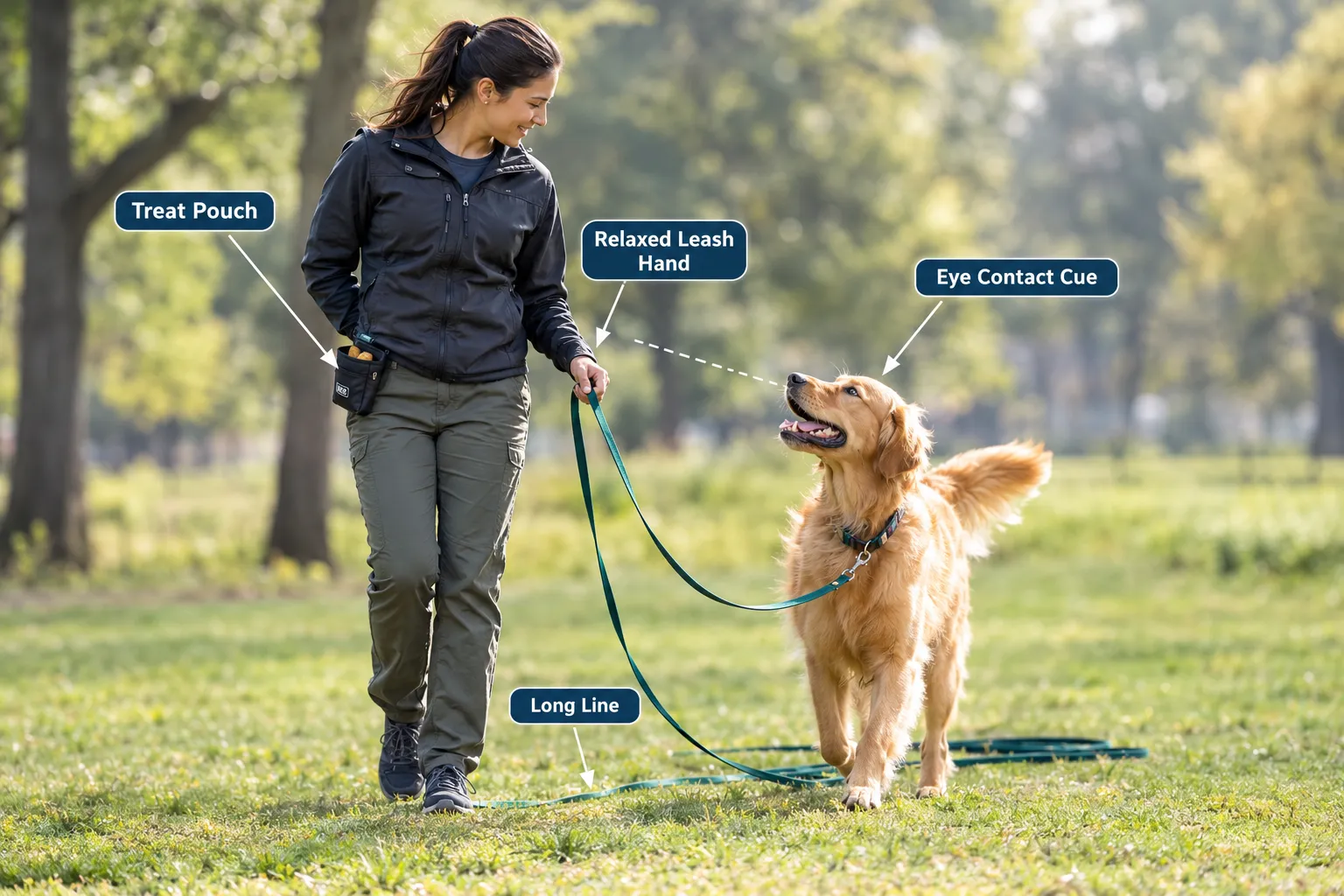
Off-leash freedom is earned, not given. The safest path uses a long training line, typically 15 to 30 feet, so the dog can explore distance while the owner keeps a safety net.
Steps to build reliable recall:
- Start in a fenced, low-distraction yard with the long line attached.
- Call the dog’s name, then “come,” and reward heavily when they arrive.
- Gradually increase distance and distractions (other dogs, food on the ground).
- Only drop the line once recall is rock-solid at 90%+ success across multiple settings.
- Practice in new locations, a skill learned in the backyard doesn’t always transfer to the park.
This slow, methodical approach beats rushing to off-leash walks, which is one of the most common and dangerous mistakes owners make with confident, scent-driven Goldens.
Advanced Impulse Control
At this stage, dogs should be able to:
- Hold a “stay” with food on the floor nearby
- Ignore another dog passing on a walk
- Settle calmly at a cafe table or during a long car ride
- Wait patiently while the owner eats dinner
These skills separate a “trained” dog from a truly polite one. It’s the difference between a dog who knows “sit” in the kitchen and a dog who can hold it together at a crowded park.
When to Consider a Board-and-Train Program
Not every owner has the time or confidence to run daily training sessions. That’s where structured board-and-train programs come in. Recent 2025 case reviews of Golden Retriever board-and-train transformations show real results when programs use reward-based methods consistently over 2-4 weeks [4][5][6][7][8][9][10].
The best programs:
- Use positive reinforcement exclusively, no e-collars or heavy-handed corrections
- Include owner “handoff” sessions to transfer skills back home
- Focus on real-life scenarios: walks, greetings, car rides, vet visits
Board-and-train isn’t a magic fix, though. The dog learns a skill with the trainer, owners still need a few weeks of follow-through to make it stick at home.
Preventing Problems Before They Start
Here’s a mindset shift that changes everything: training isn’t about fixing bad behavior. It’s about preventing it in the first place [3]. Veterinary behaviorists increasingly push this “prevention over correction” philosophy, and it’s especially true for Golden Retrievers.
Quick prevention checklist:
- ✅ Crate train from day one to avoid separation anxiety later
- ✅ Socialize broadly and gently during the 8-12 week window [1][2]
- ✅ Teach “leave it” before the puppy finds something dangerous to chew
- ✅ Practice calm greetings before guests ever walk through the door
- ✅ Build alone-time tolerance gradually, starting with short absences
Owners of other high-energy, people-focused breeds face similar challenges. There’s useful overlap with guidance for Belgian Malinois off-switch training, even though the breeds differ, the core lesson of teaching a dog to settle applies broadly.
Reading Your Golden’s Signals Along the Way
Training works best when owners can read what their dog is actually communicating. A stressed puppy learns differently than a relaxed one. Learning to spot signs of anxiety, overstimulation, or fear helps avoid pushing training too hard, too fast. For a deeper dive, see this guide on how to read your dog’s body language.
Comparing notes with other retriever owners can help too, Labrador Retriever training resources often overlap closely with Golden-specific advice, since both breeds share similar energy levels and people-pleasing instincts.
The Future of Golden Retriever Training
Looking ahead, experts expect continued growth in structured, positive-reinforcement board-and-train models and hybrid programs that blend in-person coaching with virtual follow-up [4][5][6][7][8][9][10]. The days of chain collars and dominance-based “corrections” are fading fast. Science-backed, relationship-focused training is the clear direction for 2026 and beyond.
Conclusion
Raising a well-mannered Golden Retriever isn’t about luck, it’s about following a clear path. Start socializing and training at 8 weeks. Tackle mouthing, jumping, and impulse control hard by 6 months. Build toward off-leash trust and advanced manners by the 1-year mark. Reward generously, correct gently, and never stop being that dog’s biggest cheerleader.
Next steps: Pick one skill from this guide, maybe loose-leash walking or crate comfort, and practice it for 10 minutes today. Small, consistent sessions build the tail-wagging, obedient companion every Golden Retriever has the potential to become.
References
- Socialization Mere Exposure. avsab.org.
- Puppy Socialization Position Statement Final. avsab.org.
- Preventive Behavioral Care Setting Your Pup Up for Success. avsab.org.
- Watch. youtube.com.
- Watch. youtube.com.
- Watch. youtube.com.
- Watch. youtube.com.
- Watch. youtube.com.
- Watch. youtube.com.
- Watch. youtube.com.
golden retriever training, puppy obedience, positive reinforcement training, crate training, puppy socialization, off-leash recall, dog impulse control, board and train, loose leash walking, mouthing and jumping fixes