A Great Dane puppy can cost anywhere from $1,500 to $4,000. But the real price tag shows up later, in vet bills, heartbreak, or both, when a breeder skipped health testing. That’s the blunt truth nobody puts on the puppy ads.

Finding the best Great Dane breeders isn’t about the cutest Instagram photos. It’s about paperwork, lab results, and honesty. This guide breaks down exactly what separates a responsible breeder from someone just making a quick buck off a gentle giant breed.
Great Danes are prone to serious health issues: hip dysplasia, heart disease, bloat, and even a newly identified genetic condition called IMGD. That’s why health testing isn’t optional, it’s survival. Let’s dig in. 🐾
Key Takeaways
- Health testing is non-negotiable. Hips, heart, eyes, thyroid, and genetic panels should be done on both parents before breeding [1][2].
- Verify, don’t trust blindly. Reputable breeders post OFA results publicly, buyers should check OFA.org themselves [3].
- A real contract protects the puppy for life. Look for lifetime take-back clauses and vet-check windows [4].
- Socialization matters as much as genetics. Puppies raised in the home, exposed to noise and handling, become more stable adults.
- Red flags are loud if you listen. No OFA links, vague health claims, and full registration for everyone are warning signs [3][4].
Why Health Testing Defines the Best Great Dane Breeders
Great Danes grow fast and big, that’s exactly why their joints, hearts, and eyes need extra scrutiny. The Royal Kennel Club’s updated Health Standard, released in October 2026, lists Great Danes among breeds that should complete DNA testing for Inherited Multisystemic Genetic Disease (IMGD), plus elbow dysplasia screening, eye exams, hip evaluations, and heart testing on both sire and dam before any litter is planned [1][5].
This isn’t a “nice to have.” It’s the baseline for what counts as best practice breeding [1][5].
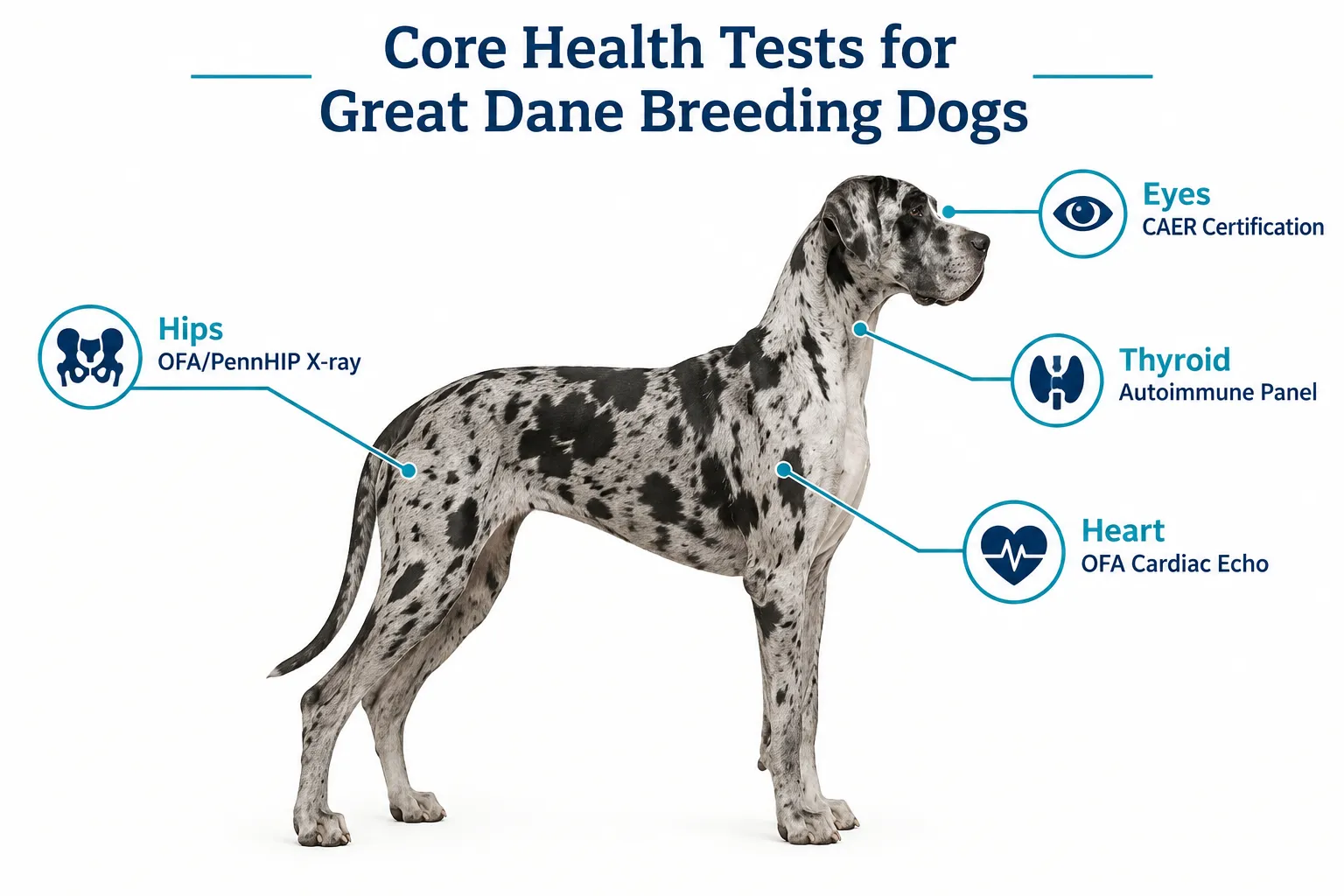
Here’s the core panel every responsible breeder should complete:
| Test | What It Catches | Where to Verify |
|---|---|---|
| Hip evaluation (OFA/PennHIP) | Hip dysplasia | OFA database |
| OFA Cardiac exam/echo | Congenital heart defects | OFA database |
| CAER/OFA Eye exam | Hereditary eye disease | OFA database |
| OFA Thyroid panel | Autoimmune thyroiditis | OFA database |
| Genetic panel (Embark, VGL) | IMGD, von Willebrand’s, coat genetics | Breeder-provided certificate |
The Great Dane Club of America (GDCA) recommends all four phenotypic tests, hips, cardiac, thyroid, and eyes, before any dog is bred, and tells buyers to verify results directly through the OFA database rather than taking a breeder’s word for it.
Genetic Testing Is the New Frontier
A June 2026 report from UC Davis’s Veterinary Genetics Laboratory (VGL) highlights specific DNA tests now available for Great Danes, including screening for the Harlequin coat pattern and for IMGD itself [6]. The VGL program goes even further, generating certificates that show a dog’s internal relatedness and genetic diversity, a big deal for a breed with a shrinking gene pool [6].
Good Dog’s October 2026 Health Testing Guide confirms that genetic panels work alongside, not instead of, physical exams like X-rays and ultrasounds, because many orthopedic and cardiac issues simply don’t have a DNA test yet [2]. Translation: a breeder waving an Embark result isn’t enough. They need the X-rays and echo too.
Some kennels are setting the bar even higher. Reager’s House of European Great Danes reportedly runs full Embark panels covering over 250 genetic conditions on all breeding dogs, with results available to buyers on request [7]. Rare Earth Danes says its program exceeds OFA, CHIC, and GDCA minimums, adding elbow screening and cardiac Holter monitoring, with all OFA results publicly linked. That’s the kind of transparency that should be the industry norm, not the exception.
Breeders listed on platforms like Good Dog, including Breken Great Danes, River Rock Danes, Beaver Creek Danes, and UNDAD’S Kennels, now routinely show OFA hip and elbow evaluations, cardiac echoes, CAER eye certs, and genetic panels on their public profiles [8][9]. If a breeder you’re considering doesn’t offer this level of detail, ask why.
For dog parents comparing breeds and long-term joint health concerns across large breeds, it helps to understand dog joint health basics before committing to any giant breed puppy.
Evaluating the Best Great Dane Breeders: Contracts, Socialization, and Red Flags
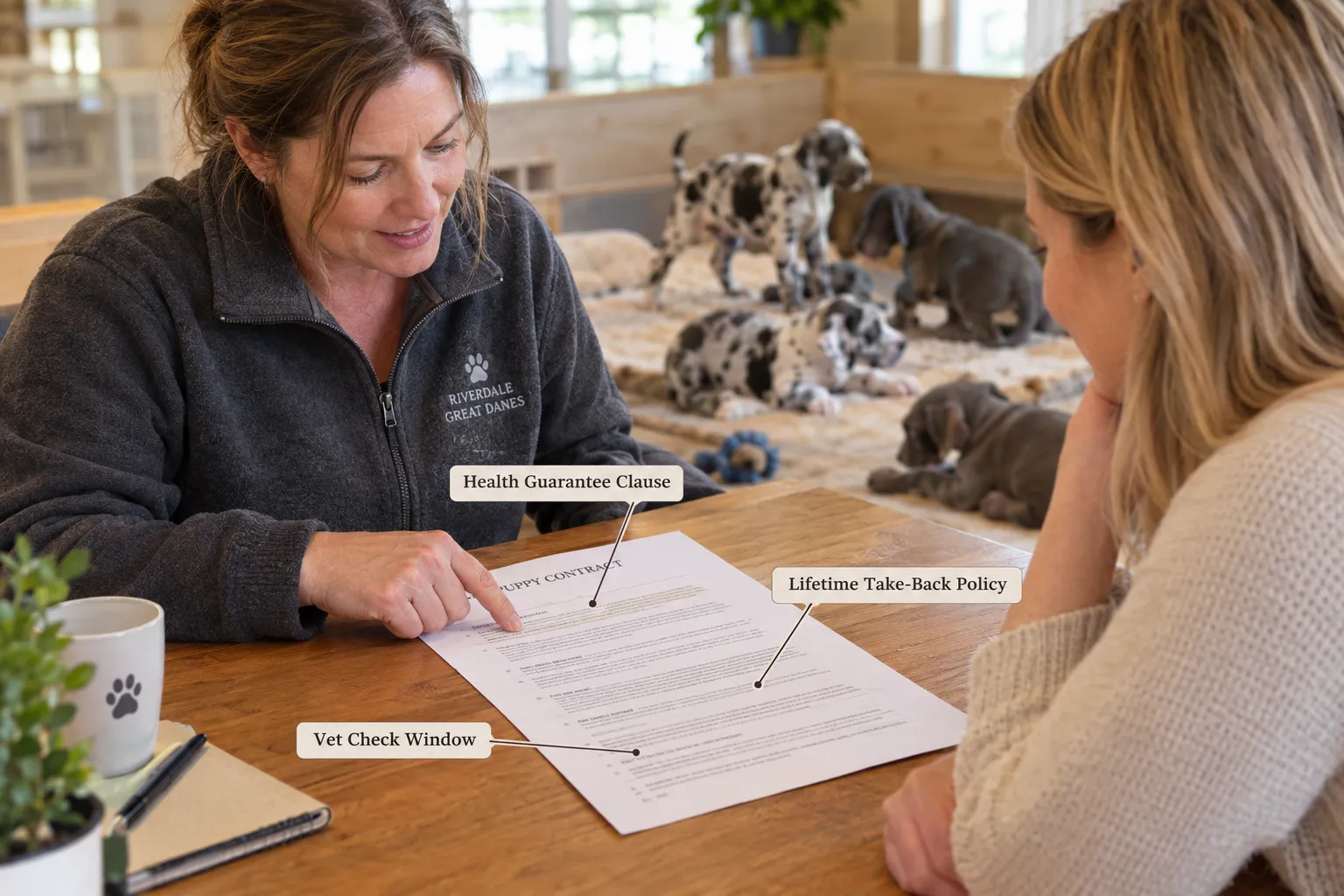
A puppy contract isn’t paperwork for paperwork’s sake. It’s the foundation of trust between breeder and family. A September 2026 Good Dog podcast episode on dog contracts called the contract “the foundation of the relationship,” noting it should spell out the puppy’s identity, price, and usually a lifetime take-back clause, meaning the breeder agrees to take the dog back if the owner ever can’t keep it.
What a Solid Contract Includes
The GDCA’s Breeder’s Code of Ethics spells out exactly what responsible breeders must provide [4]:
- Copies of all pre-screening results for both parents
- Written care instructions (feeding, health, training, ear care)
- A written contract covering spay/neuter terms, pet vs. show quality, co-ownership, and breeding rights
- The right for buyers to have the puppy examined by their own vet within 72 hours of purchase
- A full refund if a vet documents an inherited defect within that window, upon return of the puppy [4]
GDCA guidance also notes that reputable breeders provide a bill of sale and a four-generation AKC pedigree with every puppy. If a breeder can’t produce that paperwork, that’s a problem, not a paperwork delay.
“There is zero reason for a breeder not to have results posted.”, Kapari Danes, on OFA transparency [3]
Watch for Overly Controlling Contracts
Here’s a twist dog parents don’t expect: contracts can go too far the other way. The same 2026 Good Dog podcast warns breeders against clauses that are overly restrictive or legally unenforceable, because they can scare buyers away from calling if something goes wrong. A contract obsessed with control rather than the puppy’s welfare is its own red flag.
Socialization: The Part Testing Can’t Cover
Health tests catch genetic risk. They don’t guarantee a confident, well-adjusted dog. The best breeders raise puppies in the home, not in isolated kennels. Look for puppies exposed early to:
- Household noises (vacuums, doorbells, kids)
- Different flooring and textures
- Gentle handling of paws, ears, and mouth
- Short car rides
- Multiple people, not just one caretaker
Giant breeds like Great Danes grow into serious size fast, so a shaky temperament becomes a real safety issue later. For guidance on shaping good manners early, check out resources on large breed training and general large breed care.
Red Flags That Should Stop You Cold
🚩 Here’s your cheat sheet for spotting trouble fast:
- No OFA links or results. Kapari Danes flatly states there’s no excuse for this in 2026, results are public record [3].
- Vague health claims. “Health tested” with no test type, date, or registry number is meaningless.
- Full registration offered to everyone. GDCA notes ethical breeders use limited registration for pet-quality pups to prevent irresponsible breeding [4].
- No discussion of pedigree health history. Breeders should openly discuss known issues in the lines, not dodge the topic [4].
- No refund or take-back policy. No written guarantee means no accountability.
- Puppies always available. Constant litters, multiple breeds, or assembly-line vibes suggest volume over welfare.
- Pressure to buy fast. Urgency tactics (“last one, deposit today!”) are a classic sales red flag, not a breeder trait.
Regional clubs back this up. The Great Dane Club of New England’s code of ethics mirrors national guidance, requiring dogs be sold in good health, temperamentally sound, and fully documented, while discouraging commercial-scale breeding [10]. These codes exist because the gap between a hobby breeder and a puppy mill can be surprisingly hard to spot without checking the paperwork.
Quick Verification Checklist
Before handing over a deposit, dog parents should be able to check off every item below:
- OFA hip and elbow results visible online
- OFA cardiac exam on file for both parents
- CAER/eye certification current
- Thyroid panel completed
- Genetic panel (Embark/VGL) shared
- Written contract with health guarantee
- Take-back clause included
- 72-hour vet check window honored
- Four-generation pedigree provided
- Puppies raised in-home, well socialized
If any box stays empty, ask questions, or walk away. For more on the breed’s unique traits and needs before bringing one home, browse the Great Dane tag for additional breed insight.
Conclusion
The best Great Dane breeders aren’t hiding anything. They hand over OFA links without hesitation. They write contracts that protect the puppy, not just themselves. They raise litters underfoot, not in a back shed. And they talk openly about the health risks baked into this gentle giant breed.
Next steps for dog parents:
- Request OFA numbers for hips, heart, eyes, and thyroid, then verify them independently.
- Read the contract line by line before signing anything.
- Ask about socialization practices and visit in person if possible.
- Trust the red flags. If something feels rushed or vague, it probably is.
A Great Dane is a decade-plus commitment wrapped in a 150-pound package of love. Choosing the right breeder is the first, and most important, act of care in that dog’s whole life. 🐶💛
References
- The Royal Kennel Club Health Standard. royalkennelclub.com.
- Health Testing Guide. gooddog.com.
- Puppies. kaparidanes.com.
- Code of Ethics. gdca.org.
- Breedspecificrequirements. royalkennelclub.com.
- Gd Report June 2026. vgl.ucdavis.edu.
- Health Testing. reagerhouseofeurodanes.com.
- Breken Great Danes Illinois. gooddog.com.
- River Rock Danes Ohio. gooddog.com.
- Ethicsandbylaws. gdcne.org.
great dane breeders, great dane health testing, puppy contracts, OFA testing, responsible dog breeding, large breed puppies, dog adoption red flags, great dane puppies, hip dysplasia dogs, cardiac screening dogs, ethical breeders, giant breed care