A German Shepherd can learn 200 commands. A German Shepherd can also destroy a couch in under an hour if bored. Both facts are true. Both facts matter before bringing one home.

This German Shepherd Breed Guide: From Family Guardian to Working Dog, What Owners Must Know gives real talk, not just breed-standard fluff. German Shepherds are everywhere right now, on military bases, in police cars, in family living rooms, and sadly, sometimes in shelters as confused strays. This guide covers the good, the hard, and the paw-some parts of loving this breed.
Key Takeaways
- German Shepherds are brilliant, but brilliance needs a job. Without one, they get destructive and anxious.
- Show-line and working-line GSDs are almost different breeds. Pick the wrong one and you’ll struggle.
- Hip and spine health matter more here than in most breeds. Screening and weight management are non-negotiable.
- Protective instincts need shaping early. Left unmanaged, guarding can turn into real liability.
- This breed shows up everywhere, from military kennels to family couches, because they’re that versatile.
Why Every Family Needs This German Shepherd Breed Guide Before Adopting
German Shepherds aren’t a “set it and forget it” dog. They’re thinkers. They bond hard. And they take their job seriously, even when that job is just “watch the mailman.”
Military working dogs prove this intensity. Programs at bases like Aberdeen Proving Ground rely heavily on German Shepherd, type dogs for explosive detection and patrol work, trusting them with literal life-and-death tasks [1]. Overseas, communities like Vicenza use GSDs for public outreach, letting kids meet working K9s and see their softer side [2]. Police departments keep adding German Shepherds and Belgian Malinois to their K9 units for searches and drug detection, with towns like St. Joseph approving new canine funding specifically because these dogs deliver results [3].
That same intensity shows up at home. A German Shepherd left alone all day with no outlet isn’t going to nap quietly. It’s going to shred drywall. This breed guide exists because loving a GSD means understanding that work drive doesn’t switch off at the front door.
Show-Line vs. Working-Line: The Split Families Must Understand
Here’s something most pet-store descriptions skip: there isn’t just “one” German Shepherd. There are two very different versions under the same name.
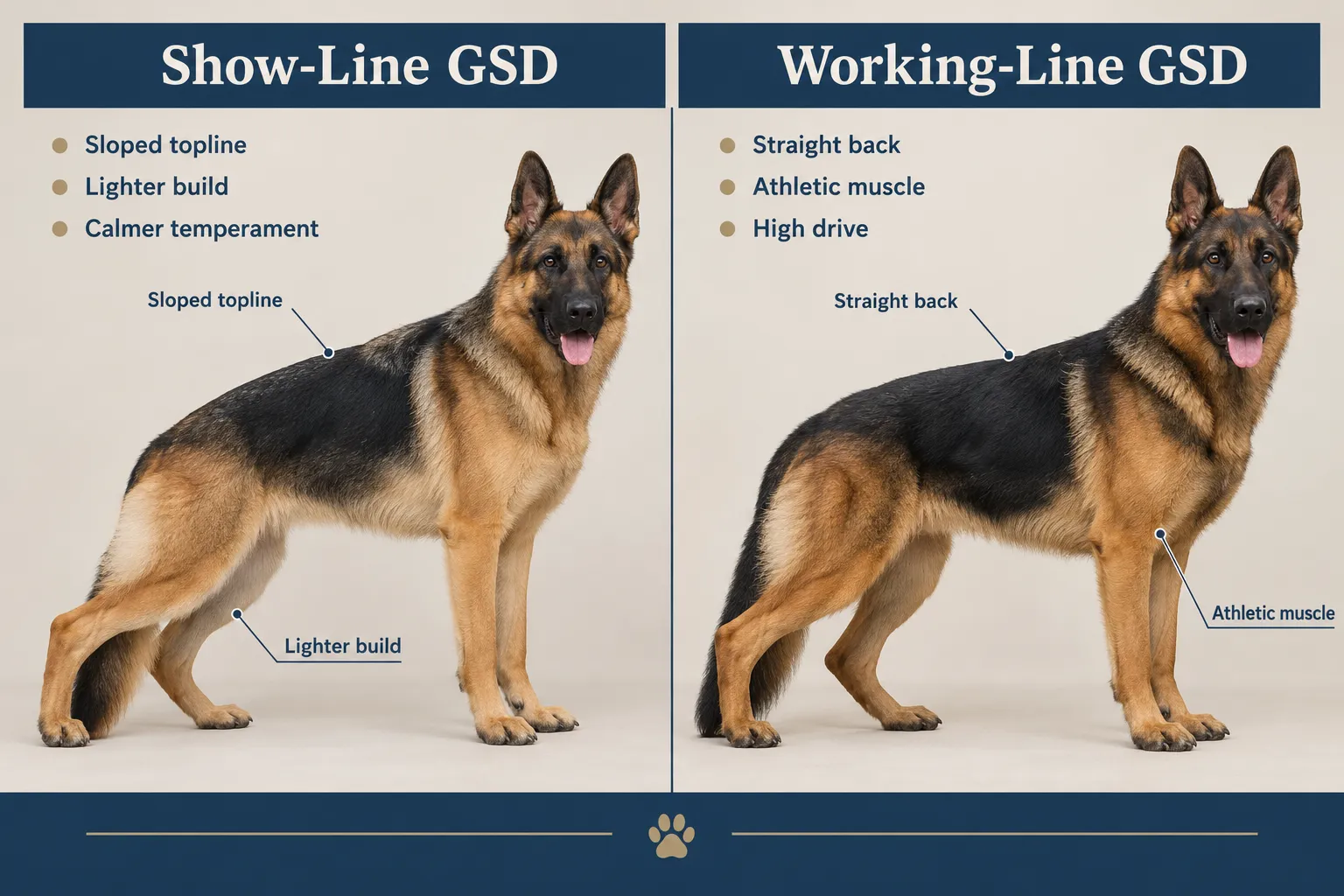
Show-line German Shepherds:
- Bred for conformation ring looks
- Sloped, dramatic topline
- Generally calmer energy
- Still smart, but more couch-compatible
Working-line German Shepherds:
- Bred for drive, nerve strength, and task ability
- Straighter back, more athletic frame
- Extremely high energy and focus
- Need serious daily mental and physical work
A family wanting a jogging buddy and a calm evening companion should lean show-line. A family wanting a dog that can train for protection sport, search work, or intense agility should look working-line. Mixing up the two is the top reason families feel “in over their heads” within six months.
Military and police programs almost exclusively use working-line dogs or close relatives, which explains why those dogs look leaner and more intense than the family GSD down the street [1][3].
Temperament, Training Intensity, and Protective Instincts
German Shepherds are loyal to a fault. That loyalty is beautiful, until it turns into overprotection. Owners constantly share stories of their GSD “warning the family” about wildlife or strangers nearby, which shows off their sharp instincts [4]. One viral moment even showed a German Shepherd puppy instantly bonding and protecting a new family member, melting hearts everywhere [5].
But protective instinct has a dark side if it’s not managed. Recent incidents, including a widely reported case involving footballer Jermaine Pennant’s family, show what happens when a German Shepherd’s guarding behavior isn’t properly channeled [6]. These stories aren’t meant to scare anyone away from the breed. They’re a reminder: this dog needs structure.
For a deeper dive specifically on managing guarding behavior, the German Shepherd protective instincts guide on overguarding and stranger reactivity walks through exactly how to prevent fear-based aggression before it starts.
Training Needs: Not Optional, Not Light
German Shepherds rank among the smartest breeds alive. That intelligence is a gift and a demand. Here’s what training realistically looks like:
- Daily structured training sessions, 15-20 minutes, twice a day minimum
- Early socialization, meet dozens of people, dogs, and environments before 16 weeks
- Job assignment, nose work, obedience sport, agility, or even scent detection games at home
- Consistent leadership, mixed signals create anxious, reactive dogs
Owners who treat training like a chore instead of a bonding ritual often end up with a frustrated, overstimulated dog. Think of training time as quality time, not homework. The payoff is a dog that reads your mood, anticipates your needs, and genuinely becomes your shadow.
“A German Shepherd without a job isn’t relaxed. It’s just waiting for one.”, that’s the honest truth every trainer repeats.
This same high-drive personality is what makes the breed a natural for service and assistance work. German Shepherds are increasingly visible helping disabled individuals navigate daily life, using their trainability and steady focus to perform real tasks, not just companionship.
If guarding instincts remind you of another intense breed, the Rottweiler training commands guide covers similar command-based structure that works well for GSDs too.
Joint, Spine, and Overall Health: The German Shepherd Breed Guide Section No One Can Skip
This is the part of the German Shepherd Breed Guide: From Family Guardian to Working Dog, What Owners Must Know that gets glossed over too often. German Shepherds are gorgeous and athletic, but their bodies carry real risk.
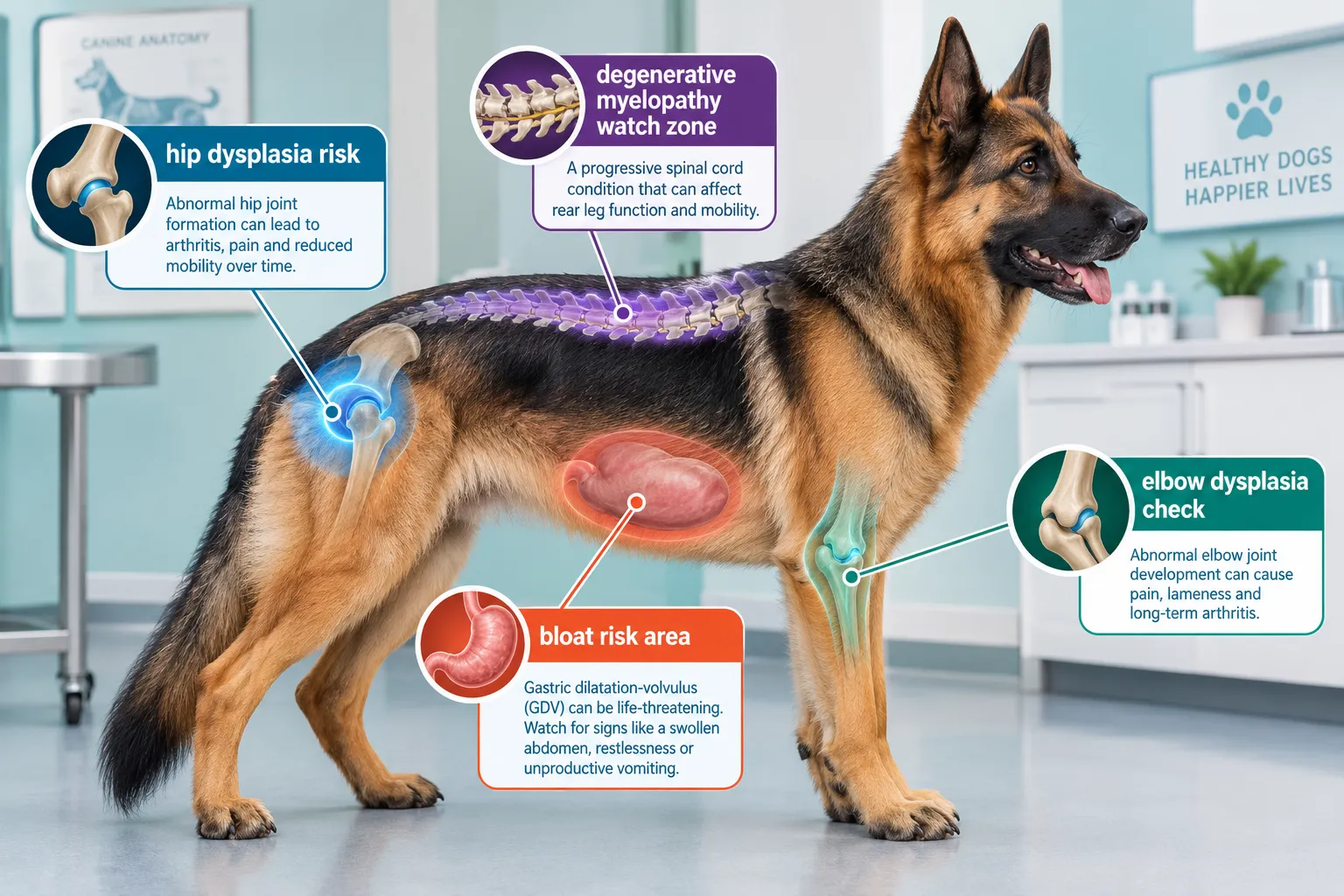
Top Health Concerns 🩺
| Condition | What It Is | What Owners Should Do |
|---|---|---|
| Hip Dysplasia | Malformed hip joint, common due to rear angulation | Screen parents, keep weight lean |
| Elbow Dysplasia | Joint malformation in front legs | Avoid over-exercising growing puppies |
| Degenerative Myelopathy | Progressive spinal cord disease | DNA test available; watch for hind-leg weakness |
| Bloat (GDV) | Stomach twists, life-threatening | Feed smaller meals, avoid exercise right after eating |
| Exocrine Pancreatic Insufficiency | Digestive enzyme deficiency | Vet-prescribed enzyme supplements if diagnosed |
German Shepherds’ sloped backs (especially in show lines) put extra stress on hips and spine over time. That’s not a reason to avoid the breed, it’s a reason to manage it well. Keep a lean body condition. Avoid high-impact jumping in puppies under 18 months. Choose breeders who screen for hip and elbow scores.
Feeding matters too. A large, active breed needs proper nutrition built for joint support and muscle maintenance. Resources on large breed dog food and large breed dog diet basics are worth bookmarking before puppy pickup day.
Safety Goes Both Ways
Responsible ownership isn’t just about health, it’s about public safety too. Recent cases of dog shootings and crime investigations tied to loose German Shepherds highlight real consequences of under-managed dogs roaming unsupervised [7][8]. Secure fencing, leash laws, and solid recall training protect both the dog and the community.
Rescue, Strays, and Why Microchipping Saves Lives
Here’s a sobering fact: shelters are seeing very young German Shepherds surrendered or picked up as strays at alarming rates. This points to one thing, people underestimate the breed, then give up fast.
Rescue networks step in constantly, running long-distance transport operations to move German Shepherds from overcrowded shelters to adoptive homes across the country. It’s a massive, often invisible effort that keeps this breed from being euthanized unnecessarily.
Microchipping and GPS tracking have become essential tools, especially for a breed known to roam or chase. Lost German Shepherds are recovered far more often when chipped and registered. If adopting from rescue, confirm microchip registration is updated immediately, this single step reunites more dogs with families than almost anything else.
For families considering rescue, check in with local shelters first. A dog photographed at a Tampa police station recently made headlines simply by visiting, showing how community-police bonds and public dog outreach go hand in hand [9].
German Shepherds as Family Guardians: Making the Bond Work
Despite the training checklist and health watch-list, German Shepherds are, at their core, deeply devoted family members. Human-interest stories keep surfacing about their intelligence and protective bonding, because it’s real. These dogs form fierce attachments and often become the self-appointed guardian of the household’s smallest humans and pets.
Owners wanting to strengthen that bond should look at consistent daily rituals. The article on acts of love your dog needs from you for life outlines small daily habits that build trust fast, which matters even more with a breed this emotionally tuned-in.
Curious why a GSD seems to track every move around the house? The explanation in the real reason your dog follows you everywhere breaks down the psychology behind that velcro-dog behavior, and German Shepherds are prime velcro-dog candidates.
If this breed’s intensity feels like too much, it’s worth comparing against lower-drive options. The Australian Shepherd energy and herding instincts guide shows a similarly smart but differently-wired herding breed for comparison shopping.
Is a German Shepherd Right for Your Family?
Quick gut-check before committing:
- ✅ You have 60+ minutes daily for exercise and training
- ✅ You want a dog that bonds hard and protects naturally
- ✅ You can commit to lifelong joint-health monitoring
- ✅ You’re okay with shedding, a LOT of shedding
- ❌ You want a low-maintenance apartment dog
- ❌ You’re rarely home and can’t provide mental stimulation
If the honest answer leans toward the ❌ side, that’s okay. Not every household needs this breed’s intensity, and that’s fine to admit.
Conclusion: Loving a German Shepherd the Right Way
German Shepherds reward effort like few other breeds. Put in the training, the health screening, and the daily engagement, and the payoff is a devoted, brilliant, tail-wagging best friend for life. Skip those steps, and the same dog can become anxious, reactive, or physically compromised.
This German Shepherd Breed Guide: From Family Guardian to Working Dog, What Owners Must Know boils down to three next steps: choose the right line for your lifestyle, commit to real training from day one, and stay proactive on joint and spine health. Do that, and this breed won’t just guard the family, it’ll become one of its most cherished members.
References
- Unwavering Guardians Inside the Aberdeen Proving Ground Military Working Dog Program. army.mil.
- K9s and Kids Connect in the Vicenza Military Community. army.mil.
- Commissioners Approve Request Police Dog to Join St Joseph Department Canine K9 Belgian Malinois German Shepherd Public Safety Searches Drug Detection Donations Cost Training Foood Vet Visits Berrien County Michigan. wsbt.com.
- German Shepherd Warns Family Wildlife 202550439. yahoo.com.
- Watch German Shepherd Puppy Instantly 234500889. yahoo.com.
- Jermaine Pennant German Shepherd Dog Attack B3073465. independent.co.uk.
- Dog Shot Richland Township Gull Prairie Nature Preserve Family German Shepherd Crime Investigation Sheriff Kalamazoo County West Michigan. wwmt.com.
- Article317595366. mahoningmatters.com.
- Tampa Dog Visits Police Station. wsvn.com.