Nine out of ten Chihuahua health problems trace back to one moment: the day someone picked the wrong puppy from the wrong breeder. That’s not a guilt trip. It’s a fact worth sitting with before you fall for the first wobbly-legged pup that licks your chin.

Knowing how to choose a Chihuahua puppy from a litter: temperament, health, and ethical breeder checks isn’t just a nice-to-have. It’s the difference between a decade of tail wags and a lifetime of vet bills. This guide hands you a real buyer’s checklist, the kind a knowledgeable friend would text you before your visit.
Key Takeaways
- Meet the whole litter, not just one puppy, behavior makes more sense in context.
- Ask for health testing paperwork on both parents, especially heart and knee screenings.
- Visit in person so you can see the facility, smell the space, and meet mom.
- Watch for red flags like multiple litters, no vet records, or breeders who won’t let you visit.
- Match the puppy’s personality to your household, especially if kids are involved.
Start With the Breeder, Not the Puppy
Here’s the uncomfortable truth: a sweet-faced puppy can still come from a bad situation. Temperament and health are shaped long before you walk in the door. So before you even look at those big round eyes, look at where they came from.
Ethical breeders are proud to show their setup. They want you asking questions. They’ve got nothing to hide [1][2].
Signs of a Responsible Chihuahua Breeder
A responsible breeder should check these boxes:
- They let you visit in person and meet the mother (and father, if on-site) [3].
- They raise puppies inside the home, surrounded by normal household noise and activity.
- They provide written health clearances for both parents, not just verbal promises.
- They ask you questions too, about your home, your experience, your lifestyle.
- They offer a written contract and agree to take the dog back if things don’t work out [1].
- They don’t pressure you to decide on the spot or pay a deposit sight unseen.
If a “breeder” meets you in a parking lot, ships the puppy without meeting you, or has puppies of five different breeds available right now, walk away. That’s not breeding, that’s a puppy mill with a nice ad [2][3].
How to Choose a Chihuahua Puppy From a Litter: Temperament Checks That Actually Work
Picking personality isn’t guesswork. It’s observation. Modern temperament-selection advice says the same thing again and again: watch the puppy and the parents, in more than one setting [4][5].
Watch the Whole Litter Together
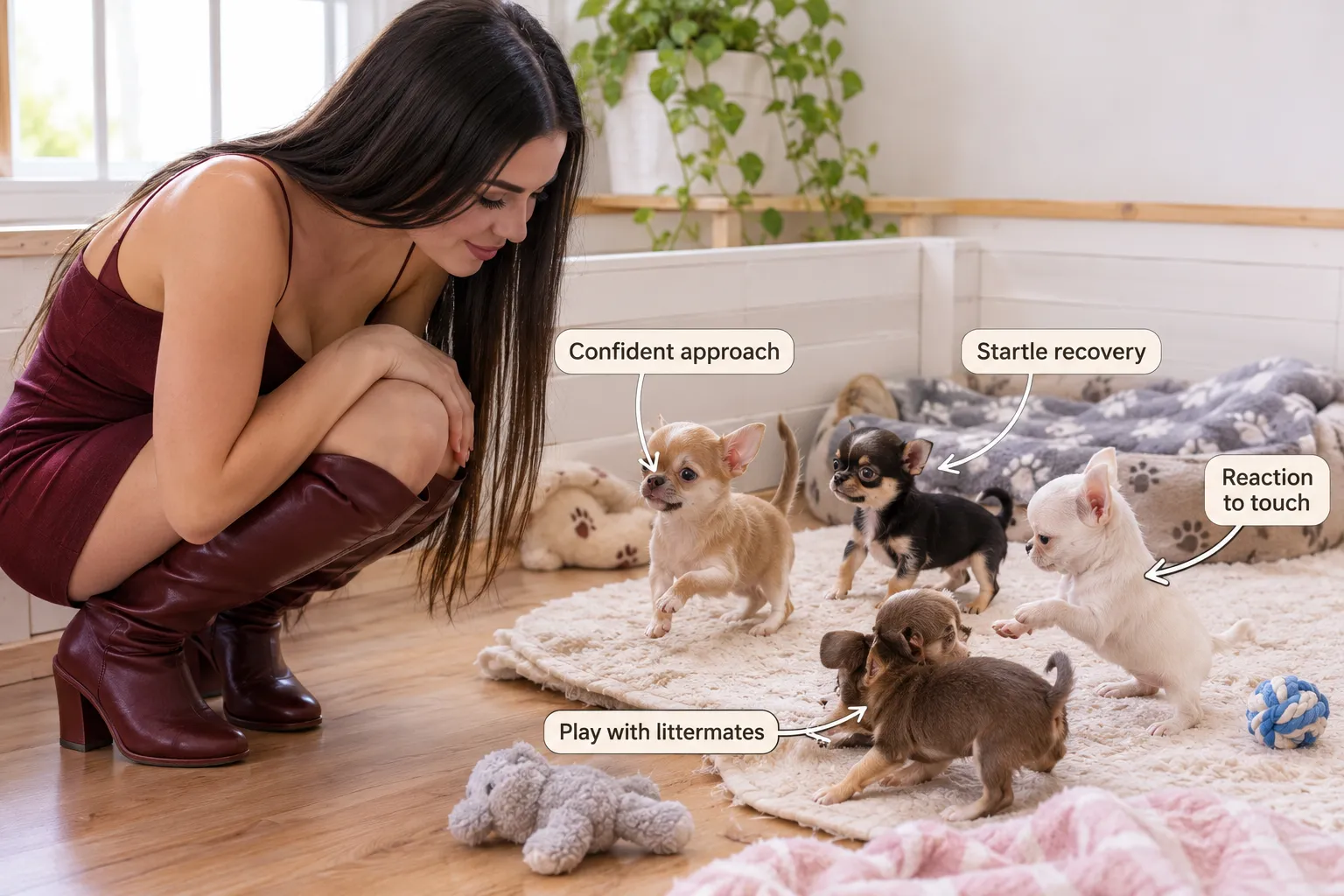
Don’t just hold one puppy and call it love at first sight. Sit back and watch the group play for ten minutes.
Look for:
- The confident explorer, sniffs new objects, recovers fast from a startle.
- The middle-of-the-pack pup, plays well, doesn’t dominate or hide.
- The shy one, hangs back, avoids eye contact, flinches at sudden sound.
- The bossy pup, guards toys, nips hard, climbs over littermates constantly.
Most families do best with the confident-but-gentle middle pup, not the boldest or the shyest extreme [6].
Test Reactions One-on-One
Once you’ve watched the group, spend time with individual puppies:
- Clap softly a few feet away. Does the puppy startle and recover, or stay frozen?
- Gently roll the puppy onto its back for a few seconds. Does it struggle briefly then relax, or panic completely?
- Walk away and call softly. Does curiosity win out?
- Pick the puppy up. Does it wiggle happily or freeze stiff with fear?
None of these are pass/fail tests. They’re a window into how this puppy processes the world.
Meet the Mom
The mother’s temperament is the single biggest predictor of how the puppies will turn out. A nervous, snappy mom often means nervous, snappy pups down the line. A relaxed, friendly mom is gold [4][5].
Chihuahua Temperament and Kids: A Real Caution
Chihuahuas are tiny, often under six pounds. That fragility cuts both ways. Rough handling can genuinely hurt them, and many Chihuahuas respond to that risk with fear-based snapping [4][7].
If young children are in the picture:
- Pick the most tolerant, least reactive puppy in the litter.
- Avoid puppies that flinch or growl at sudden movement or noise.
- Commit to teaching kids gentle handling from day one.
- Consider whether an older, calmer Chihuahua might actually be a better fit than a puppy.
For more on building the right home routine once your pup is settled, check out Chihuahua Care for breed-specific daily tips.
How to Choose a Chihuahua Puppy From a Litter: Health Screening and Breeder Documentation
Temperament gets the heart. Health keeps the tail wagging for years. This is the part too many buyers skip, and it’s the part that matters most.
The 2026 CHIC/OFA Health-Testing Baseline
Good breeders now follow a clear health-testing standard built around the Canine Health Information Center (CHIC) and Orthopedic Foundation for Animals (OFA) databases [8]. For Chihuahuas, that typically includes:
| Test | What It Screens For | Why It Matters |
|---|---|---|
| Patella evaluation | Luxating patella (slipped kneecap) | Extremely common in the breed [4][7] |
| Cardiac exam | Heart murmurs, structural defects | Small dogs are prone to congenital heart issues [7][8] |
| Eye exam | Cataracts, other eye disease | Chihuahuas can inherit eye conditions [7] |
| Molera assessment | Open skull soft spot | Common and usually manageable, but worth knowing about [4] |
Ask to see the actual certificates, not just a verbal “yep, they’re healthy.” Real documentation has registration numbers you can look up [8].
Advanced Diagnostics Responsible Breeders Are Using Now
By late 2026, more conscientious Chihuahua breeders are going beyond basic exams. That includes advanced cardiac ultrasounds and detailed orthopedic imaging on breeding parents to catch subtle issues before they’re passed down [8][9]. If a breeder can talk comfortably about these tests and show results, that’s a strong sign of commitment.
Common Chihuahua Health Issues to Plan For
Even healthy, well-bred Chihuahuas can face certain breed-linked risks. The current consensus points to a short, consistent list [4][7]:
- Luxating patella, kneecap slips out of place, sometimes needing surgery.
- Heart murmurs and congenital heart disease, ranging from mild to serious.
- Dental crowding, tiny jaws, big dental problems if not managed.
- Hypoglycemia in puppies, low blood sugar, especially in very small pups.
- Tracheal collapse, a coughing, honking cough in some individuals.
- Hydrocephalus, more common in very tiny “teacup” lines.
None of these should scare you off the breed. They should just shape your questions and your vet-visit schedule after adoption. For general preventive guidance, Wag Daily’s Dog Health Tips is a handy ongoing resource.
“A puppy’s paperwork tells you more about its future than its cuteness ever will.”
What to Check During Your In-Person Visit
This is non-negotiable. Never buy a Chihuahua puppy sight unseen [1][2]. When you visit, bring this checklist:
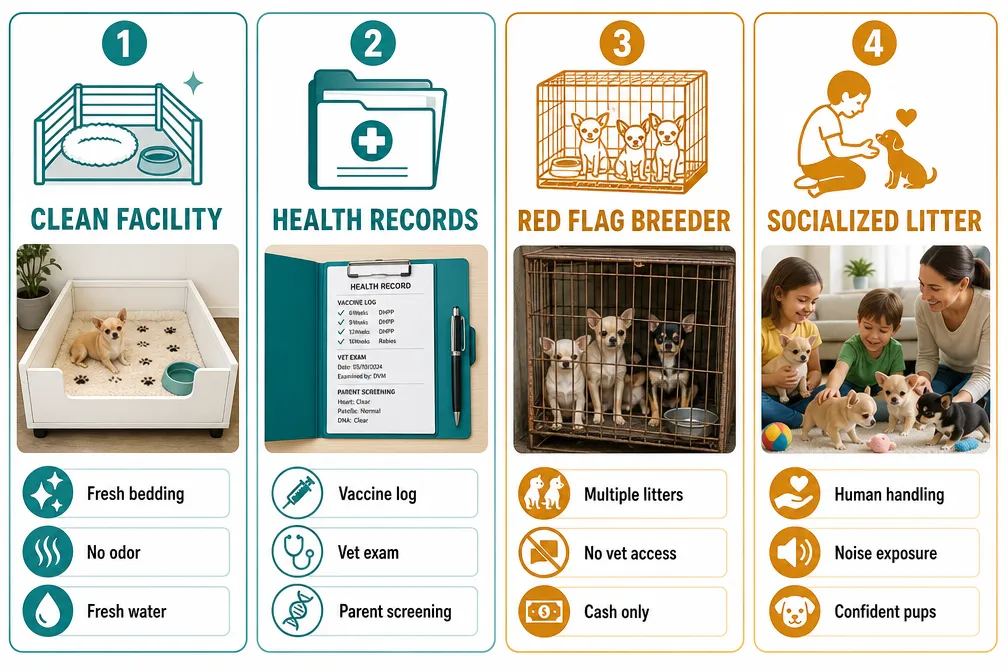
- Smell and cleanliness. Fresh bedding, no overwhelming odor, clean water bowls.
- Puppy body condition. Round bellies are normal, but ribs shouldn’t be visible, and coats should look soft, not dull or flaky.
- Eyes, ears, nose. Clear eyes, clean ears, no discharge.
- Energy level. Playful and curious beats lethargic, every time.
- Vet records in hand. First vaccinations, deworming schedule, a checkup already on file.
- Space to roam. Puppies raised in a sterile crate 24/7 miss critical early development.
Red-Flag Breeder Behaviors to Walk Away From
Trust your gut here. The Humane Society and AKC both flag the same warning signs again and again [2][3]:
- Refuses an in-person visit or only meets off-site.
- Has several different litters or breeds available simultaneously.
- Can’t produce any health testing documents.
- Pressures you with “limited time” discounts or urgency.
- Sells puppies younger than eight weeks old.
- Can’t answer basic questions about the puppy’s parents.
- No contract, no return policy, no follow-up support.
Any one of these alone might be explainable. Two or more together? That’s a clear signal to find a different breeder.
Questions That Reveal Poor Breeding Practices
Asking the right questions does double duty: it protects you, and it shows the breeder you’re a serious, informed adopter. Try these:
- “Can I see where the puppies and parents live?”
- “What health testing have you done on the parents, and can I see the results?”
- “How many litters has this mother had, and how far apart?”
- “What’s your socialization routine for the puppies before they go home?”
- “What happens if I can’t keep the dog later in life?”
- “Can you give me references from past puppy buyers?”
Ethical breeders answer these without hesitation. Breeders running puppy mills tend to get defensive, vague, or suddenly “too busy” [1][3].
Socialization: Why the First 8 Weeks Matter So Much
Puppies raised with lots of gentle human contact, varied noises, and safe new experiences tend to grow into more confident, adaptable adults [5][6]. Before you pick your puppy, ask how the litter has spent its early weeks.
Good signs include:
- Daily handling by multiple people, including children and strangers.
- Exposure to household sounds, vacuums, TV, doorbells.
- Short car rides or outings once age-appropriate.
- Gentle introductions to different surfaces and textures.
A puppy raised in a quiet, isolated kennel with minimal handling starts life at a disadvantage, no matter how good its genetics are.
Matching Lifestyle to Puppy, Not Just Looks
It’s tempting to pick based on coat color or the tiniest runt of the litter. Resist that urge. The “teacup” trend has pushed some breeders toward unhealthy extremes, and runts often carry more health risk, not less [4][7].
Instead, think about your actual life:
- Active household? Choose the confident, playful pup who handles stimulation well.
- Quiet household, older owners? A calmer, more cuddly puppy may be the better match.
- Young kids at home? Prioritize tolerance over boldness, and never skip adult supervision.
- Apartment living? Chihuahuas do fine in small spaces, but energetic pups still need daily play.
This same lifestyle-first thinking applies across small breeds. If you’re weighing Chihuahuas against other compact companions, Wag Daily’s roundup of 19 Cute Dog Breeds from Around the World (2026) is a solid starting point for comparison.
A Quick Buyer’s Checklist
Print this or screenshot it before your visit:
- Breeder allows in-person visits and shows the whole litter
- Health clearances available for both parents (heart, patella, eyes)
- Clean, non-crowded facility with fresh bedding and water
- Puppies are at least 8 weeks old
- Vet records already started (vaccines, deworming)
- Puppies show confident, curious behavior, not fearful or listless
- Written contract and return policy offered
- Breeder asks about your home and lifestyle too
- No pressure tactics or rush-to-decide language
Conclusion: Bring Home the Right Puppy, Not Just a Cute One
Choosing a Chihuahua puppy is an emotional decision, and it should be. These little dogs become full-blown family members fast. But emotion works best paired with a plan.
Use the checklist above. Visit in person. Ask the hard questions. Watch the whole litter, not just one adorable face. Review the health paperwork like it’s a contract, because in many ways, it is.
Do that, and you won’t just pick a puppy. You’ll pick the right one, healthy, well-socialized, and matched to your life for the next 12 to 18 years. That’s a tail-wagging outcome worth the extra homework.
References
- Responsible Breeders. aspca.org.
- How Find Ethical Responsible Dog. humaneworld.org.
- Signs of a Responsible Breeder. akc.org.
- Chihuahua. rspca.org.uk.
- Chihuahua. getapet.com.
- Chihuahua. idognames.com.
- Fact Sheet Dog Breed Chihuahua. qualzucht-datenbank.eu.
- Health Testing Guide. gooddog.com.
- 202611160345mct News Svc 43334 Ksign. delivery.tribunecontentagency.com.
chihuahua puppy, choosing a puppy, dog breeder checklist, puppy temperament test, ethical dog breeders, chihuahua health issues, puppy health testing, small dog breeds, responsible breeding, chihuahua care, puppy socialization, dog adoption tips