A dog’s nose has up to 300 million scent receptors. Yours has about 6 million. The moment a dog meets someone, its brain is already sorting that person by smell alone, long before it ever “looks” at a face. So no, your dog doesn’t see you as human the way another person does. But here’s the good news: what your dog actually thinks you are is even more special than “human.” Science says your dog sees you as something close to a full-time protector, best friend, and safety blanket, all rolled into one.

This idea sounds catchy, but it is not really about tricking your dog into thinking you’re a giant hairless Labrador. Dogs are smart. They know a human is not a dog. What they do is build a totally unique mental box just for you, one that no other animal fits into.
What Your Dog Actually Thinks You Are
Dogs are not confused about biology. Studies on canine perception show dogs easily tell human faces apart from dog faces, and human voices apart from dog voices.[3][5] Their nose confirms it every time, since humans and dogs smell completely different. So the theory that dogs think their owners are just weird, tall dogs does not hold up.
What is really happening is more interesting. Dogs build a separate mental “folder” for humans, just like they have one for cats, squirrels, or the mail carrier’s truck. Inside the human folder, though, something extra happens: dogs also create individual files for the specific people they know. Your dog does not just recognize “human.” Your dog recognizes you, your walk, your voice, your smell, even your mood.[7][10]
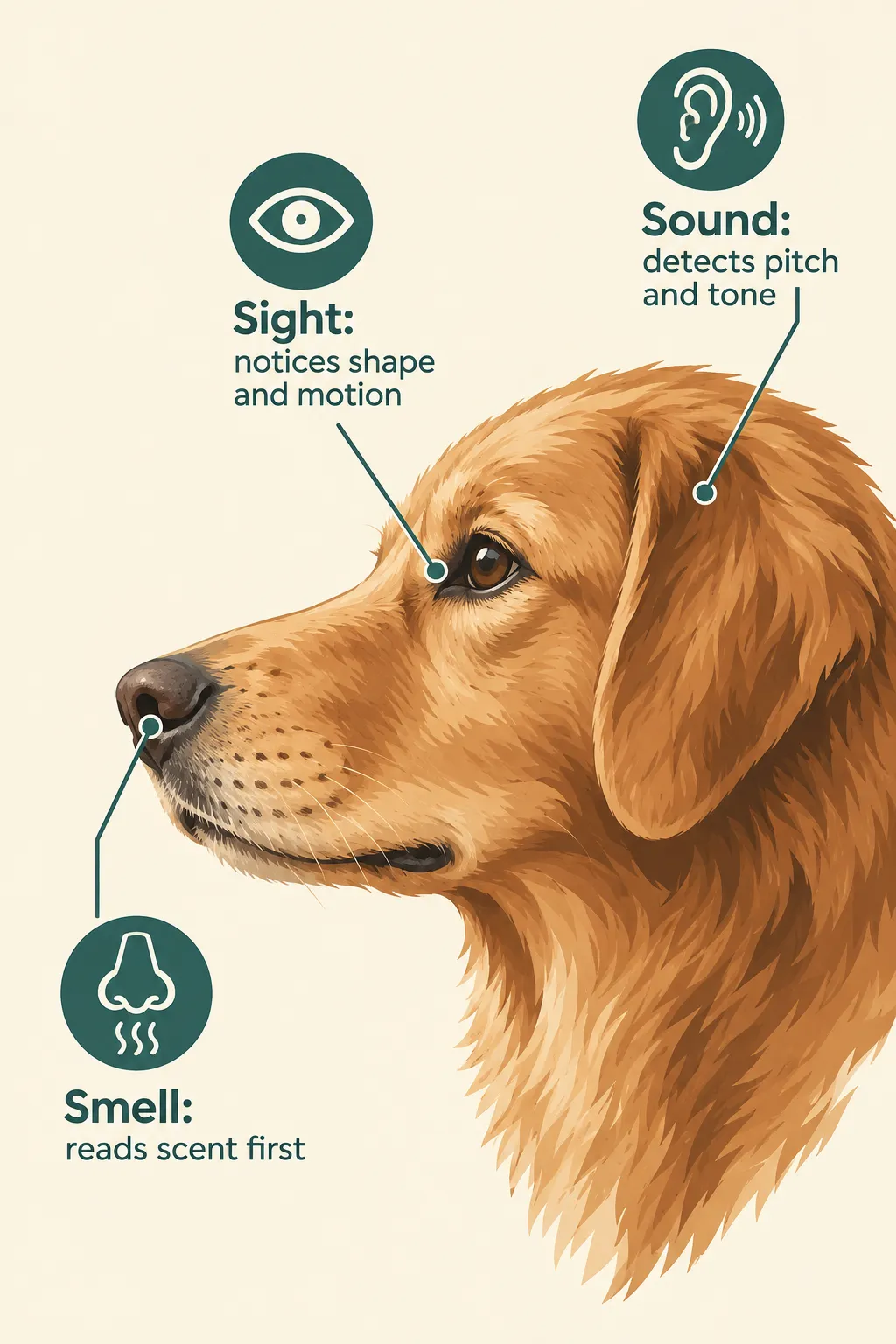
Researchers who study dog brains have found that dogs use a mix of tools to sort out who you are:
| Sense | What It Tells the Dog | Why It Matters |
|---|---|---|
| Smell 👃 | Confirms identity, even health or mood | Strongest and fastest sense used |
| Sight 👁️ | Face shape, body movement, gestures | Helps spot familiar people at a distance |
| Sound 👂 | Tone, pitch, and voice patterns | Alerts dog to feelings before words register |
“Dogs don’t see humans as dogs. They see us as something else entirely, a partner worth watching closely.” [4][7][8]
This is really the heart of the phrase Your Dog Doesn’t See You as Human, (Here’s What You Really Are to Them). Dogs are not misreading who we are. They are placing us in a role no other species holds in their world: a trusted, watched, and loved partner.
The Science Behind Why Your Dog Doesn’t See You as Human
Dog brains did not evolve mainly to understand people. They evolved to understand other dogs first. A 2026 study in Animal Cognition found that dogs reacted more strongly to dog sounds than to human or chimp sounds, showing more alertness and interest.[2][13] This means a dog’s hearing system is still tuned like a radio dial set closest to the “dog station.”
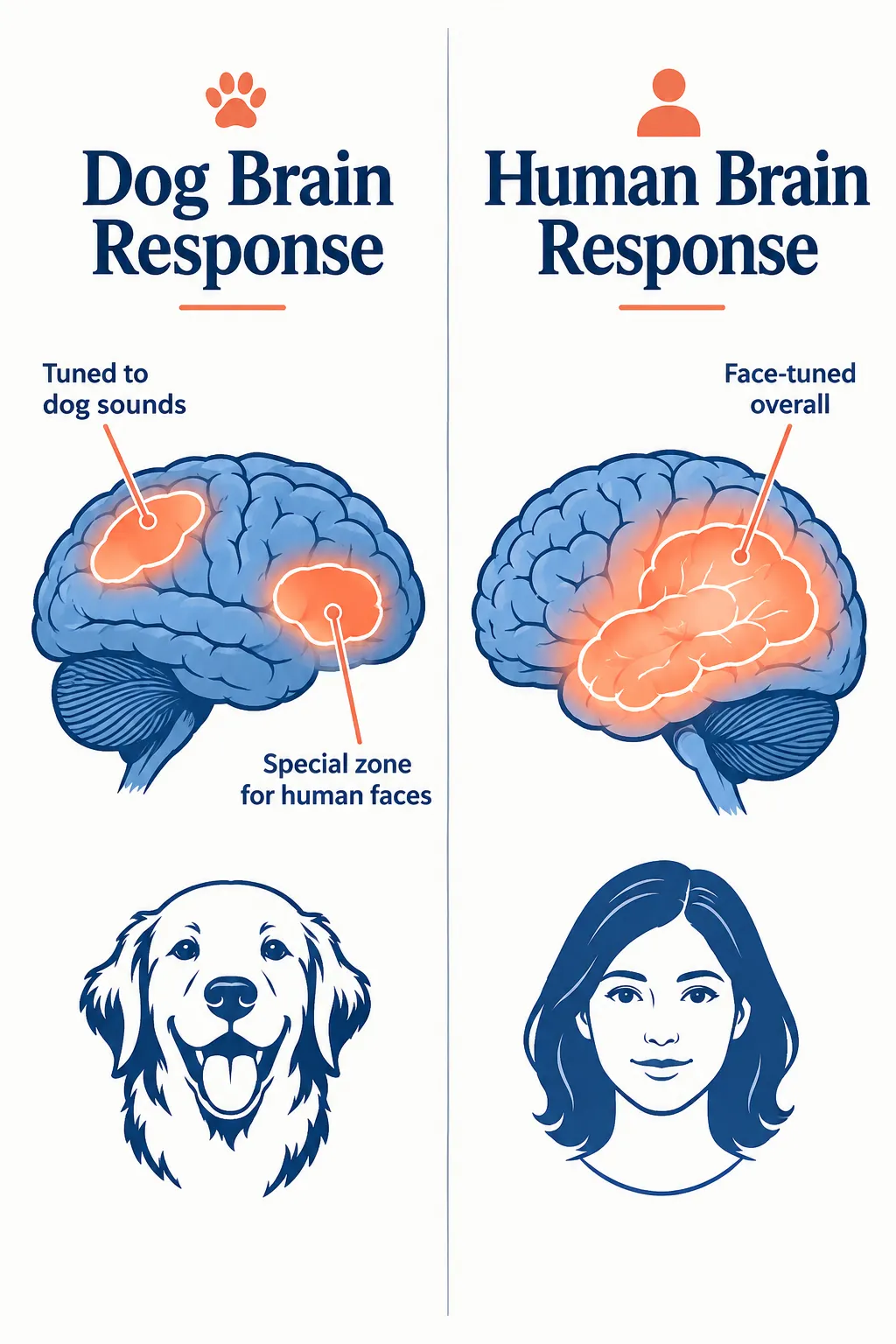
Brain scan research backs this up. A 2020 study in the Journal of Neuroscience found that most of a dog’s visual brain cares more about “is this a dog?” than “is this a face?”, the opposite pattern seen in human brains, where face recognition rules everything.[6] So on a pure biology level, dogs are built dog-first.
But here is the twist: dogs also grew a special skill just for us. Brain imaging from August 2026 showed dogs have distinct brain patterns for reading human facial expressions like happiness, sadness, anger, and fear.[1][15] That is not something wolves in the wild need. It is something that developed because dogs live so closely with people.
Eye-tracking research adds more detail. A 2026 study in the Journal of Comparative Psychology found dogs and humans both pay extra attention to the eyes of their own species. But dogs still watch human mouths closely too, especially happy human mouths, showing they are actively decoding our expressions, not ignoring them.[14]
Smell plays a role in dog-to-dog communication too. A February 2026 study found dogs can smell emotional information in other dogs’ body odor, spending more time sniffing new emotional scents than familiar ones.[11] This proves dogs have a whole private “emotional language” with each other that humans are not part of, which is one more reason dogs clearly know we are not dogs.
Even so, dogs do not treat human emotional signals as unimportant. Earlier research found dogs matched emotional faces with matching emotional voices for both dogs and humans, though the match was strongest for dog-to-dog signals.[12] In plain words: dogs read us well, just not quite as fluently as they read each other.
Why Your Dog Doesn’t See You as Human but Still Loves You Like Family
If dogs know we are not dogs, and their brains are tuned to prioritize other dogs, why do so many dogs act like their owner is the center of the universe? The answer lies in attachment, not species confusion.
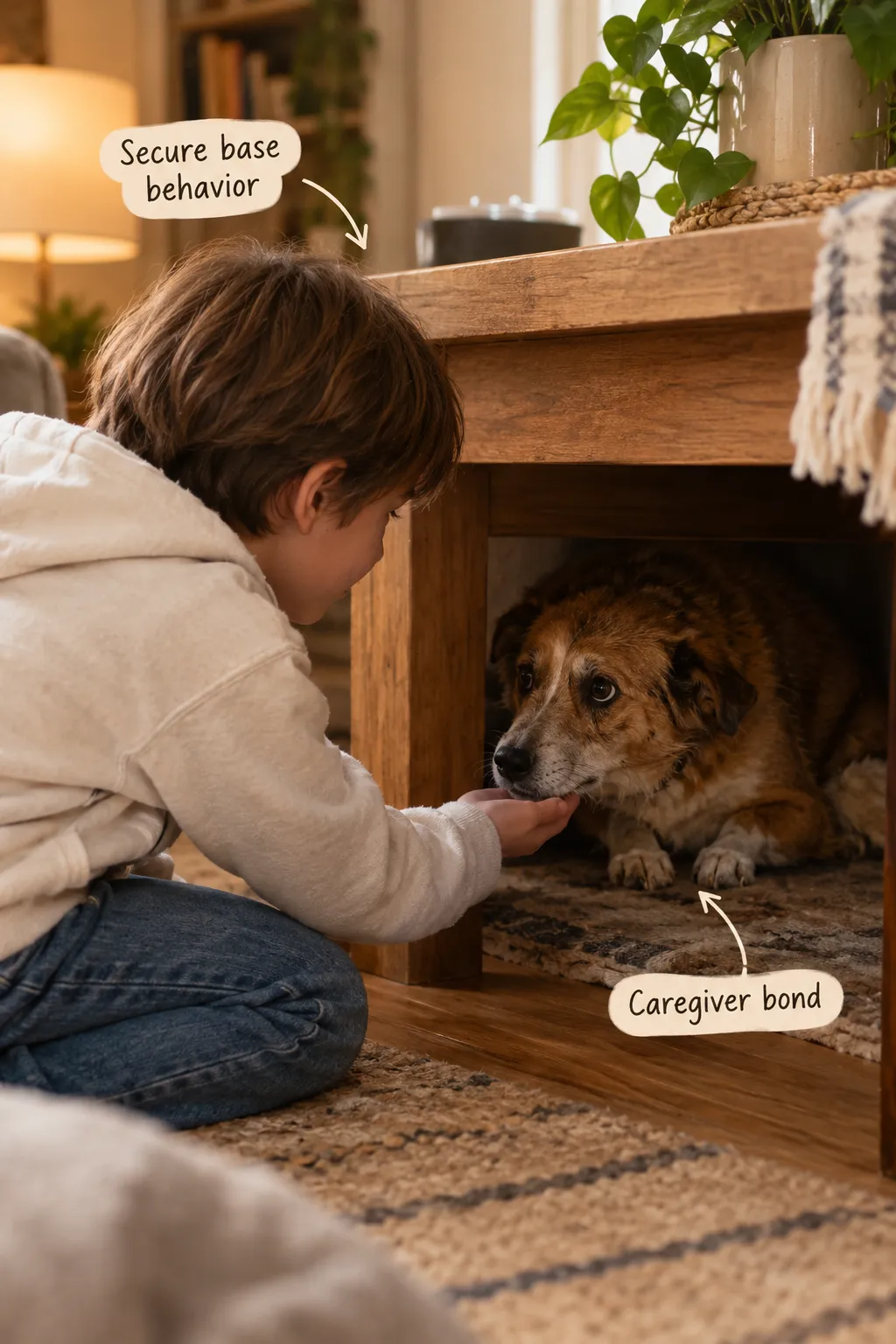
Canine attachment studies describe something called “secure base” behavior. This means a dog treats its owner the way a toddler treats a parent, running to them when scared, staying calm when the owner is nearby, and feeling distress when the owner leaves.[4][10] This is not pack behavior between equals. It looks much closer to a child-caregiver bond.
Duke University’s Dr. Brian Hare, a well-known dog cognition expert, has pointed out that dogs organize their whole social world around humans, even though they know we are a different species.[4][7][8] Dogs do not see us as alpha wolves or bigger packmates. They see us as the steady point their whole world spins around.
There’s more proof dogs treat humans as thinking, aware partners rather than just big warm objects. Research on perspective-taking shows dogs pay attention to whether a person is actually looking at them. Dogs are more likely to sneak food when a human’s back is turned or their eyes are closed, and less likely when the human is clearly watching.[9] That is a big deal, it means dogs believe humans have their own awareness and attention, just like another thinking creature would. Dogs are not just reacting to movement. They are reading intention.
Put together, here is a simple way to picture how a dog’s mind sorts the world:
- Other dogs → speak the same “native language,” full of smell and body signals
- Wild animals → mostly ignored or treated as prey/threat depending on species
- Strangers → cautious interest, judged by scent, tone, and body language
- You, the owner → a known, safe, emotionally important individual with their own thoughts and attention
This is exactly why the phrase Your Dog Doesn’t See You as Human, (Here’s What You Really Are to Them) works so well as an idea. Dogs are not mistaking us for something we’re not. They have created a totally new category, somewhere between packmate and parent, just for the humans they trust.
What This Means for Daily Life With Your Dog
Understanding this changes how pet owners can think about training, bonding, and comfort.
- Be consistent, Since dogs read tone, face, and scent together, mixed signals confuse them. Match your voice tone to your intended message.
- Respect the “secure base” role, If your dog leans on you during storms or vet visits, that is healthy attachment, not weakness.
- Use your face on purpose, Dogs study human mouths and eyes for emotional clues, so calm, open expressions help nervous dogs relax.[14]
- Let them sniff, Since smell is a dog’s fastest way to confirm safety and identity, allow greeting sniffs before rushing interactions.
- Remember they’re always “reading” you, Dogs track your gaze and attention, so they notice more about your mood and focus than most owners realize.[9]
Conclusion
Dogs are not confused about who is a dog and who is a human. Their noses, eyes, and brains all confirm the difference every single day.[3][5][6] But dogs go one step further than simple recognition, they build a special, emotionally rich category just for the humans they love, closer to a caregiver or life partner than a pack member.[1][4][10][15]
So next time someone jokes that dogs think we’re just big dogs, share the real story: dogs know exactly what we are, and they still choose to love us like family. That is not confusion, that is one of the most remarkable animal-human bonds on the planet.
Next steps for dog owners: Spend a few extra minutes each day making calm eye contact, use a steady voice during training, and let your dog sniff new visitors before greeting them. Small habits like these strengthen the very bond science says makes your dog feel safe, seen, and loved.
References
[1] Dogs Human Expressions Scli Intl – https://www.cnn.com/2026/08/13/science/dogs-human-expressions-scli-intl [2] pubmed.ncbi.nlm.nih.gov – https://pubmed.ncbi.nlm.nih.gov/42319563/ [3] Do Dogs Know We Are Dogs – https://www.petscare.com/news/faq/do-dogs-know-we-are-dogs [4] What Do Dogs Think We Are – https://www.petscare.com/en-gb/news/faq/what-do-dogs-think-we-are [5] Do Dogs Think Humans Are Dogs – https://www.petscare.com/en-au/news/post/do-dogs-think-humans-are-dogs [6] jneurosci – https://www.jneurosci.org/content/40/43/8396 [7] How Do Dogs See Humans – https://www.kinship.com/dog-behavior/how-do-dogs-see-humans [8] Do Dogs Think Humans Are Dogs Too – https://www.dogster.com/lifestyle/do-dogs-think-humans-are-dogs-too/ [9] Pmc9877093 – https://pmc.ncbi.nlm.nih.gov/articles/PMC9877093/ [10] How Do Dogs View Humans – https://www.petscare.com/news/faq/how-do-dogs-view-humans