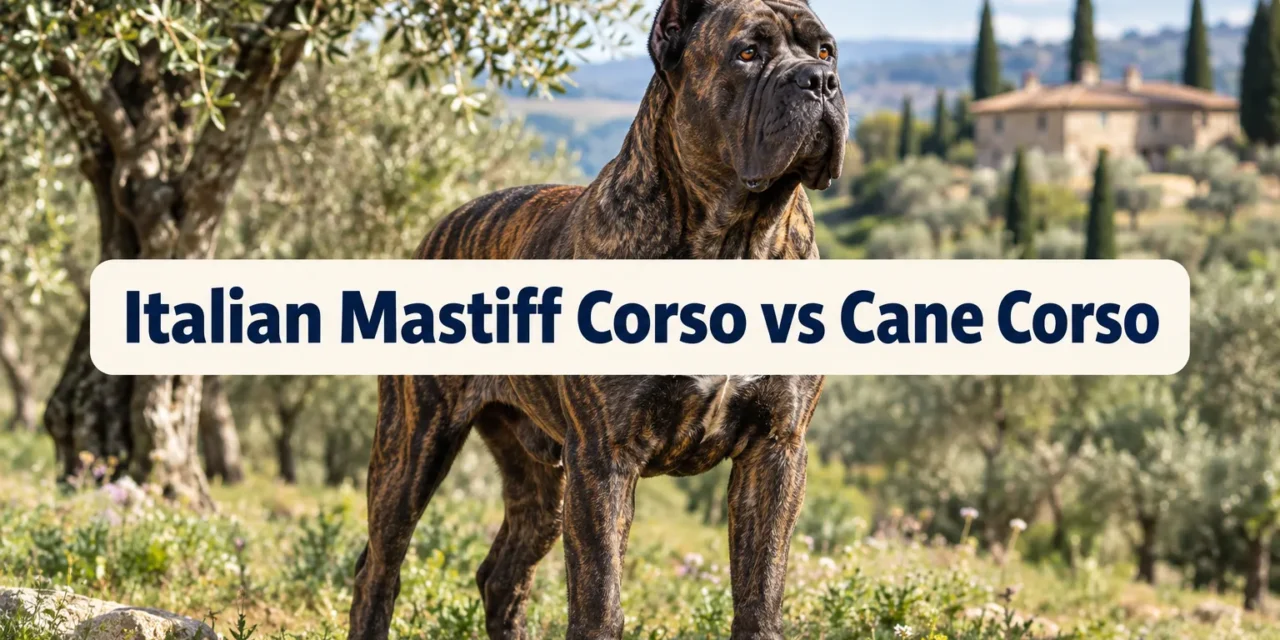
A quick Google search for “Italian Mastiff Corso” turns up thousands of listings every month. But here’s the surprising truth: that exact breed doesn’t officially exist. The dog most people picture, a muscular, square-headed guardian with Roman war-dog roots, has one real name. It’s called the Cane Corso.

So why does the confusion stick around? And does it matter when there’s a deposit check involved? Let’s dig into Italian Mastiff Corso vs Cane Corso: Are They Really the Same Dog Breed?, sort fact from marketing fluff, and get you ready to shop smart.
Key Takeaways
- “Italian Mastiff Corso” is not an official breed name. The real, kennel-club-recognized breed is the Cane Corso [1].
- “Italian Mastiff” is often just a nickname for the Cane Corso, but some sites confusingly use it for the Neapolitan Mastiff instead [2][3].
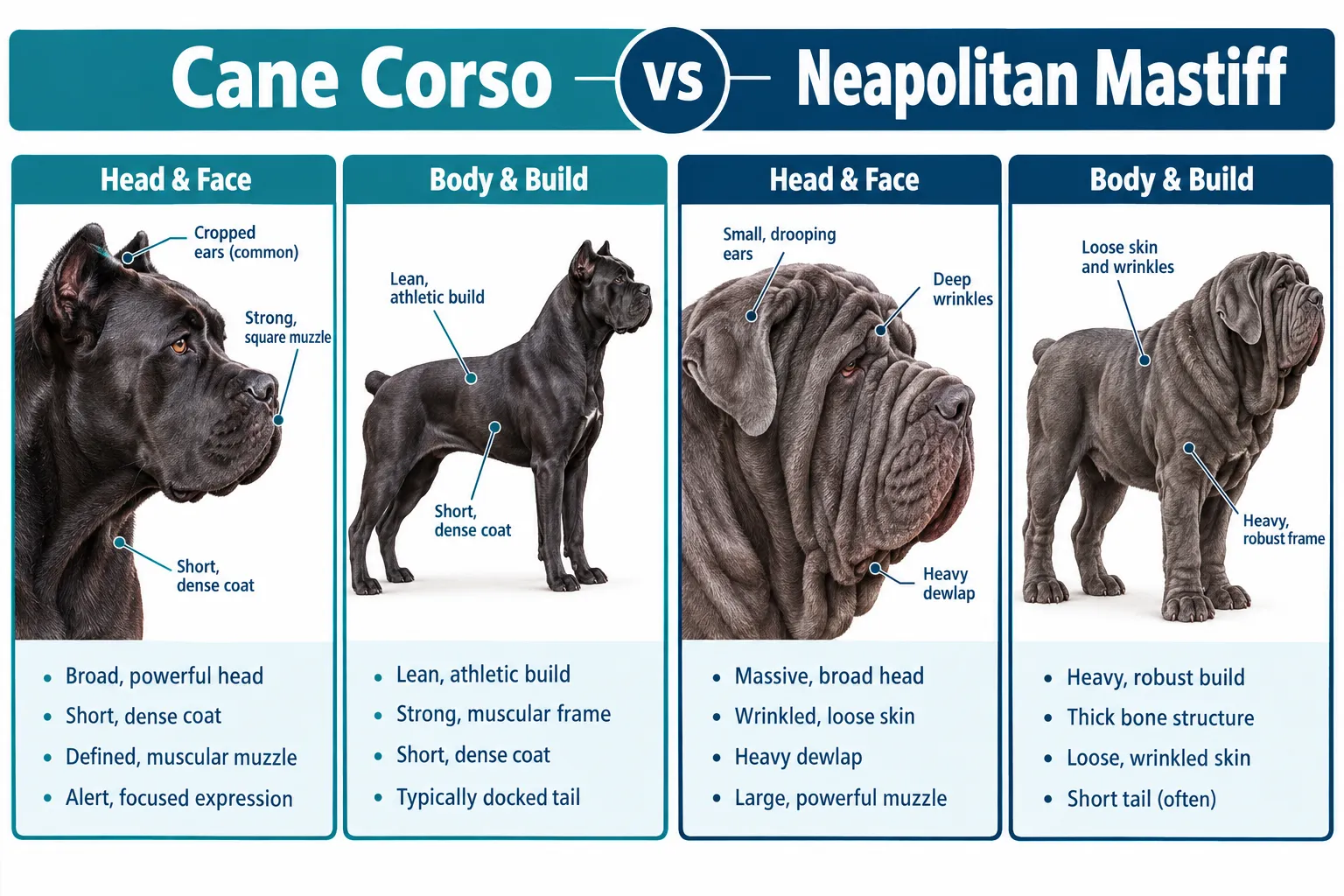
- The actual mix-up dog lovers run into is Cane Corso vs Neapolitan Mastiff, two genuinely different breeds with different coats, builds, and temperaments [3][5].
- Cane Corsos are lean, athletic, and built for guarding, not the droopy, heavy-boned look many people expect from a “mastiff” [4][7].
- Before paying a deposit, always verify a breeder’s registration and ask to see both parent dogs. Naming confusion is a red flag for backyard breeding, not a cute quirk.
Why “Italian Mastiff Corso” Confuses So Many Dog Lovers
Here’s where the mix-up starts. Dog lovers hear “Italian Mastiff,” picture a giant wrinkly guard dog, then stumble onto “Cane Corso” listings that look athletic and lean. Naturally, they assume these must be two different pups. They’re not. 🐾
The Cane Corso is Italy’s mastiff breed. Historically, it descended from Roman war dogs, later working as a farm guardian and big-game hunting companion across southern Italy [1][9]. The name “Cane Corso” is widely believed to trace back to the Latin “cohors,” meaning guardian or protector [1]. That heritage is exactly why people slap “Italian Mastiff” onto its name, it’s a mastiff-type dog, and it’s Italian. Simple enough.
But pet-content sites muddy the water. Some use “Italian Mastiff” as a straightforward synonym for Cane Corso [2]. Others, confusingly, use “Italian Mastiff” to describe the Neapolitan Mastiff, a totally separate breed with saggy skin and a much heavier frame [3]. So when someone searches “Italian Mastiff Corso,” they’re often accidentally blending two different dogs into one search term.
Add in casual nicknames like “Italian Corso dog” or “cane mastiff,” and you’ve got a perfect storm of search confusion. None of these are formal names. They’re all pointing, one way or another, back to the Cane Corso, or getting tangled up with its heavier-boned cousin.
Bottom line: If a listing says “Italian Mastiff Corso,” ask the seller one simple question: “Is this a Cane Corso?” Their answer, and how confidently they give it, tells you a lot.
Italian Mastiff Corso vs Cane Corso: What Kennel Clubs Actually Say
Want the official word? Go straight to the source. Major kennel clubs only recognize one breed here: the Cane Corso. There is no separate, formally recognized breed called “Italian Mastiff Corso” as of 2026 [1]. It simply doesn’t exist on any official breed standard list.
This matters a lot more than it might seem. Kennel club recognition isn’t just paperwork. It sets the rules for:
- Physical standards, height, weight, coat type, color patterns
- Temperament expectations, what’s normal vs. what’s a red flag
- Health testing requirements, hip, elbow, and cardiac screenings
- Breeding eligibility, which dogs can be registered and shown
When a seller invents a name like “Italian Mastiff Corso,” they’re stepping outside that whole framework. That doesn’t automatically mean the dog is unhealthy. But it does mean you lose the safety net that comes with verified, registered breeding lines.
Here’s the simple truth to remember: Cane Corso is the Italian mastiff. It’s not a cousin breed, a mixed breed, or a rare designer variant. It’s the dog, full stop [1][7]. For more context on where this breed really comes from and what makes it tick, check out these fascinating facts about the Cane Corso dog breed.
Is “Cane Mastiff” Just Another Name for the Same Dog?
Yes, mostly. “Cane mastiff” is a casual, non-official term people use when they’re not sure how to translate “Cane Corso” or when they’re trying to describe its mastiff-family roots. It’s not used by any kennel club. Treat it as slang, not a separate category.
Cane Corso vs Neapolitan Mastiff: The Real Breed Mix-Up
This is the comparison that actually matters, and it’s the one most “Italian Mastiff Corso” searches are secretly trying to sort out.
Both breeds share Italian roots. Both are classified as mastiff-type dogs. That’s roughly where the similarities end. Recent expert commentary confirms that naming confusion mostly involves Cane Corso vs Neapolitan Mastiff, not some third mystery breed [3].
| Feature | Cane Corso | Neapolitan Mastiff |
|---|---|---|
| Build | Lean, athletic, muscular [4][7] | Heavy-boned, massive frame [3] |
| Skin | Tight, minimal wrinkles [4] | Loose, deeply wrinkled skin [3] |
| Coat | Short and dense [1] | Short but thicker, looser over frame [3] |
| Energy level | Active, needs daily exercise [9] | Lower energy, more laid-back [3] |
| Guarding style | Alert, agile protector [9] | Imposing, stationary deterrent [3] |
Think of it this way: the Cane Corso is the fit, fast guardian who patrols the fence line. The Neapolitan Mastiff is the massive, loyal couch boulder who scares off intruders just by existing. Totally different vibes, same country of origin. 🇮🇹
If you want a deeper dive into standard mastiff comparisons beyond just these two, the broader dog breed comparison collection is a great next stop.
Physical Differences: Cane Corso vs Other “Italian Mastiffs”
Numbers don’t lie, and the Cane Corso’s physical standards back up its athletic reputation loud and clear. Authoritative sources from 2024-2026 are consistent: this is not your classic droopy, slow-moving mastiff [4][6].
Here’s what sets the Cane Corso apart, physically speaking:
- Height: Males typically stand 25-27.5 inches at the shoulder; females run slightly smaller [1][7].
- Weight: Adults usually weigh 88-120 pounds, with a visibly muscular, square-shaped body [1][9].
- Head shape: Large, flat skull with a broad muzzle, powerful but not exaggerated [1].
- Coat: Short, stiff, and low-maintenance, coming in black, fawn, red, and brindle [1][7].
- Movement: Agile and confident, built for quick direction changes, not a slow lumbering gait [4].
Compare that to a generic “mastiff” stereotype, heavier bone structure, looser skin, more laid-back movement, and you can see why some buyers get thrown off. The Cane Corso borrows the mastiff family’s size and guarding instinct but trades the bulk for speed and precision [4][6].
This athletic build isn’t just for looks. It’s functional. Historically, Cane Corsos needed to cover ground fast while herding livestock or hunting wild boar [9]. That working history still shows up in how the breed moves and behaves today.
Temperament and Training: One Breed, One Profile
Here’s some good news for anyone worried they’ll get a “different” temperament depending on which name is used: they won’t. Modern breed guides from 2026 consistently describe one unified Cane Corso temperament profile, there’s no separate “Italian Mastiff Corso” personality type floating around out there [8][9].
So what does that real profile actually look like?
- Loyal and bonded to their family, often described as velcro dogs who want to be near their people [8].
- Naturally protective, with strong watchdog instincts that kick in early [9][10].
- Intelligent but independent, meaning training needs consistency, not harsh corrections [9].
- Reserved with strangers until properly socialized, this isn’t a dog that warms up to everyone instantly [10].
- Playful with familiar family members, including kids in households where the dog was raised with structure and supervision [8].
Because of that protective streak and sheer size, early socialization and obedience work aren’t optional extras, they’re essential. A well-trained Cane Corso is a calm, confident family guardian. An under-socialized one can become a serious handful. For guidance on getting training right from puppyhood, the large breed training resources are worth bookmarking.
Curious whether this breed actually fits a family setup? These dogs were literally bred to be farm and family protectors, and that instinct hasn’t gone anywhere. Learn more in 13 reasons why a Cane Corso dog makes the perfect family guardian.
Health and Lifespan: What “Italian Mastiff Corso” Buyers Need to Know
This is where the naming confusion actually becomes a practical risk, not just a vocabulary problem. Veterinary content in 2026 treats Cane Corso and Neapolitan Mastiff as separate health-management categories, each with its own risk profile [3][5]. If a buyer thinks they’re getting one breed but ends up with genetics from the other, they could be caught off guard by health issues they didn’t research.
Common health watch-outs for Cane Corsos include:
- Hip and elbow dysplasia, common in large, fast-growing breeds [10]
- Bloat (gastric dilatation-volvulus), a life-threatening emergency more common in deep-chested dogs [10]
- Eyelid abnormalities, like entropion or ectropion [10]
- Heart conditions, including dilated cardiomyopathy in some lines [10]
Average lifespan runs roughly 9 to 12 years, with proper weight management, joint support, and regular vet checkups all playing a role in getting toward the higher end of that range [10].
Since genetics and build directly affect joint stress, bloat risk, and energy needs, nutrition isn’t a side note, it’s central to keeping this breed healthy long-term. For a full rundown of warning signs to watch for at every life stage, see 10 health problems every Cane Corso dog owner should watch for. And because diet directly ties into joint health and bloat prevention, it’s worth pairing that with 11 best foods to feed your Cane Corso dog for optimal health and a look at 4 feeding schedules that work best for Cane Corso dogs.
Before You Put Down a Deposit: A Buyer’s Checklist
Here’s the part that really matters. If a listing uses “Italian Mastiff Corso,” “Italian Corso dog,” or “cane mastiff” instead of the clear, official “Cane Corso,” slow down. It’s not automatically a scam, but it is a signal to ask more questions.
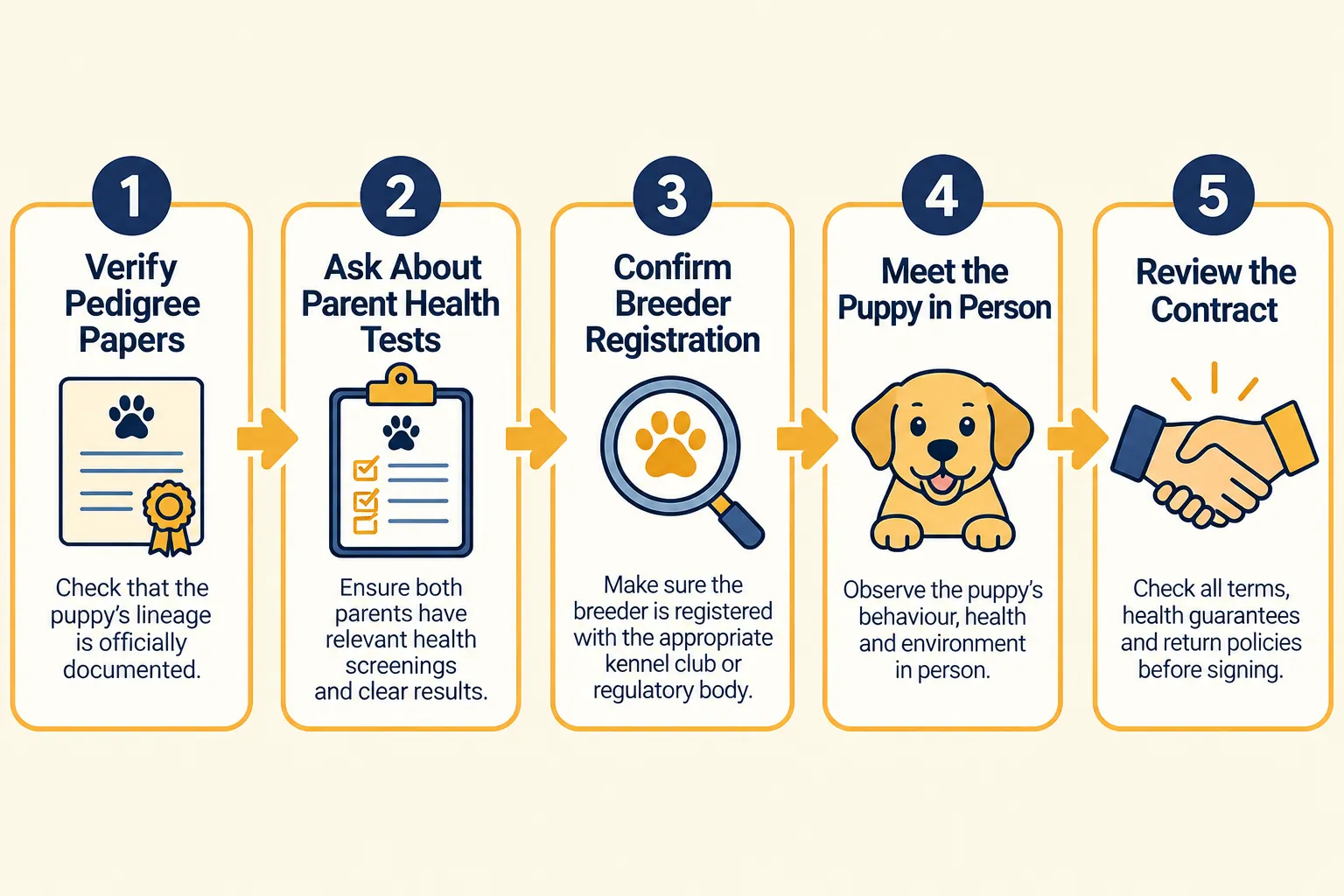
Run through this checklist before any money changes hands:
- Ask directly what breed the puppy is registered as. A legitimate breeder will say “Cane Corso,” clearly and confidently, every time.
- Request registration paperwork from a recognized kennel club. No papers, no proof, walk away.
- Ask for health clearances on both parents, especially hip, elbow, and cardiac screenings.
- Meet both parent dogs in person (or via live video call, at minimum) to check temperament and physical condition.
- Compare the puppy’s expected adult size against standard Cane Corso measurements, 25-27.5 inches tall, 88-120 pounds [1][7].
- Watch for inflated pricing tied to “rare” naming. Terms like “Italian Mastiff Corso” sometimes get used to justify a premium price for what’s really just a standard Cane Corso, or worse, a poorly bred mix.
- Ask about socialization and early exposure to people, noises, and other animals. Responsible breeders start this work early.
If a seller gets defensive, vague, or can’t produce paperwork when you ask about breed naming, treat that as a dealbreaker, not a quirky detail.
The Prediction: Where the Naming Trend Is Headed
Terminology is slowly converging, and it’s heading in a sensible direction. Expect “Cane Corso” to keep solidifying as the single, formal breed name going forward, with “Italian Mastiff” sticking around as a casual, acceptable synonym. Meanwhile, “Italian Mastiff Corso” is likely to keep fading as the imprecise, marketing-driven term it always was.
That’s genuinely good news for dog lovers. Clearer terminology means fewer surprises, better-informed buyers, and less room for shady breeders to hide behind a made-up name. The more people search with accurate terms, the harder it becomes to pass off confusing, misleading listings.
Conclusion: Same Dog, Clearer Name
Let’s bring it home. Italian Mastiff Corso vs Cane Corso: Are They Really the Same Dog Breed? The answer is a confident yes, there’s no secret second breed hiding behind that extra word. “Italian Mastiff Corso” isn’t an official name; it’s a search-engine mash-up born from genuine confusion between the Cane Corso and its heavier cousin, the Neapolitan Mastiff.
Here’s the action plan going forward:
- Use “Cane Corso” when researching breeders, health info, or training advice, it’s the accurate, searchable term.
- Double-check any listing that uses unofficial names like “Italian Mastiff Corso” or “cane mastiff.”
- Verify registration papers and parent health screenings before any deposit leaves your hands.
- Lean into trusted resources for ongoing care, from nutrition to 19 life stages every Cane Corso dog goes through.
Bringing home a Cane Corso is a big, wonderful commitment. Get the name right, and the rest of the research gets a whole lot easier. This breed has earned its spot as one of the most devoted guardian dogs out there, no confusing nickname needed. 🐶💛
References
[1] Cane Corso – https://en.wikipedia.org/wiki/Cane_Corso [2] Italian Mastiff Vs Cane Corso – https://www.thedailytail.com/italian-mastiff-vs-cane-corso/ [3] Cane Corso Vs Mastiff – https://www.dogster.com/dog-breeds/cane-corso-vs-mastiff/ [4] Mastiff Vs The Cane Corso – https://a-z-animals.com/pets/dogs/dog-comparison/mastiff-vs-the-cane-corso/ [5] Mastiff Vs Cane Corso Breeds – https://worldanimalfoundation.org/dogs/mastiff-vs-cane-corso-breeds/ [6] Mastiff – https://dogfluence.com/pt/dog-breeds/cane-corso/vs/mastiff [7] Cane Corso – https://a-z-animals.com/animals/cane-corso/ [8] Are Cane Corsos Affectionate – https://www.dogster.com/lifestyle/are-cane-corsos-affectionate/ [9] Cane Corso Dog Breed – https://www.carecredit.com/well-u/pet-care/cane-corso-dog-breed/ [10] Cane Corso – https://www.pdsa.org.uk/pet-help-and-advice/looking-after-your-pet/puppies-dogs/large-dogs/cane-corso