
A Dachshund’s bark can hit the same volume as a delivery truck horn. That’s not an exaggeration, these tiny dogs were bred to be loud on purpose. Understanding Dachshund Barking: Why Wiener Dogs Vocalize and How to Reduce It Humanely starts with one surprising truth: your wiener dog isn’t broken. He’s doing his job.

Dachshunds were built centuries ago to hunt badgers underground. Alerting their human hunting partners with a sharp, piercing bark was the entire point [1]. So when your couch-potato Dachshund barks at a falling leaf today, he’s channeling thousands of years of breeding. That doesn’t mean the barking has to take over your home. It just means training has to work with his instincts, not against them.
This guide breaks down the real reasons behind dachshund barking and gives you gentle, breed-safe ways to dial it back, without yelling, shock collars, or stressing out that long little back.
Key Takeaways
- 🐾 Dachshunds bark because of hunting heritage, not because something is “wrong” with them.
- 📊 New research suggests behavior problems like excessive barking may be less universal than older studies claimed [2].
- 🔊 Four main bark types drive most wiener dog noise: alert, demand, separation, and boredom barking.
- 🧠 Humans frequently misread dog emotions, which can make training less effective if we don’t understand the “why” first [3][4].
- 🦴 Any training plan for a Dachshund must protect the long spine and short legs, jumping and rough play during training sessions can cause injury.
Why Dachshund Barking Happens: The Breed’s Hunting Instinct
Dachshunds were engineered, literally bred, to chase badgers into tunnels and bark loudly enough for hunters above ground to find them. That deep, surprisingly big bark coming from such a small body? That’s a feature, not a glitch [1][5]. Compared to quieter breeds like Basenjis or Greyhounds, Dachshunds sit near the top of barking charts for small dogs, right alongside terriers and other “go-to-ground” breeds [5].
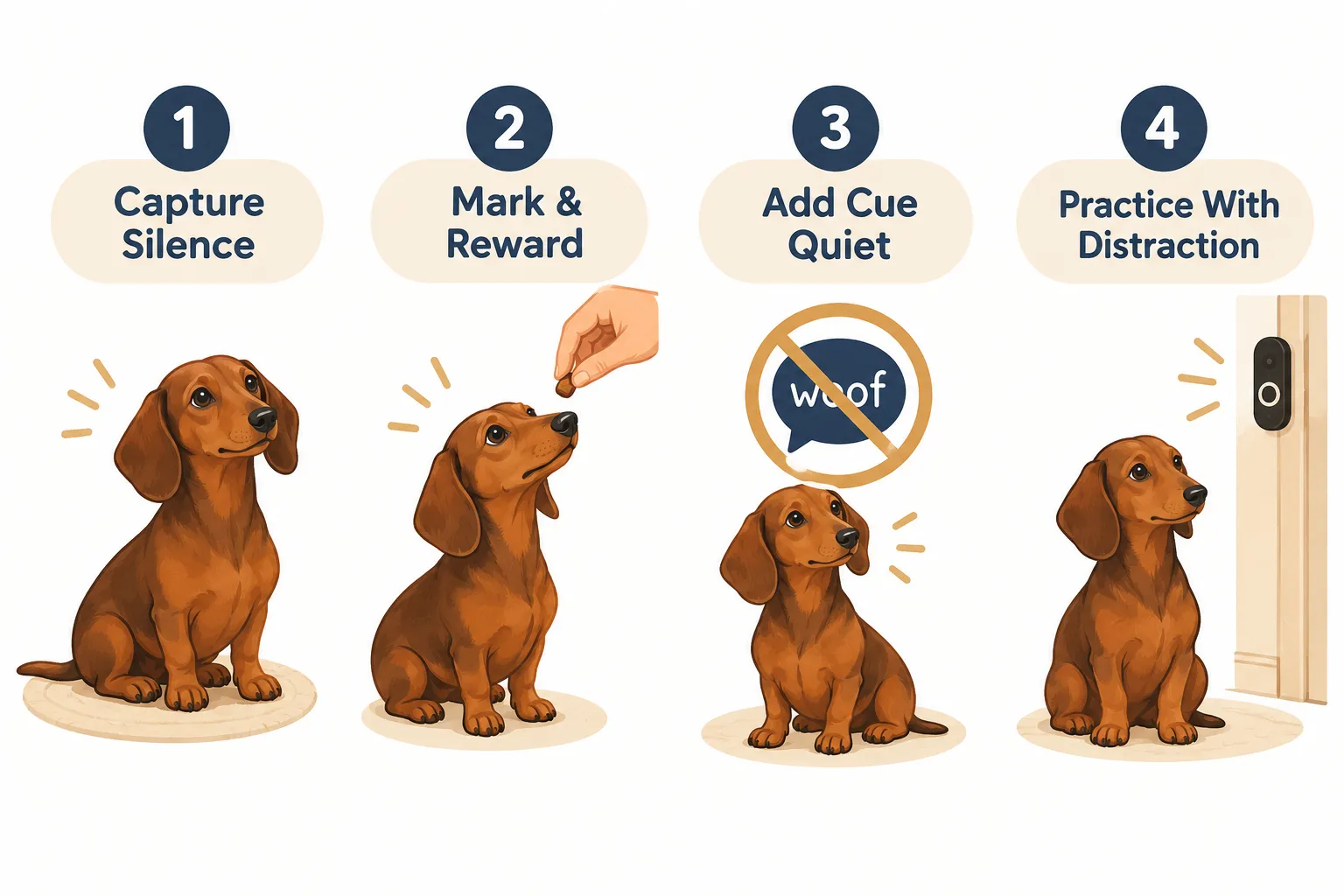
This matters for Dachshund Barking: Why Wiener Dogs Vocalize and How to Reduce It Humanely because it reframes the goal. You’re not trying to erase barking completely. You’re managing an instinct, like teaching a Border Collie to stop herding the kids. Realistic expectations save a lot of frustration.
The Four Main Triggers
Most Dachshund barking falls into one of these buckets:
- Alert barking, someone at the door, a squirrel, a noise outside.
- Demand barking, “Pick me up,” “Feed me,” “Play with me NOW.”
- Separation-related vocalization, barking, whining, or howling when left alone.
- Boredom barking, noise that fills an empty, under-stimulated day.
Each type needs a slightly different fix. Lumping them together is where a lot of owners go wrong.
How Common Is Excessive Barking, Really?
Here’s some good news: a 2026 review challenges the long-repeated claim that 99% of pet dogs have behavior problems. Researchers found that figure was likely overstated, and that many dogs labeled “problematic” are actually behaving within normal ranges for their breed [2]. Translation: your barky Dachshund might be completely typical, not a training failure.
That said, barking is still one of the top complaints dog parents bring to trainers and vets. Acoustic researchers are now using AI to study bark patterns, pitch, and rhythm to better understand what dogs are actually communicating [6]. Early findings suggest barks carry more specific information than we once assumed, different barks really do mean different things, even if humans aren’t great at telling them apart yet [6][7].
What the New Science Says About Reading Your Dog
A 2025-2026 body of research into how humans interpret canine emotion found something humbling: people are often wrong about what a bark means [3][4]. We tend to project human emotions onto dog sounds, assuming a high-pitched bark means excitement when it might mean stress, or that a low growl-bark is aggression when it’s actually fear [3].
“Dogs are talking to us constantly, we just haven’t fully learned the language yet.”
This matters for training. If you assume your Dachshund is barking out of “stubbornness” when he’s actually anxious, you’ll pick the wrong fix every time. Slow down, watch the whole dog, body posture, tail position, ears, not just the bark itself. For a deeper look at how dogs actually perceive their world and their humans, check out Understanding Dogs.
Dachshund Barking: Why Wiener Dogs Vocalize and How to Reduce It Humanely, Alert Barking Fixes
Alert barking is the “someone’s at the door!” response. It’s rooted in the hunting instinct and tends to be the loudest, sharpest bark type [1].
Humane strategies:
- Block the trigger visually. Frosted window film or furniture rearrangement can stop street-watching barking before it starts.
- Teach “thank you, that’s enough.” Let your Dachshund bark two or three times, then calmly say “thank you” and redirect to a treat. This acknowledges the alert without punishing the instinct.
- Desensitize to doorbells. Play recorded doorbell sounds at low volume, reward calm behavior, and slowly increase volume over days or weeks [8][9].
Never scream over the barking to “out-bark” your dog. It just sounds like you’re joining in.
Demand Barking and Boredom: Teaching Quiet Without Crushing Personality
Demand barking happens when barking has worked before. If barking gets your Dachshund a treat, a lap, or a toy, he’ll keep doing it. Boredom barking is different, it’s a release valve for a mind with nothing to do.
Breaking the Demand-Bark Cycle
- Never reward mid-bark. Wait for a pause, even a half-second one, then reward the silence.
- Teach an incompatible behavior, like “go to your mat,” so barking and lying down can’t happen at once.
- Ignore consistently. This is the hardest part. If you cave even one time in ten, the barking gets worse, not better, because now it’s a slot machine.
Solving Boredom at the Root
Dachshunds are smart, nosy little dogs with big personalities packed into small frames. A bored Dachshund finds his own entertainment, usually barking at the mail carrier for the fifth time today.
- Snuffle mats and lick mats slow down mealtime and give the brain a job. Explore options under Lick Mat For Dogs.
- Short, low-impact play sessions multiple times a day beat one long walk.
- Puzzle feeders turn kibble time into a 20-minute mental workout.
Apartment living doesn’t have to mean constant barking either, smart enrichment routines work well for apartment dogs of all breeds, Dachshunds included.
Separation-Related Vocalization: When Alone Time Means Loud Time
Dachshunds bond hard with their people. That devotion is paw-some for cuddles, but it can turn into real distress when you walk out the door. Separation-related barking often comes paired with other signs like pacing, drooling, or destroying a favorite blanket.
Gentle steps to ease it:
- Practice fake departures. Grab your keys, put on your coat, and sit back down. Repeat until the “leaving cues” stop triggering panic.
- Build alone-time tolerance in small doses. Start with 2-3 minutes away, then slowly stretch the gap.
- Use calming tools. A snug, well-fitted anxiety wrap for dogs can take the edge off for some dogs.
- Leave background noise on. A radio or white noise machine masks startling outside sounds.
If barking is severe, paired with self-injury, or doesn’t improve with consistent practice, loop in a vet or certified behaviorist. Persistent distress can sometimes mask physical pain too, review 19 Silent Signs of Pain in Dogs Every Owner Should Know to rule that out.
Training “Quiet” the Spine-Safe Way
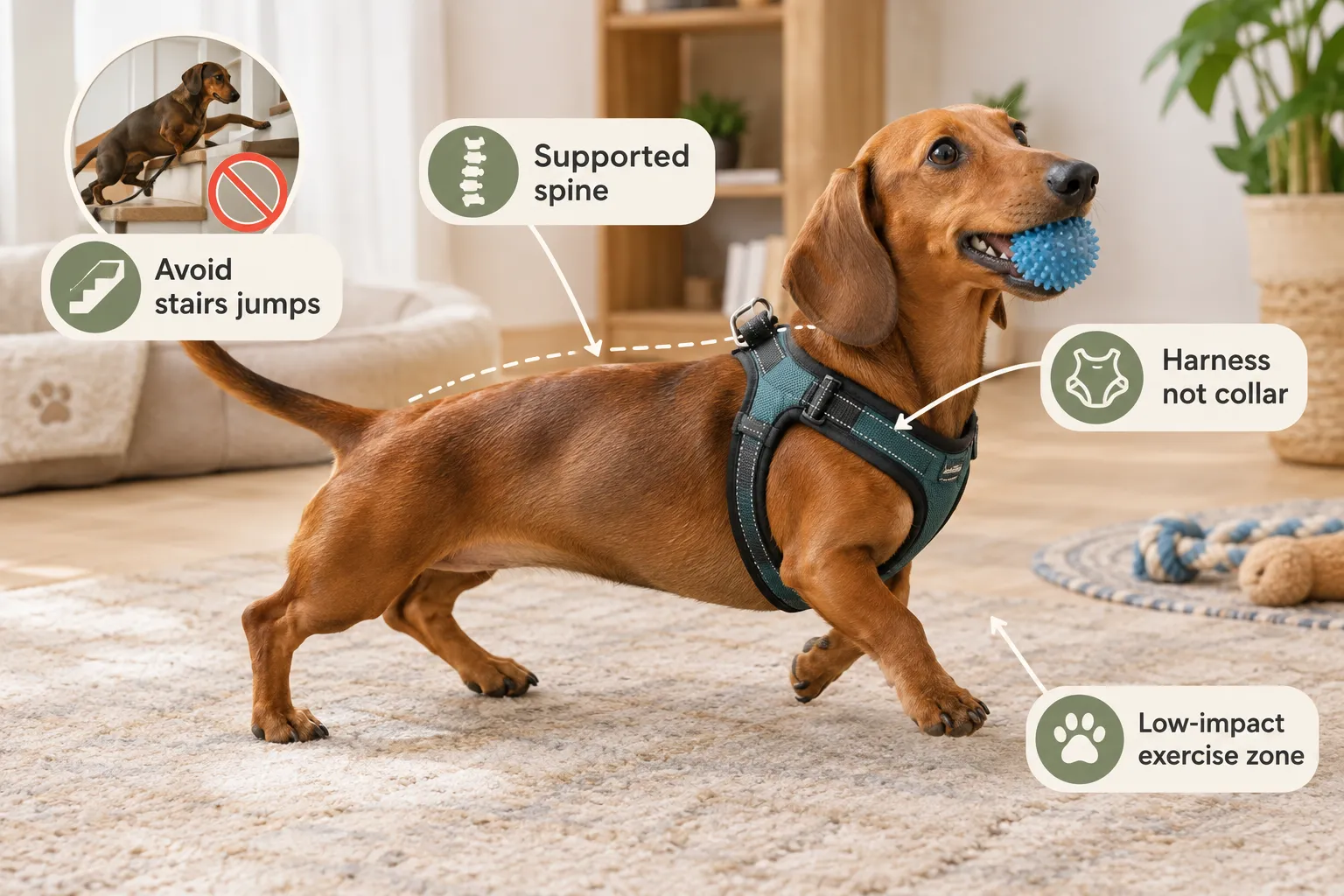
Here’s the part most generic dog-training guides miss: Dachshunds have long backs and short legs that are prone to intervertebral disc disease. Any training plan has to protect that spine, especially since barking training often involves jumping, excitement, or sudden movement.
Spine-safe training rules:
- Train at floor level. Kneel or sit so your Dachshund doesn’t jump up to get your attention or a treat.
- Use ramps, not stairs, for furniture access during training sessions involving the couch or bed.
- Skip jump-based tricks like “sit pretty” or fetch games that involve leaping for a toy.
- Harness over collar, always, especially during leash-based training walks that reduce boredom barking.
- Keep sessions short, five minutes, two or three times a day, beats one long, excitable session.
This approach matters whether you’re working with a stubborn puppy or an older dog. It mirrors advice given for other strong-willed small breeds, see 10 Chihuahua Training Tips for Stubborn Tiny Dogs for parallel strategies on patience and consistency.
When Barking Is Normal vs. When It’s a Problem
| Situation | Likely Normal | Worth Investigating |
|---|---|---|
| Barks at doorbell, stops within seconds | ✅ | |
| Barks nonstop for 20+ minutes when alone | ⚠️ | |
| Occasional bark at passing dogs on walks | ✅ | |
| Sudden new barking paired with limping or hiding | ⚠️ | |
| Barks for attention, settles once acknowledged | ✅ | |
| Barks at “nothing” repeatedly, seems distressed | ⚠️ |
If barking appears suddenly and out of character, a vet visit should come before any training plan. Dialavet’s case notes on a mini Dachshund “barking at everything” highlight how quickly a behavior change can signal an underlying medical issue, not just a training gap [10]. Vets and behaviorists increasingly recommend ruling out pain, vision loss, or hearing changes before assuming it’s purely behavioral [10].
Comparing Dachshunds to Quieter Breeds
Breeds like Basenjis, Greyhounds, and Bernese Mountain Dogs tend to vocalize far less than Dachshunds [5]. That’s not a flaw in your wiener dog, it’s just a different genetic blueprint. If you’re choosing between breeds and quiet is a top priority, breeds known for calmer temperaments might fit better; families curious about low-noise, steady companions often look at options like those featured in 25 Heartwarming Reasons Bernese Mountain Dogs Are the Best Family Dogs.
But if you already have a Dachshund, or you’re set on getting one, accept that some barking comes with the territory. Management, not elimination, is the realistic and humane goal. New owners weighing their first dog breed overall can compare temperaments at Best Dogs For Beginners.
Socialization and Exercise: Prevention Beats Cure
A well-socialized, well-exercised Dachshund barks less across every category, alert, demand, separation, and boredom. Puppies exposed early to different people, sounds, and environments grow into adults who startle less and settle faster [8][9].
- Early socialization window (8-16 weeks) is prime time for exposure to new sights and sounds.
- Daily sniff walks satisfy the nose-driven hunting brain better than fast-paced jogging.
- Rotating toys weekly keeps boredom barking at bay without buying a mountain of new gear.
- Calm-greeting practice with guests reduces door-based alert barking over time.
For families balancing a Dachshund with kids, consistent socialization also supports smoother integration, a theme echoed across guides on best family dogs.
Conclusion: A Quieter, Happier Wiener Dog Is Possible
Dachshund barking isn’t a mystery, and it’s definitely not a character flaw. It’s instinct, communication, and sometimes a cry for more stimulation or reassurance. Understanding Dachshund Barking: Why Wiener Dogs Vocalize and How to Reduce It Humanely means meeting your dog halfway, honoring the hunter inside him while gently teaching when quiet pays off.
Next steps:
- Identify which type of barking shows up most in your home, alert, demand, separation, or boredom.
- Start one spine-safe training technique this week, like capturing and rewarding silence.
- Boost daily enrichment with sniff walks and puzzle feeders.
- Rule out pain or health changes with a vet if barking shifts suddenly.
- Celebrate small wins, a three-second pause in barking is real progress.
Every bark is a message. Learn the language, and the whole household gets calmer, together. 🐶
References
- Do Dachshunds Bark a Lot. dogster.com.
- New Study Challenges Finding That 99 of US Dogs Have Behavior Problems Says Rates Were Overstated. dvm360.com.
- 250310134153. sciencedaily.com.
- 08927936.2025.2469400. tandfonline.com.
- 15 Popular Dog Breeds Bark 120104396. yahoo.com.
- Who Let the Dogs Talk. uta.edu.
- 67ba2335fdddffb1898b45a9. mundoamerica.com.
- How to Train a Dachshund Not to Bark. dogster.com.
- How to Quiet a Barking Dachshund Dog. petcarerx.com.
- Mini Dachshund Barking at Everything 71614. dialavet.com.
Dachshund barking, wiener dog training, excessive dog barking, separation anxiety dogs, dog behavior science, Dachshund care, humane dog training, dog enrichment, breed-specific training, dog vocalization, puppy socialization, small dog breeds