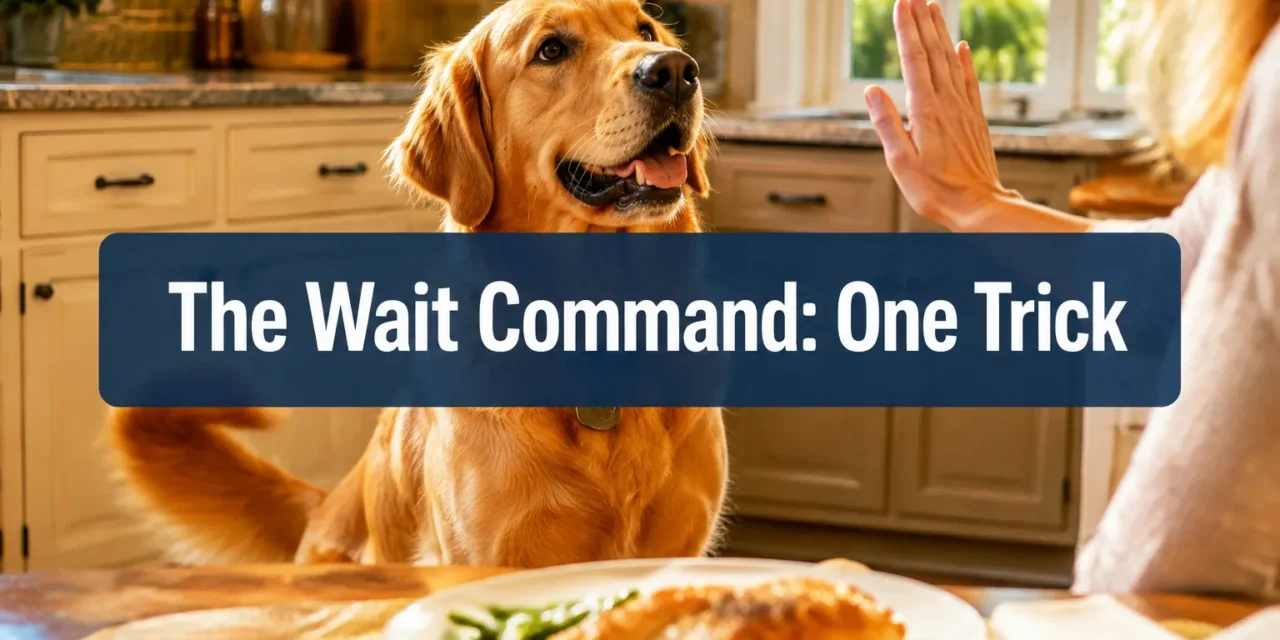
A study by the American Kennel Club found that dogs who learn impulse control commands are three times less likely to develop destructive behaviors at home. Yet most dog owners skip right past one of the simplest, most powerful commands in the book. The “Wait” Command: The One Trick That Will Save Your Sanity (and Your Food) is not flashy. It does not win ribbons at dog shows. But it might just be the single most useful thing you ever teach your dog, and it takes less than five minutes a day to learn.

Whether your pup bolts out the front door, dives face-first into their dinner bowl, or steals food off the counter, the wait command is the answer. This guide breaks it all down in plain, simple language so any dog lover can start today.
Key Takeaways
- 🐾 The “wait” command teaches dogs to pause and hold still until given a release cue.
- 🍽️ It stops food stealing, door dashing, and jumping, fast.
- ✅ Any dog of any age can learn it using positive reinforcement.
- ⏱️ Short, consistent 5-minute training sessions work best.
- 🏠 Once learned, “wait” works in dozens of real-life situations every single day.
What Exactly Is the “Wait” Command?
Before diving into training steps, it helps to understand what “wait” actually means to a dog. The wait command tells your dog: “Pause what you are doing and do not move forward until I say so.”
It is different from “stay.” Here is a quick comparison:
| Command | What It Means | When to Use It |
|---|---|---|
| Stay | Hold your exact position until I return to you | Formal, longer holds |
| Wait | Pause and do not move forward | Doorways, food, crossings |
| Leave it | Do not touch that thing | Dropped food, dangerous objects |
“Wait” is more flexible than “stay.” The dog can shift their weight or look around, they just cannot move forward. Think of it as a soft pause button. 🎮
“Wait is the command that bridges the gap between chaos and calm. It gives your dog a job to do instead of reacting.”, Dr. Patricia McConnell, animal behaviorist
The “Wait” Command: The One Trick That Will Save Your Sanity (and Your Food) works because it replaces a bad habit (rushing forward) with a good one (pausing and checking in with you). Dogs love having a clear job. This command gives them one.
Why Every Dog Owner Needs This Command
Think about a normal day with your dog. How many times does rushing forward cause a problem?
- 🚪 The front door, Your dog bolts outside the second you turn the handle.
- 🥣 Dinner time, Your dog crashes into the bowl before you even set it down.
- 🛒 Grocery bags, Your dog sniffs and steals before you can unpack.
- 🚗 The car, Your dog leaps out before you can clip on the leash.
- 👋 Meeting guests, Your dog jumps all over visitors.
Every one of these problems has the same root cause: lack of impulse control. And the wait command fixes all of them.
Impulse control is a skill, just like sit or shake. Dogs are not born knowing how to pause. Their brains are wired to go after things they want, food, fun, freedom. Teaching “wait” rewires that instinct into a calm, polite pause.
The Science Behind Impulse Control
Research published in Animal Cognition (2014) showed that dogs who practice impulse control tasks show measurable improvements in self-regulation over time. Just like a muscle, the more a dog practices pausing, the better they get at it.
This means that every time your dog successfully waits, they are literally getting better at being calm. That is a big deal! 🧠
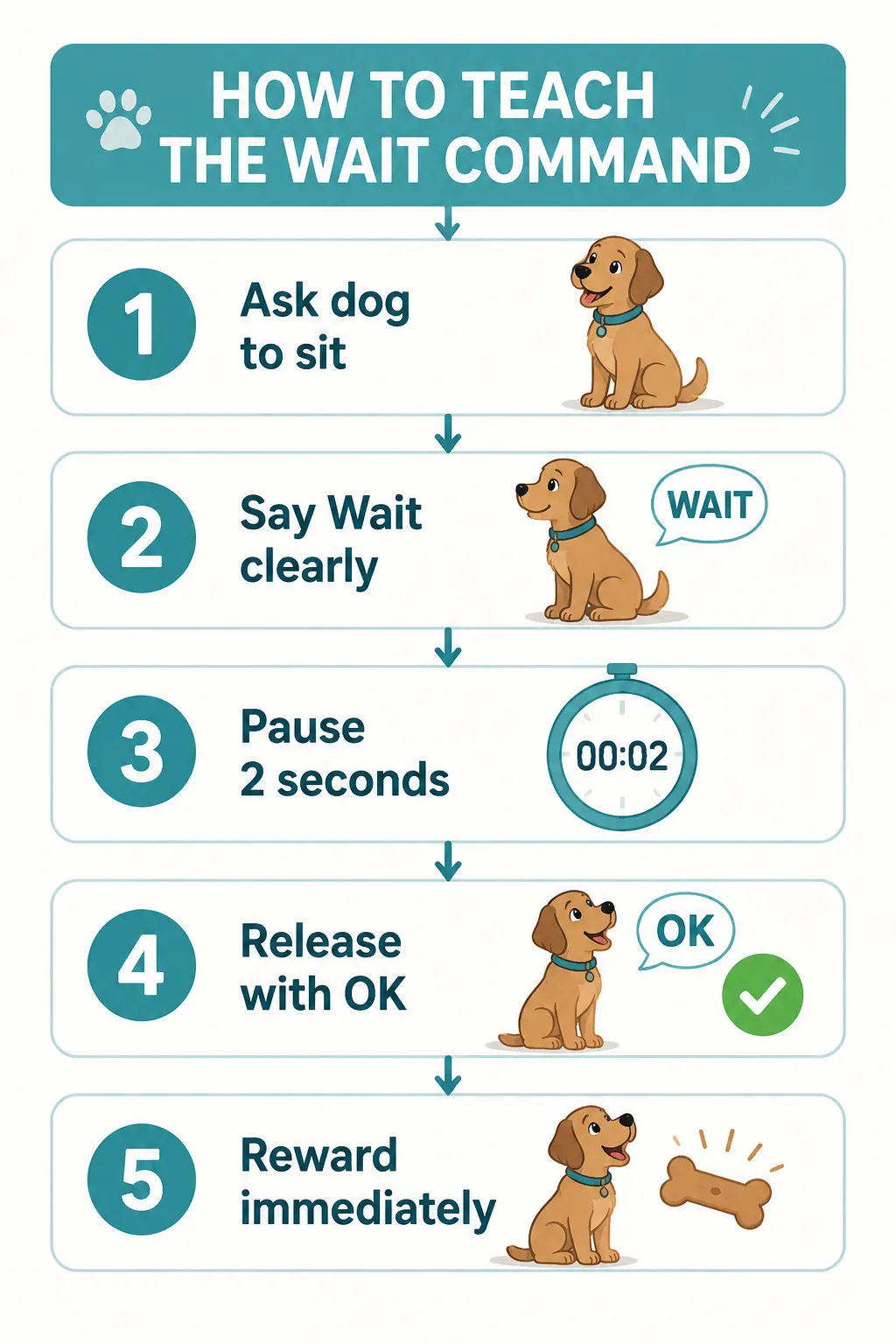
How to Teach the “Wait” Command Step by Step
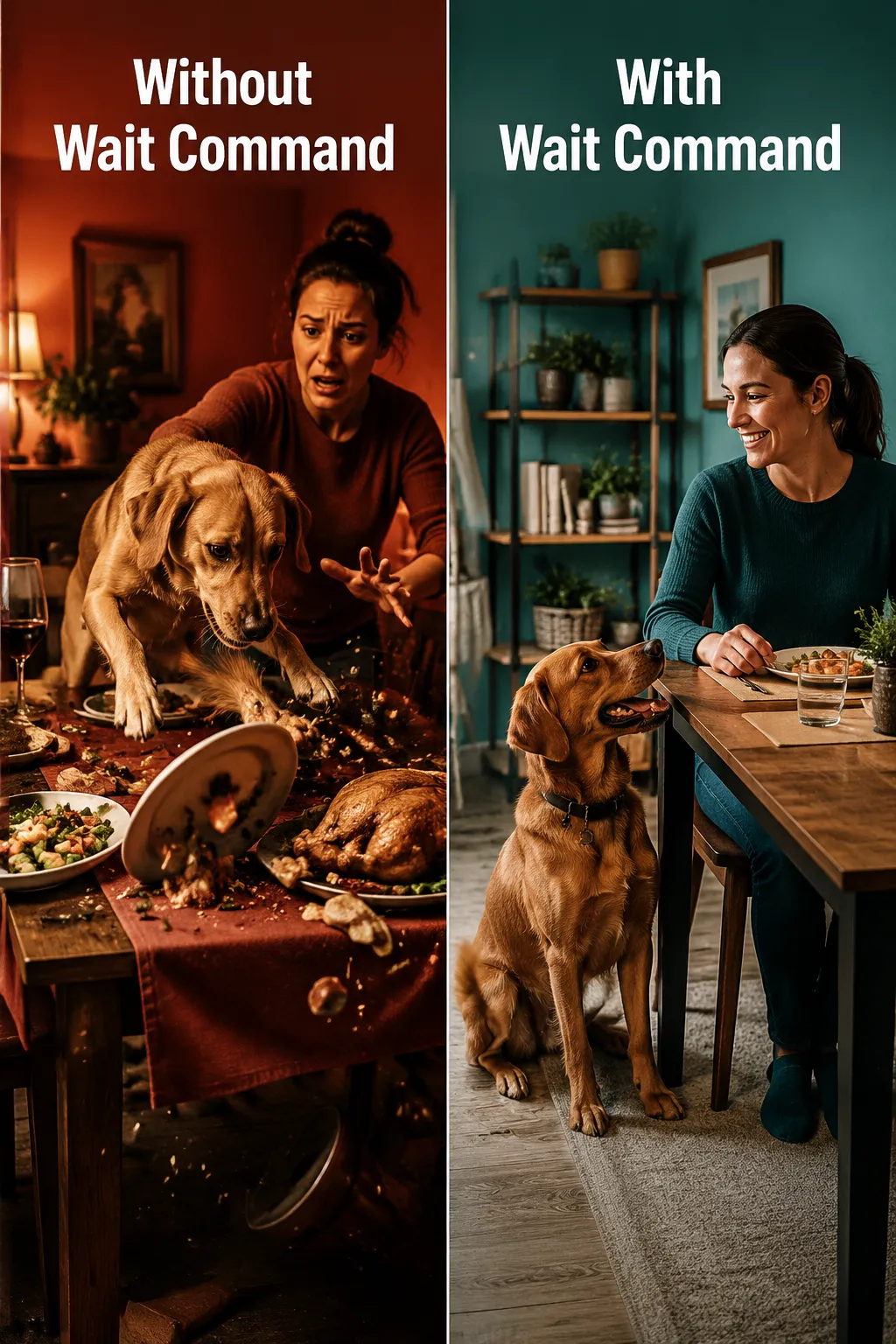
Here is the good news: teaching the wait command is simple. No fancy equipment needed. Just treats, patience, and about five minutes a day.
What You Will Need
- ✅ Small, tasty treats (pea-sized pieces work great)
- ✅ A leash (for the first few sessions)
- ✅ A doorway or food bowl to practice with
- ✅ A calm, distraction-free space
Step-by-Step Training Guide
Step 1: Start with a sit
Ask your dog to sit. This gets them into a calm starting position. If your dog does not know “sit” yet, teach that first, it only takes a day or two.
Step 2: Say “wait” clearly
Use a calm, clear voice. Say “wait” just once. Do not repeat it over and over. One word, one time.
Step 3: Pause for just 2 seconds
At first, only ask for a tiny pause. Two seconds is enough. You want your dog to succeed! Success builds confidence and makes them want to do it again.
Step 4: Give a release cue
Say “okay!” or “free!” or whatever word you choose. Be consistent, always use the same release word. This tells your dog the wait is over and they can move forward.
Step 5: Reward immediately
The moment your dog waits AND releases on your cue, give them a treat and lots of praise. 🎉 The treat must come right away, within 2 seconds, so your dog connects the reward to the right behavior.
Building Up Gradually
Once your dog can wait for 2 seconds, slowly increase the time:
- Week 1: 2-5 seconds
- Week 2: 5-10 seconds
- Week 3: 10-20 seconds
- Week 4+: 30 seconds and beyond
Never rush this process. If your dog breaks the wait, you moved too fast. Go back to a shorter time and rebuild. No big deal, just reset and try again.
Common Mistakes to Avoid
❌ Repeating the word, Saying “wait, wait, WAIT” teaches your dog to ignore the first cue.
❌ Skipping the release word, Without a clear release, your dog will guess when to move.
❌ Training when distracted, Start in a quiet room, not at a busy front door.
❌ Asking for too long too soon, Short wins beat long failures every time.
The “Wait” Command: The One Trick That Will Save Your Sanity (and Your Food) in Real Life
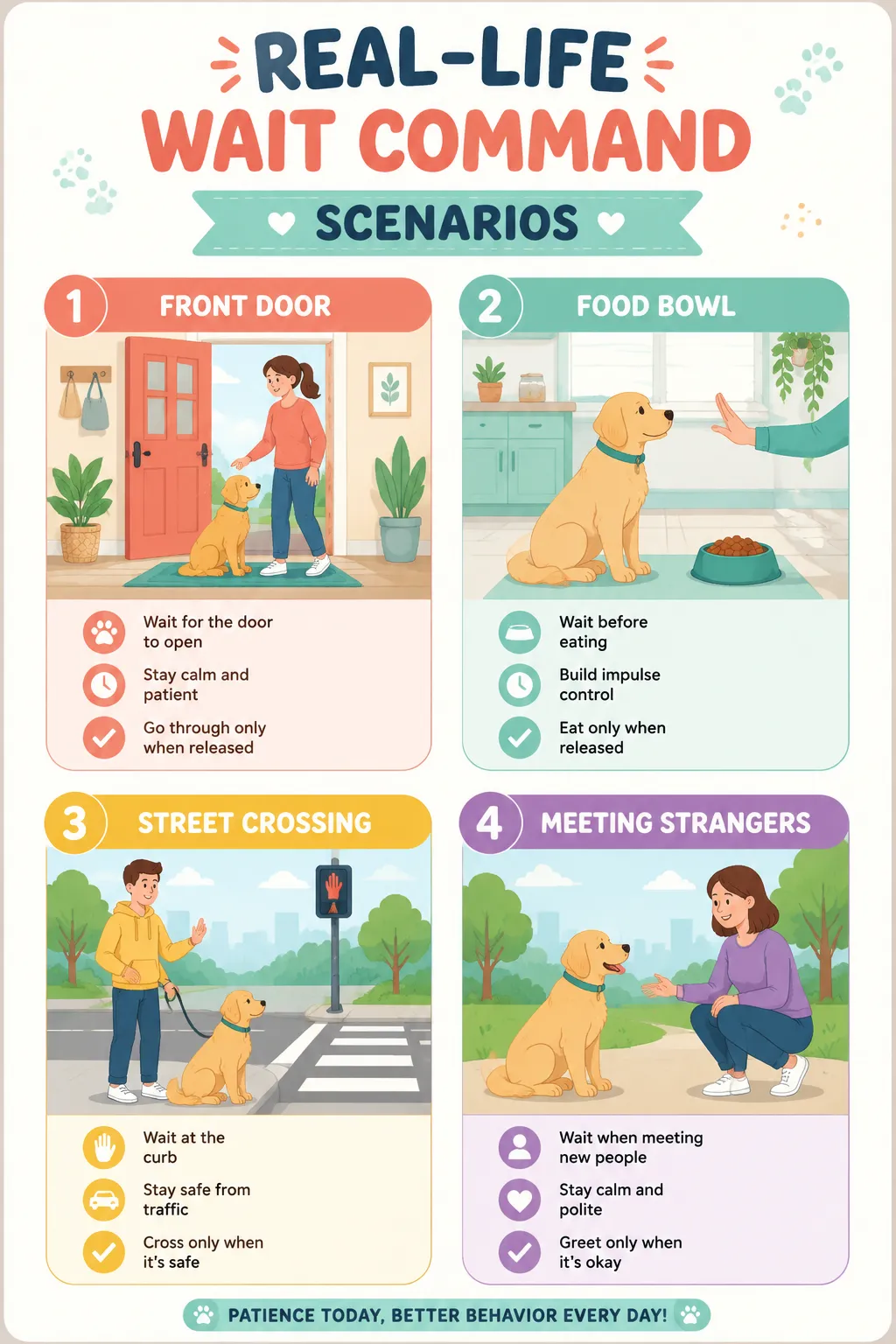
Once your dog has the basics down, it is time to use the wait command where it really matters. Here are the most life-changing places to practice.
At the Front Door 🚪
Door dashing is dangerous. A dog who bolts out the door can run into traffic, get lost, or scare a neighbor. The wait command fixes this fast.
How to practice:
- Walk toward the door with your dog.
- Say “wait” before you touch the handle.
- Open the door slowly.
- If your dog holds still, say “okay!” and walk out together calmly.
- If your dog moves forward, calmly close the door and start again.
Within a week, most dogs learn that the door opening does not mean “GO.” It means “wait for the signal.” 🏆
At the Food Bowl 🥣
This one is a favorite for dog owners everywhere. Instead of a frantic, splashing, food-flying mess at dinner time, picture your dog sitting calmly while you place the bowl down.
How to practice:
- Ask your dog to sit.
- Hold the food bowl and say “wait.”
- Lower the bowl slowly.
- If your dog dives in, lift the bowl back up. No scolding needed, just reset.
- When your dog holds the wait as the bowl touches the floor, say “okay!” and let them eat.
This also helps dogs who eat too fast, which can cause digestive problems. A calm start to mealtime leads to calmer eating overall.
At Street Crossings 🚦
Safety first! Teaching your dog to wait at every curb before crossing the street could save their life.
How to practice:
- Walk to the curb and stop.
- Say “wait.”
- Look both ways (model good behavior!).
- Say “okay” and step off the curb together.
Do this every single time. Make it a habit for both of you.
When Greeting Guests 👋
Jumping on guests is one of the top complaints from dog owners. The wait command gives your dog something to do instead of launching themselves at visitors.
How to practice:
- When a guest arrives, ask your dog to sit and wait before you open the door.
- Open the door.
- Release your dog only when they are calm.
It may take a few tries at first. That is completely normal. Stay consistent and it will click.
In the Car 🚗
A dog who leaps out of a car before you are ready is a safety hazard. Teach your dog to wait when the car door opens.
- Open the car door.
- Say “wait.”
- Clip on the leash first.
- Then give the release cue.
Simple, safe, and stress-free.
Tips to Make the “Wait” Command Stick for Life
Teaching a command once is not enough. Consistency is what turns a new trick into a lifelong habit. Here are the best ways to make the wait command a permanent part of your dog’s vocabulary.
Practice Every Single Day
Five minutes of daily practice beats one hour once a week. Dogs learn through repetition. Short, frequent sessions keep the lessons fresh and fun.
Use It in Real Life, Not Just Training Sessions
The best training happens in real moments. Every time you reach for the food bowl, every time you open the front door, use the wait command. Real-life practice is more powerful than any formal session.
Keep It Positive 🌟
Never punish your dog for breaking a wait. Just calmly reset and try again. Positive reinforcement, treats, praise, play, builds a dog who WANTS to wait because good things happen when they do.
Involve the Whole Family
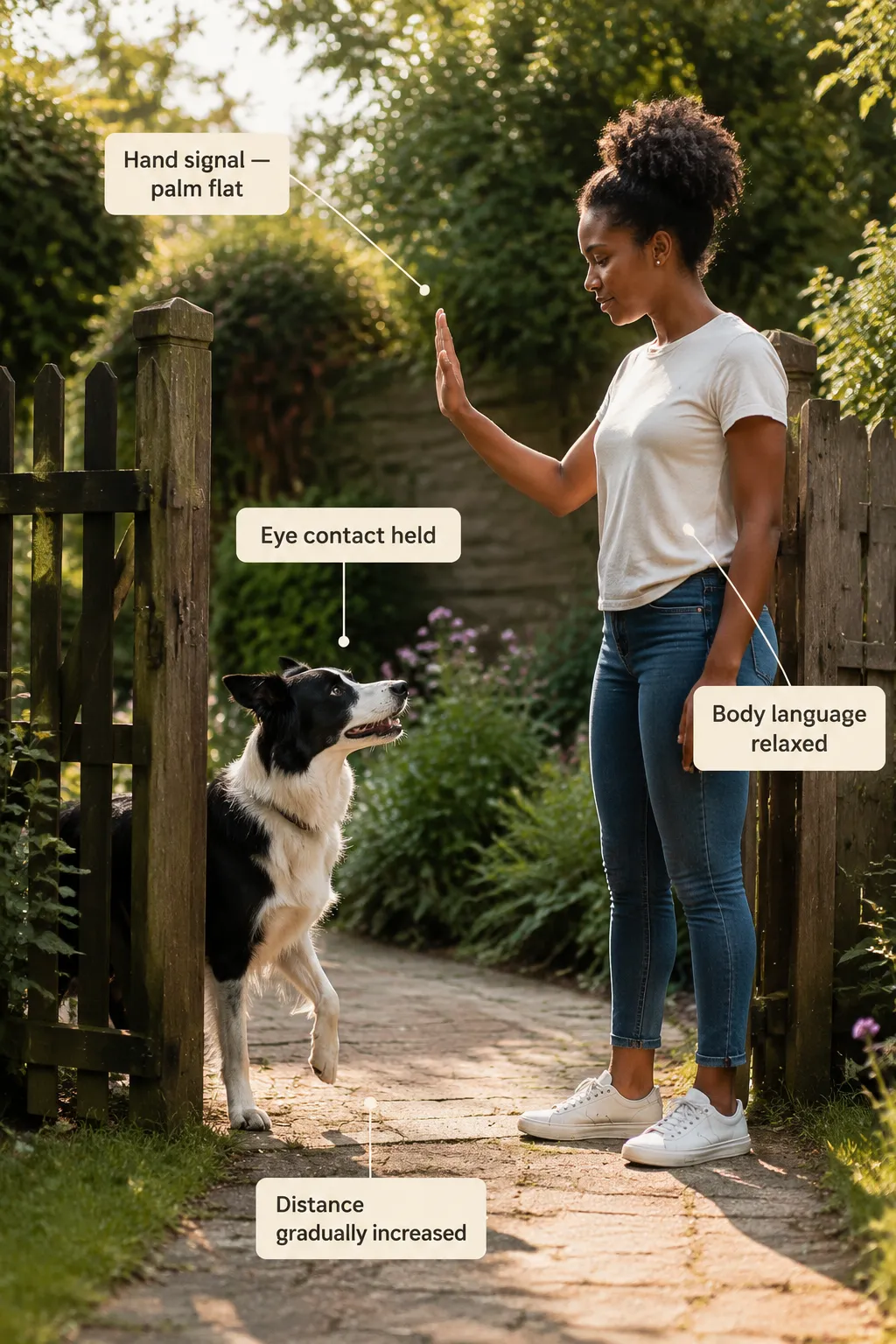
If one person lets the dog rush through the door but another asks for a wait, the dog gets confused. Get everyone on the same page. Use the same word, the same hand signal, the same release cue.
Add a Hand Signal
Pair the word “wait” with a hand signal, a flat palm facing the dog works great. This gives your dog two cues instead of one, which makes the command stronger and easier to understand across distances.
Proof the Behavior
“Proofing” means practicing in different places with different distractions. Once your dog waits well at home, try it:
- At the park
- At a friend’s house
- Outside a pet store
- On a busy sidewalk
Each new location is a new challenge. Start easy and build up.
What About Older Dogs?
Great news: old dogs absolutely can learn new tricks. The process is the same. Older dogs may take a little longer to break old habits, but with patience and consistency, they get there. Senior dogs often appreciate the mental stimulation that training provides. 🐕🦺
Troubleshooting: When “Wait” Is Not Working
Even with the best training, some dogs hit a wall. Here are the most common problems and how to fix them.
Problem: My dog waits but then creeps forward slowly.
Fix: The moment your dog starts to creep, say “wait” again and take a small step toward them. Do not give the release cue until they are fully still.
Problem: My dog ignores the command completely.
Fix: Go back to basics. Make sure your dog knows “sit” first. Use higher-value treats. Practice in a quieter location.
Problem: My dog waits perfectly at home but not outside.
Fix: This is a proofing issue. Start practicing outside in a very low-distraction area (like your backyard) before moving to busier spots.
Problem: My dog waits but then bolts the second I say the release word.
Fix: Practice releasing your dog calmly. Say “okay” in a calm voice, not an excited one. Ask your dog to walk forward slowly with you rather than letting them explode into motion.
Problem: My dog only waits for certain family members.
Fix: Everyone in the house needs to practice the command equally. Consistency across all people is key.
Conclusion
The “Wait” Command: The One Trick That Will Save Your Sanity (and Your Food) is simple, powerful, and endlessly useful. It takes just a few minutes a day to teach and pays off in every single area of your dog’s life, from safer door manners to calmer mealtimes to stress-free car rides.
Your Action Plan Starts Today 🐾
- Tonight: Practice “wait” at dinner time with your dog’s food bowl.
- Tomorrow morning: Add “wait” at the front door before your walk.
- This week: Practice 5 minutes every day, building up the wait time gradually.
- This month: Proof the behavior in at least three new locations.
Every dog can learn this. Every owner can teach it. The wait command is not just a trick, it is a communication tool that builds trust, safety, and a calmer, happier relationship between you and your dog. Start today. Your sanity (and your dinner) will thank you. 🍽️🐶
References
- McConnell, P. B. (2002). The Other End of the Leash. Ballantine Books.
- Udell, M. A. R., & Wynne, C. D. L. (2008). A review of domestic dogs’ (Canis lupus familiaris) human-like behaviors. Learning & Behavior, 36(4), 247-258.
- Bray, E. E., MacLean, E. L., & Hare, B. A. (2014). Context specificity of inhibitory control in dogs. Animal Cognition, 17(1), 15-31.
- American Kennel Club. (2023). Impulse Control and Your Dog. AKC.org.
- Overall, K. L. (2013). Manual of Clinical Behavioral Medicine for Dogs and Cats. Elsevier Mosby.
- Pryor, K. (1999). Don’t Shoot the Dog: The New Art of Teaching and Training. Bantam Books.